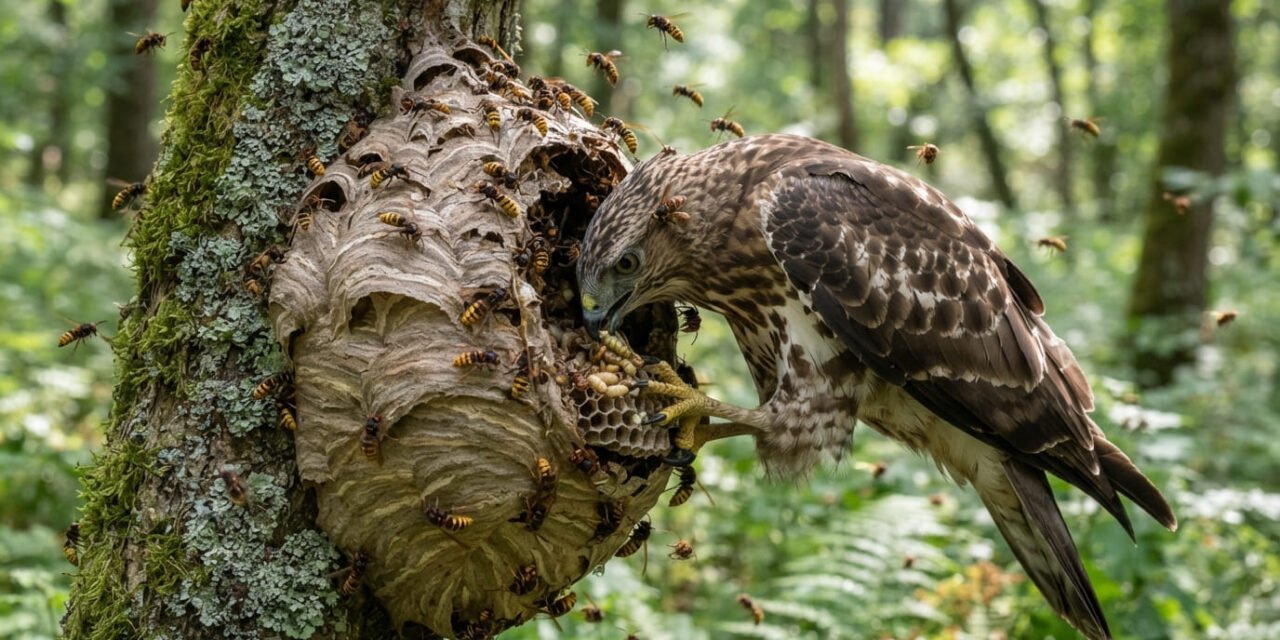
If you take a walk through a dense, broadleaf forest in central Europe during the height of summer, you might accidentally stumble upon something that sends a primal shiver down your spine: the low, angry vibration of a hornet’s nest.
For humans, and indeed for almost every other animal in the forest, that sound is an immediate warning to turn around and walk away. A swarm of angry hornets or yellowjackets is a formidable defensive force. But there is one resident of these woodlands that hears that aggressive hum and doesn’t run away. Instead, it gets hungry.
The European honey buzzard, scientifically known as Pernis apivorus, is a medium-sized bird of prey that has decided to ignore all the standard rules of survival. While hawks and eagles are out chasing rabbits, mice, and other birds, the honey buzzard prefers a meal that aggressively fights back. It raids the nests of some of the most highly defensive stinging insects on the planet, and it does so completely unharmed.
To understand how a bird can dive headfirst into a swarm of furious, venomous insects and come out fine, we have to look closely at a masterclass in specialized evolutionary armor.
The Unlikely Prey
Before we look at the buzzard itself, let’s talk about what exactly it is trying to eat. The common name “honey buzzard” is actually a massive historical misunderstanding. This bird doesn’t care about honey at all, and it generally leaves honey bees alone. What it actually craves are the protein-rich larvae and pupae found deep inside the nests of wasps and hornets.
Their absolute favorite targets are social wasps. This includes common yellowjackets, like those in the Vespula genus (such as Vespula vulgaris, the common wasp, and Vespula germanica, the German wasp), as well as the massive, intimidating European hornet, Vespa crabro.
If you have ever been stung by a wasp, you know exactly how painful it is. Unlike honey bees, which die after stinging once, insects in the Vespula and Vespa genera have smooth stingers. This means a single angry hornet can sting an intruder over and over again, pumping venom into the skin with every strike. When their nest is threatened, these insects release alarm pheromones that send hundreds, or even thousands, of workers into a synchronized, highly aggressive frenzy.
A bear or a badger might try to dig up a wasp nest occasionally, but they usually rely on thick fur and brute force, taking plenty of painful stings in the process. The honey buzzard, however, isn’t just powering through the pain. It is completely immune to the physical attacks.
Feathers Like Chainmail
The secret to the honey buzzard’s invincibility lies entirely in its feathers. If you look at the face of a normal hawk or eagle, you will see soft, fluffy feathers around the eyes and the base of the beak. If a hornet landed on a regular hawk’s face, its stinger would slide right through that soft down and hit the sensitive skin underneath.
The honey buzzard is built differently. The feathers covering its face, forehead, and the area around its beak don’t look or act like normal feathers. Instead, they are short, dense, and incredibly stiff. They overlap each other tightly, almost like the heavy scales on a reptile or a suit of medieval chainmail.
When a furious Vespa crabro hornet lands on the buzzard’s face and tries to drive its stinger in, it simply can’t. The stinger slips off the stiff, waxy surface of these specialized feathers. The armor is so tightly packed that the insect cannot find a gap to reach the bird’s skin.
But the defenses don’t stop there. The buzzard’s eyes, which are bright yellow and highly observant, are protected by thick, heavy ridges that overhang them, keeping angry stingers away from its vision. Even its respiratory system is fortified. When a wasp swarm goes on the offensive, they tend to crawl into dark spaces—like ears and noses. To counter this, the honey buzzard has evolved long, narrow, slit-like nostrils. The openings are so thin that even a determined Vespula worker cannot squeeze inside to cause damage.
Finally, there are the bird’s legs and feet. Wasp nests are often hidden underground or inside rotting tree cavities, which means the bird has to do a lot of digging. The legs of the honey buzzard are heavily scaled, and the skin on its toes is remarkably thick. They are essentially wearing heavy leather work boots, allowing them to stomp around in a swarm of furious insects without feeling a thing.
Chemical Warfare and Deterrents
While the mechanical armor of the stiff facial feathers is the bird’s primary defense, scientists have long suspected there might be a chemical component to the buzzard’s immunity.
When observing a honey buzzard raiding a nest, researchers have noticed that the wasps, while clearly agitated, sometimes seem hesitant to actually land on the bird. There is an ongoing theory that Pernis apivorus naturally produces a specific chemical compound, coating its feathers in a scent that acts as a mild wasp deterrent. While this chemical shield hasn’t been definitively proven to stop attacks completely, it suggests that the bird might be fighting a two-front war against the insects: confusing their senses chemically while blocking their weapons physically.
It is also highly likely that over thousands of generations of eating venomous insects, the buzzard has developed an internal, physiological resistance to the venom itself. Even with perfect armor, a few stings are bound to slip through over a bird’s lifetime. A regular bird might go into shock from a handful of hornet stings, but a honey buzzard simply shrugs it off and keeps eating.
The Patient Hunt
Because their diet is so incredibly specific, honey buzzards don’t hunt like other birds of prey. You won’t see them soaring high in the clouds looking for movement in the grass, and they certainly don’t engage in high-speed, acrobatic dives.
Instead, a hunting honey buzzard is a picture of supreme patience. They fly quietly into a forest canopy, lands on a hidden branch, and they just sit there. They are watching for insects.
When a buzzard spots a worker wasp, say, a Vespula vulgaris returning from a foraging trip, the bird locks onto it. It tracks the insect’s flight path through the trees. It’s a bit like a detective tailing a delivery truck to find out where the secret warehouse is located. If it loses sight of one wasp, it waits for another, slowly piecing together the invisible highway the insects are using.
Eventually, this patience pays off, and the bird tracks the workers back to the hidden entrance of the colony.
The Excavation
Once the nest is located, the real work begins. Many social wasps build their paper nests in abandoned rodent burrows under the forest floor. When a honey buzzard finds one of these subterranean nests, it hops down to the dirt and turns into an excavation machine.
Most hawks have heavily curved talons designed for gripping and killing live prey. The honey buzzard, however, has claws that are much straighter and thicker. They aren’t meant for stabbing mice; they are meant for digging dirt.
The bird rips away the soil, moss, and roots with surprising speed. As it breaks through the roof of the burrow, the wasp colony goes into total panic. Thousands of angry workers flood out of the broken ground, swarming the bird’s head, crawling over its back, and desperately trying to sting the invader.
The buzzard completely ignores them. With its eyes closed to narrow slits and its stinger-proof facial feathers doing their job, the bird reaches its beak deep into the paper comb of the nest. It uses a specially adapted, deeply hooked upper beak, which acts perfectly like a pair of precision tweezers, to delicately pluck the fat, white wasp larvae straight out of their hexagonal cells.
Adult wasps are mostly crunchy exoskeleton and aren’t very nutritious, so the bird usually leaves the flying defenders alone. It is there purely for the babies. The larvae and pupae are soft, incredibly rich in protein, and packed with the fats the buzzard needs to survive and to feed its own growing chicks back at its nest.
A Highly Specialized Life
Relying entirely on a diet of wasp and hornet larvae is a risky evolutionary gamble. Wasps are highly seasonal. During the cold European winters, the wasp colonies die off, leaving only a few dormant queens buried in the frost. With its primary food source entirely wiped out, the European honey buzzard is forced to pack up and fly thousands of miles south, migrating across the Mediterranean Sea to spend the winter in the warmer climates of sub-Saharan Africa.
When they return to Europe in the spring, they have to wait for the wasp colonies to grow large enough to sustain them. During this waiting period, they will occasionally snack on frogs, worms, or other small insects, but they are simply holding over until the Vespula and Vespa nests hit peak population in late summer.
When you look closely at Pernis apivorus, you see a creature that found a massive, completely untapped food resource in the forest and evolved the perfect set of tools to claim it. The wasps and hornets might be the terror of the woods for most animals, but to the honey buzzard, they are just a challenging puzzle standing between it and a protein-rich meal. It is a brilliant reminder that in the natural world, no matter how tough or well-defended an animal might be, something else has usually figured out a way to eat it.