Imagine walking through a quiet, sunlit forest in India, Sri Lanka, or Thailand. The canopy overhead is a thick weave of green leaves, and wild orchids hang from old mossy branches. As you push past a low-hanging vine, you pause to look at a cluster of leaves sitting right at eye level.
At first, you see nothing unusual. It looks like a long, thin tendril of a climbing plant, no thicker than a pencil. But then the tip of the vine lifts off the wood. A tiny, pointed head turns toward you, and you find yourself staring directly into two of the strangest eyes in the animal kingdom.
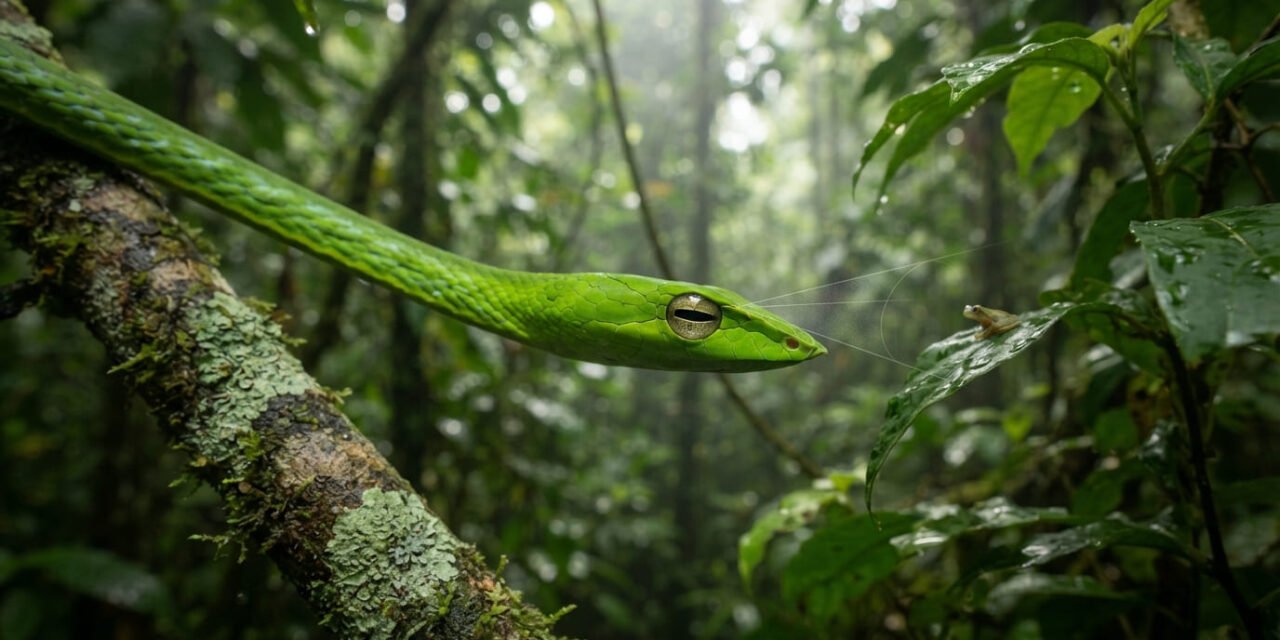
The eyes are bright yellow, but the pupils inside are not round like a human eye, nor are they vertical slits like those of a house cat or a rattlesnake. Instead, the pupil is a sharp, horizontal slit with a rounded notch at the front, shaped remarkably like an old-fashioned keyhole.
This is the Asian vine snake (Ahaetulla nasuta), also known as the long-nosed whip snake. It is a soft-bodied, bright green tree dweller that turned the canopy into its personal highway. While most snakes rely almost entirely on scent and chemical cues to find their food, the Asian vine snake built its entire survival strategy around high-definition visual physics. It is one of the very few snakes on Earth that can see the world in true, three-dimensional depth, using keyhole optics to hunt fast-moving lizards along the thinnest twigs in the forest.
The Depth Perception Challenge in the Trees
To appreciate why the Asian vine snake’s eyes are so special, you first have to look at the massive physical challenge of living in the treetops.
For a ground-dwelling snake, finding a meal usually involves scent. A garter snake or a python flicks its tongue into the air, picking up microscopic odor particles from the soil and carrying them to a specialized sensory organ in the roof of its mouth. It can track a rodent through dark leaves or underground burrows without ever needing a clear view of its target.
If you live high in the canopy, scent tracking becomes much harder. The wind quickly blows smell particles away from thin branches, leaving very few trails to follow along dry bark.
More importantly, moving through the treetops requires extreme physical precision. A tree-dwelling snake cannot simply crawl forward blindly. It must extend its long, thin body across open air gaps, reaching from one branch to another without falling thirty feet to the hard ground below.
When it spots a target, like a fast, skittering garden lizard resting on a nearby leaf, the snake cannot afford a trial-and-error approach. If it lunges too short, it falls through the canopy. If it lunges too far, it slams into the branch and alerts the lizard, which instantly leaps to safety.
To strike successfully across an open gap, the snake must calculate the exact distance to its dinner down to the millimeter. To do that, it needs a visual system capable of depth perception. It needs 3D vision.
Monocular Side-Eyes vs. Binocular Focus
Most reptiles have eyes positioned flat on the sides of their heads. Biologists call this monocular vision.
Side-mounted eyes give an animal a wide field of view, allowing it to scan almost three hundred sixty degrees around its body to watch for flying hawks or climbing predators. The trade-off is that the visual fields of the left and right eyes do not overlap. Each eye sees a completely different picture. Without an overlapping field of view, the brain cannot compare two perspectives of the same object, which makes accurate depth perception almost impossible.
If you cover one of your own eyes and try to touch the tip of a pencil held in front of you, you will notice how much harder it gets to judge the distance. That is what a typical monocular snake experiences every day.
The Asian vine snake chose a completely different evolutionary path. It shifted its eyes forward toward its snout.
Instead of pointing out to the sides, the vine snake’s eyes sit at an angle that allows the visual fields of both eyes to meet directly in front of its nose. This creates a wide area of overlapping vision, known as binocular vision.
When the vine snake looks at a lizard sitting on a twig, both eyes lock onto the exact same spot. Its brain receives two slightly different images of the lizard and blends them into a single, three-dimensional mental map. This allows the snake to calculate depth, distance, and speed with the accuracy of an optical rangefinder.
The Keyhole Pupil and the Nose Barrel
Creating binocular vision is only half the battle. If a snake has a long, pointed head, its own nose can easily block the line of sight, preventing the eyes from looking forward over the tip of the snout.
The Asian vine snake solved this geometric problem through a mix of pupil design and skull structure.
First, there is the shape of the pupil itself. The horizontal keyhole slit is wider at the front edge than at the back. This specific keyhole shape allows light to enter the eye from a wide angle directly in front of the snake’s face, even when the pupil is constricted in bright sunlight.
While a vertical slit pupil is great for controlling light levels in nocturnal hunters, the horizontal keyhole pupil is tuned specifically for daylight vision along a horizontal plane. It expands the snake’s forward view while cutting down on glare from the bright sky above.
Second, the snake’s snout features a unique anatomical detail: a deep, horizontal groove running along each side of the face, right in front of the eyes. This is called the loreal groove.
When the vine snake locks its keyhole pupils onto a target, it aligns its line of sight directly along these two facial grooves. The grooves act like the twin sights on a rifle barrel. They create a clear, unobstructed visual channel from the retina straight out past the tip of the elongated nose. The snake is literally looking down the barrel of its own face to lock its aim onto the target.
The Swaying Vine Theater
Even with keyhole optics and nasal sights, tracking a camouflaged green lizard in a sea of green leaves is exceptionally difficult. Many tree lizards stay completely still when they sense danger, blending seamlessly into the foliage.
To break the lizard’s camouflage, the Asian vine snake uses a behavioral trick called motion parallax.
When the snake spots a suspicious shape on a branch, it does not move forward immediately. Instead, it holds its long, slender body in a loose curve and begins to sway its head gently from side to side.
To an outside observer, this motion looks like a thin green vine moving naturally in a soft forest breeze. It is a form of active physical camouflage.
At the same time, this side-to-side motion serves a visual purpose for the snake’s brain. As the snake shifts its head back and forth, objects that are close to it appear to move across its field of view much faster than objects that are farther away. By adding this motion to its binocular vision, the snake gathers extra spatial data. The subtle difference in background speed reveals the exact outline of the hidden lizard, making the prey stand out against the stationary leaves behind it.
Rear Fangs and High-Wire Balance
Once the distance is calculated and the target is clear, the strike is quiet and controlled.
The Asian vine snake does not launch its entire body off the branch in a wild leap. It anchors its tail tightly around a sturdy vine or stem, using specialized, keeled belly scales that grip the rough bark.
It slowly extends the front half of its body out into the open air, holding its weight horizontal without any support beneath its chest. It can extend up to two-thirds of its body length straight out into empty space, floating like a living extension of the branch.
When it gets within striking distance, the snake lunges forward. It snaps its jaws shut around the lizard’s neck or shoulder.
Unlike vipers or cobras, which have long, hollow fangs in the front of their mouths, the Asian vine snake is rear-fanged, belonging to a group known as opisthoglyphous snakes. Its enlarged, grooved teeth sit in the back of its upper jaw beneath its eyes.
When the snake grips the lizard, it uses a chewing motion to work the rear teeth into the prey’s skin, letting a mild venom flow down the grooves of the teeth into the bite. This venom is harmless to humans, usually causing nothing more than mild swelling or itching if a person is bitten, but it is extremely effective against small cold-blooded prey.
Within a few minutes, the lizard stops struggling, going completely limp. This rapid paralysis is vital for the snake’s high-wire lifestyle. Struggling prey could easily throw the slender snake off balance, sending both hunter and meal tumbling down to the forest floor. Once the prey is immobilized, the snake swallows the lizard whole while still dangling upside down from its tail anchor.
Lessons for Modern Optics and Robotics
You should care about the Asian vine snake because its unique eye design is helping engineers solve real-world problems in human technology.
Designing lightweight, low-power vision systems for small autonomous drones is a major challenge in modern robotics. Traditional 3D camera systems rely on two bulky lenses set far apart, powered by heavy microprocessors that calculate depth using high-energy algorithms. This equipment is often too heavy and power-hungry for tiny micro-drones designed to fly through tight spaces.
By studying the compact geometry of the vine snake’s keyhole pupil and loreal groove, optical engineers are developing single-lens cameras with customized aperture shapes.
These bio-inspired sensors can capture overlapping focal points within a very narrow frame, granting lightweight drones built-in depth perception without needing wide, heavy multi-camera setups. The snake proved millions of years ago that you do not need a massive head or separate cameras to see the world in three dimensions; you just need the right geometric cut in your lens.
A Quiet Master of the Canopy
The Asian vine snake is a wonderful reminder that evolution often finds unexpected solutions to daily problems. It took a legless, cold-blooded body plan designed for crawling through the dirt and rebuilt it into a precision-guided aerial hunter.
It did not achieve this by developing heavy claws or explosive speed. Instead, it used keyhole optics, facial rifle grooves, and a gentle, wind-like sway to master the subtle physics of light and distance.
The next time you walk beneath a canopy of green leaves, take a moment to scan the low branches carefully. What looks like a simple, harmless vine blowing in the breeze might actually be a quiet master of visual geometry, holding its breath, aligning its sights, and watching the world through two golden keyholes in the leaves.