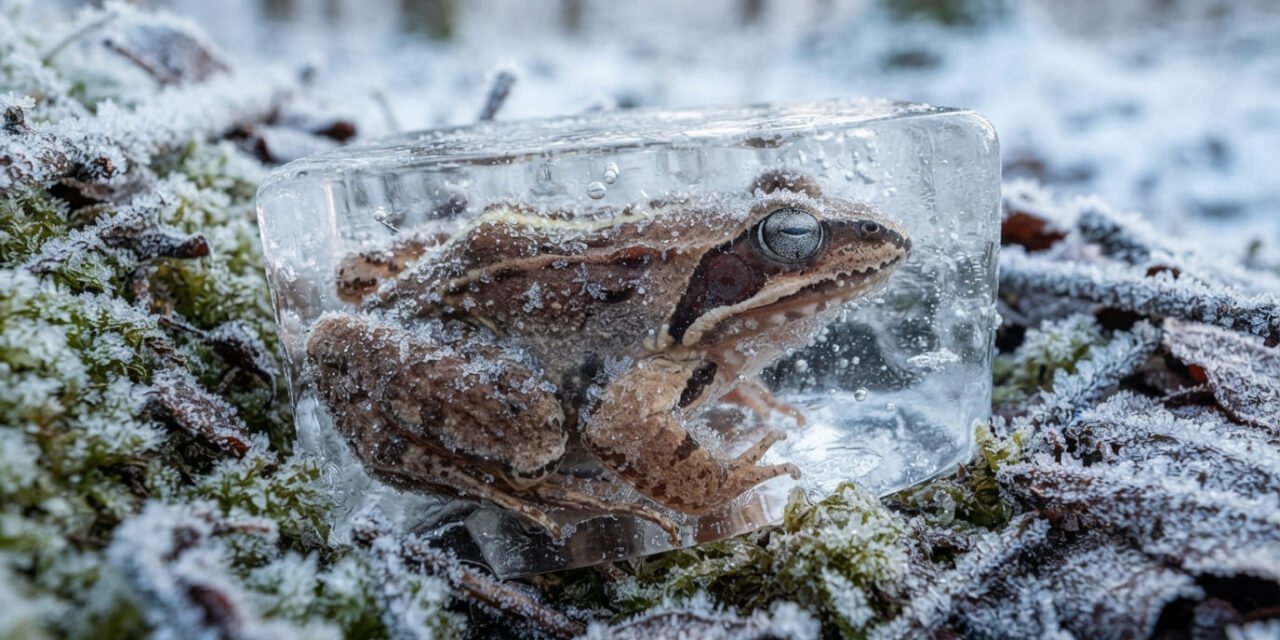
If you walk through the woods in Alaska or Canada during the peak of winter, you are surrounded by dead things. The trees are dormant, the insects are gone, and the ground is frozen several feet deep. But under a thin layer of dead leaves and snow, there is a creature that is neither fully alive nor truly dead. The Wood Frog (Lithobates sylvaticus) spends its winter as a solid block of ice. Its heart does not beat. It does not breathe. If you dropped it on a rock, it would clink like a marble.
Most living cells die when they freeze. Water makes up about 70 percent of a frog’s body. When water freezes, it expands and forms jagged crystals. In a normal animal, these crystals act like tiny knives, shredding the delicate membranes of the cells and causing the internal organs to collapse. When the ice melts, the animal is left with a soup of ruptured cells. The Wood Frog avoids this fate through a process of extreme sugar regulation and controlled ice formation. It is the only frog found north of the Arctic Circle because it has mastered the art of freezing without dying.
Preparing for the First Frost
The Wood Frog does not wait for mid-winter to start its survival process. The preparation begins at the moment the first ice crystal touches its skin. This physical contact triggers a massive hormonal response. The frog’s liver, which is unusually large for its body size, begins to convert stored starch into glucose. In a matter of hours, the frog’s blood sugar levels spike to 100 times their normal levels.
In a human, this level of blood sugar would cause a diabetic coma and death. For the Wood Frog, this sugar is the key to staying alive. The glucose moves out of the blood and into every individual cell in the frog’s body. Because sugar water has a lower freezing point than pure water, the insides of the cells stay liquid even as the temperature drops well below freezing. This is biological antifreeze. It prevents the water inside the cells from turning into ice, which keeps the cell membranes intact.
Controlling the Ice
While the inside of the cells remains liquid, the water outside the cells—in the body cavities and between the tissues—does turn to ice. The Wood Frog uses specialized proteins in its blood to control this. These proteins are called ice-nucleating agents. They provide a surface for ice to grow on, ensuring that the freezing process starts in a predictable, controlled way in the safe areas of the body.
By the time the temperature hits 20 degrees Fahrenheit, about 65 to 70 percent of the water in the frog’s body is solid ice. This ice sits in the space between the skin and the muscles and fills the abdominal cavity. The frog’s eyes turn white and opaque as the fluid inside them freezes. The internal organs, like the liver and lungs, are squeezed into small, dehydrated raisins because the forming ice pulls water out of them. This dehydration is actually a safety feature. By removing water from the organs, there is even less chance of internal ice damage.
Life Without a Heartbeat
Once the freezing process is complete, the Wood Frog enters a state of suspended animation. Its heart slows down, skips beats, and eventually stops entirely. Because there is no blood flow, no oxygen reaches the brain or the organs. In any other mammal or amphibian, this lack of oxygen would cause permanent brain damage within minutes.
The Wood Frog survives this through a metabolic shutdown. Its cells stop trying to perform their normal jobs. They enter a “power-saving” mode where they use almost zero energy. They produce specific protective proteins that act like bubble wrap, holding the shape of the cell’s internal machinery so it doesn’t warp while it is inactive. The frog can remain in this state for up to seven months. It does not age, it does not heal, and it does not move. It is a biological pause button.
The Spring Thaw and the Restart
The most dangerous part of the Wood Frog’s life is not the freezing, but the thawing. If the frog thaws too slowly or too unevenly, its tissues can be damaged. In the spring, the Wood Frog thaws from the inside out. Scientists have observed that the heart is the very first thing to come back to life.
As the ice between the cells melts, the water is reabsorbed into the organs. The heart begins to twitch and then starts a steady rhythm, even before the brain is fully active. This ensures that as the rest of the body warms up, the blood is already moving, carrying oxygen and moving the excess sugar back to the liver for storage. Within 24 hours of being a solid block of ice, the Wood Frog is hopping and capable of mating.
This speed is its greatest competitive advantage. Most other frogs hibernate at the bottom of ponds where the water stays at a constant 39 degrees. They have to wait for the entire pond to thaw before they can move. Because the Wood Frog hibernates just under the leaves on the forest floor, it feels the warmth of the sun immediately. It reaches the breeding ponds weeks before its competitors, giving its tadpoles a head start in the race to grow before the summer heat dries up the water.
Why You Should Care
The Wood Frog is not just a curiosity for biologists. It is a blueprint for the future of human medicine. Currently, the biggest hurdle in organ transplantation is time. When a human heart or kidney is donated, it must be transplanted within hours. We cannot freeze these organs because the ice damage would make them useless.
Researchers are studying the Wood Frog’s “sugar flood” to see if we can replicate it in human tissue. If we could use the same glucose-loading technique to freeze a human heart, we could store organs for weeks or months instead of hours. This would eliminate the frantic race against the clock and allow doctors to match donors with patients all over the world. The frog has already solved a problem that kills thousands of people on transplant waiting lists every year.
Managing the Risks of Multiple Freezes
Spring weather is unpredictable. In places like Ohio or Pennsylvania, it might be 60 degrees one day and 20 degrees the next. The Wood Frog is built for this volatility. It can freeze, thaw, and freeze several times again in a single month.
Each time it freezes, it uses up some of its energy stores. The sugar it uses as antifreeze is expensive to produce. If the weather fluctuates too many times, the frog can run out of fuel and die before the real spring arrives. This is why the frog’s oversized liver is so important. It acts as a massive battery, holding enough starch to power multiple “restarts” if the weather stays unstable.
Sensory Survival
Even while frozen, the Wood Frog’s skin remains its primary defense. The skin produces antimicrobial peptides. These are natural chemicals that kill bacteria and fungi on contact. This is vital because the frog is immobile and its immune system is shut down during the winter. Without these chemicals, soil bacteria would begin to eat the frog while it is still frozen.
These peptides are so effective that scientists are looking at them as a source for new types of antibiotics for humans. We are entering an era where many common bacteria are becoming resistant to current drugs. The Wood Frog’s skin might hold the secret to the next generation of medicine that can kill “superbugs.”
Finding the Wood Frog
You can identify a Wood Frog by the dark brown or black patch behind its eyes. It looks like a small mask. Their bodies are usually tan, brown, or rust-colored, which helps them blend into the leaf litter where they hide.
They are one of the first sounds you will hear in the spring. Their call is a soft clucking sound, like a group of ducks. Because they breed so early, you can often see them swimming in ponds that still have chunks of ice floating in them. While other animals are still hiding from the cold, the Wood Frog is already working on the next generation.
Final Thoughts
The Wood Frog is a reminder that survival is often about adaptation rather than strength. It does not have the thick fur of a bear or the deep burrows of a groundhog. It lives in the coldest places on earth by becoming as cold as its environment.
It uses sugar to save its cells and controls ice to protect its organs. It is a living machine that can turn itself off and on again without losing its memory or its health. In a world that is getting more extreme, the Wood Frog’s ability to “pause” its life is perhaps the ultimate survival skill. It doesn’t just survive the winter; it owns it. When you see a Wood Frog hopping through the woods this spring, remember that it spent the last few months as a stone-cold ice cube, waiting for the exact right moment to come back to life.