If you were to walk along a tropical reef during low tide, you might hear a sound like dry twigs snapping or popcorn popping. That noise isn’t coming from the movement of the water or the shifting of the sand. It comes from a creature barely two inches long. The Pistol Shrimp, also known as the snapping shrimp, carries a weapon that defies the standard rules of biology. It doesn’t use its claw to pinch or crush its prey. Instead, it uses it to create an explosion.
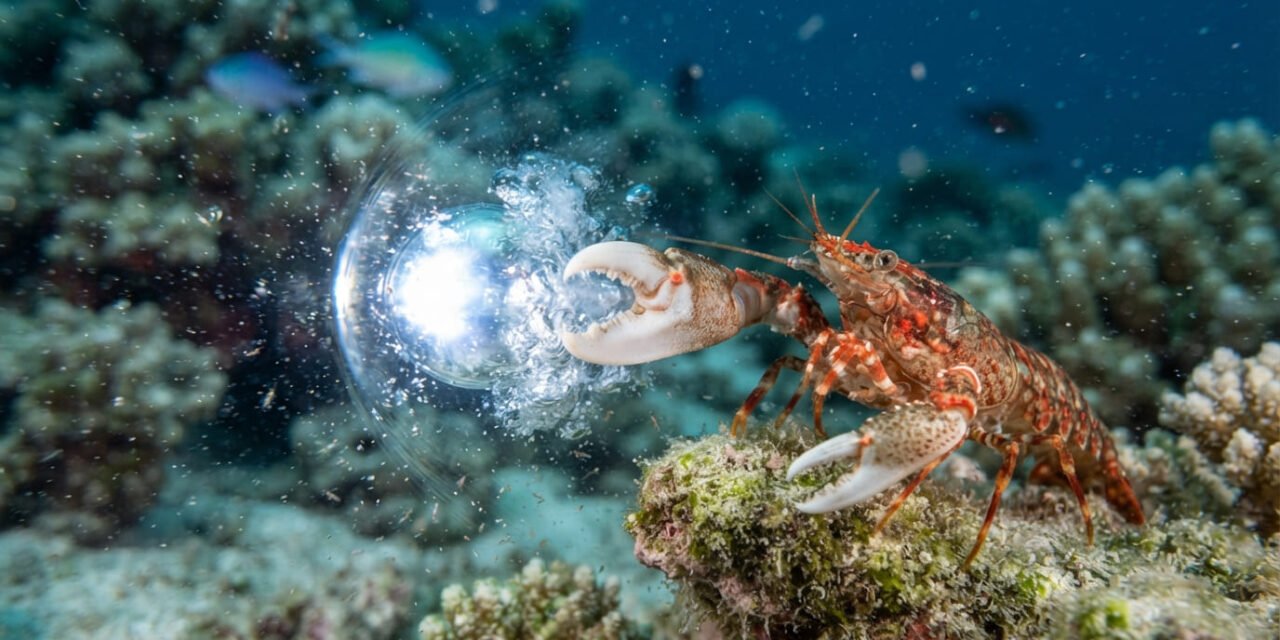
This shrimp has one normal-sized claw and one massive, oversized snapper claw that can grow to be half the size of its entire body. When this claw snaps shut, it produces a sound louder than a jet engine. For a brief moment, the interior of the resulting bubble reaches temperatures of 8,000 degrees Fahrenheit. This is nearly the temperature of the surface of the sun. It is a biological phenomenon called cavitation, and it makes this tiny crustacean one of the loudest and most dangerous hunters in the sea.
The Mechanics of the Snap
Most animals move their limbs using muscles that contract and pull. The Pistol Shrimp uses a system of cocking and releasing. The snapper claw has a specialized joint that allows it to stay open under extreme tension. A massive muscle in the shrimp’s body pulls the claw back, cocking it like a hammer on a revolver.
When the shrimp sees a fish or a small crab, it releases the latch. The claw doesn’t just close; it slams shut at a speed of 60 miles per hour. This movement is too fast for the water to get out of the way. As the “plunger” part of the claw hammers into a socket, it squirts out a jet of water at such high velocity that it creates a low-pressure zone behind it.
In physics, when pressure drops fast enough, water boils. This isn’t because of heat, but because the liquid literally tears apart. This creates a tiny vapor bubble. As the surrounding water pressure rushes back in, the bubble collapses. This collapse is the actual weapon. The sound you hear isn’t the two halves of the claw hitting each other. It is the sound of a bubble imploding.
The Power of Cavitation
The collapse of this cavitation bubble happens in less than a millisecond. When the bubble pops, it releases a massive amount of energy in the form of a shockwave. This shockwave is what stuns or kills the prey. A small fish within a few centimeters of the snap will be knocked unconscious or killed instantly by the pressure change.
The heat is a byproduct of this violent collapse. As the gas inside the bubble is squeezed into a microscopic point, the atoms get so crowded and move so fast that they generate a flash of light and a burst of heat. This light is called sonoluminescence. It is invisible to the naked eye because it happens so fast, but scientific sensors have confirmed it.
The shrimp is unaffected by its own explosion. Its body is reinforced at the joints to handle the recoil, and its eyes are often protected by a transparent hood. It simply waits for the shockwave to do the work, then crawls out of its burrow to collect the stunned meal.
Interfering with the Navy
The Pistol Shrimp is so loud that it has caused genuine problems for human technology. During World War II, the U.S. Navy began using sonar to track enemy submarines. They were confused by massive “clouds” of static noise that appeared on their screens near coral reefs.
It turned out that thousands of these shrimp snapping at once created a wall of sound that masked the acoustic signatures of ships. Submarine commanders eventually learned to hide their vessels in “shrimp beds” to avoid being detected by enemy sonar. Even today, modern acoustic sensors have to be programmed to filter out the constant snapping of these shrimp. If they didn’t, the ocean would sound like a continuous construction site.
A Partnership for Survival
Despite having such a powerful weapon, the Pistol Shrimp has a major weakness: it is nearly blind. Because it spends most of its time digging burrows in the sand, its vision is poor. To survive, it often enters a roommate agreement with a fish called a goby.
The goby has excellent eyesight but no way to dig a safe home. The shrimp digs a deep, stable burrow for both of them. In exchange, the goby acts as a lookout. When they are outside the burrow, the shrimp keeps one of its antennae in constant contact with the goby’s tail. If the goby sees a predator, it wiggles its tail, and the shrimp immediately retreats into the hole. If the predator gets too close, the shrimp uses its sonic pistol to defend the entrance. This cooperation allows the shrimp to focus on maintenance and hunting without being eaten by surprise.
Why You Should Care
The Pistol Shrimp is a reminder that being small does not mean being weak. It uses a complex understanding of fluid dynamics to hunt. By turning water into a weapon, it bypasses the need for large teeth or heavy armor.
Scientists are currently studying the shrimp’s claw to solve problems with boat propellers. Human-made propellers often suffer from “cavitation erosion,” where bubbles created by the spinning blades pop and eat away at the metal. By understanding how the shrimp creates and survives these bubbles, engineers can design tougher materials for ships and submarines.
The shrimp also shows us that the ocean is much louder than we think. We often view the underwater world as a “silent world,” but for the creatures living there, it is a place of constant acoustic warfare. The Pistol Shrimp is the heavy artillery of the reef.
The Colony Sound
Pistol Shrimp are social. They often live in large groups within sponges or coral heads. When you have hundreds of these creatures snapping in a small area, the sound is constant. It serves as a territory marker. Other shrimp know that a specific area is occupied because of the “gunfire” they hear through the water.
This sound travels for miles. Unlike light, which fades quickly underwater, sound waves are incredibly efficient at moving through the sea. The “snap” of a single shrimp can be detected by sensors far from the reef. It is a biological beacon that signals a healthy, active ecosystem.
Observations for Divers
If you are snorkeling or diving, you can often trigger a snap by moving your fingers near a crevice in the rock. The shrimp will see the movement as a threat and fire a warning shot. You will feel a sharp “click” in the water, even if you are several feet away.
Do not try to catch one with your bare hands. While the shrimp is small, the snap can easily break the skin or cause a painful bruise. It is a specialized tool meant for killing, and it treats a human finger the same way it treats a predator.
Final Thoughts
The Pistol Shrimp is an example of extreme specialization. It has traded a versatile claw for a single, high-powered weapon. It relies on a fish to see for it and a bubble to hunt for it. This combination of teamwork and physics has made it one of the most successful hunters in the tropical oceans.
When you hear that popping sound on a beach, remember that it is the sound of boiling water and solar-level heat happening in the palm of your hand. The Pistol Shrimp is a tiny engineer that has mastered the art of the explosion, proving that in nature, the most effective weapons are often the ones you can’t even see.