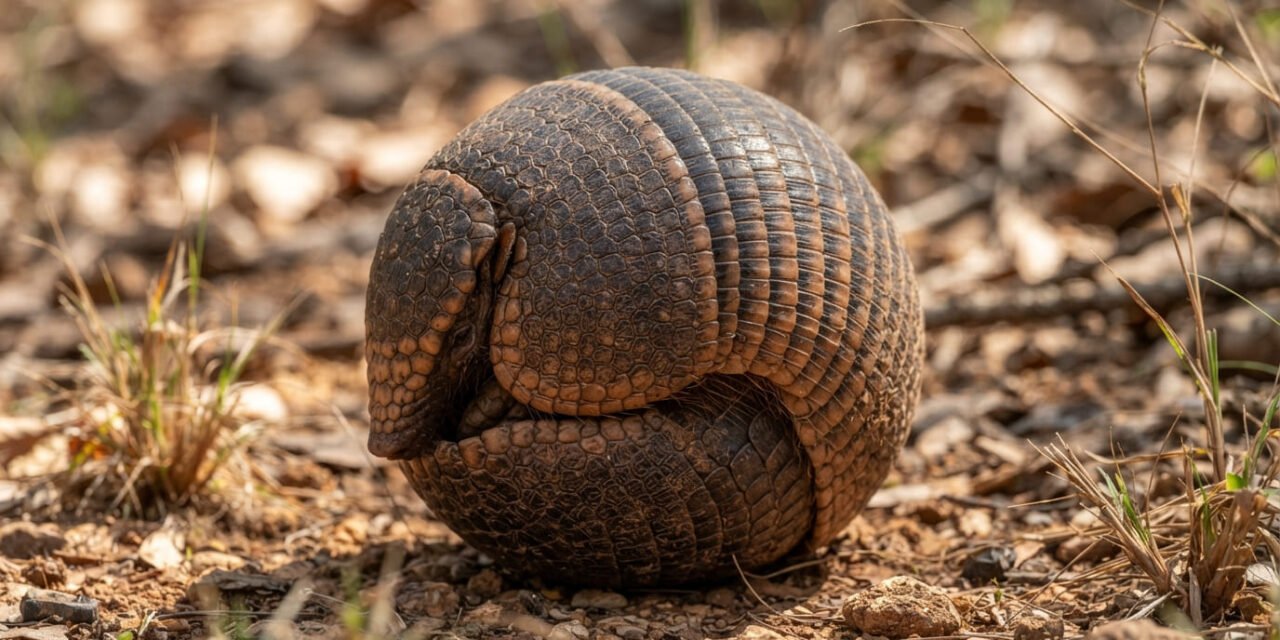
Most armadillos have a problem. When a predator like a jaguar or a maned wolf attacks, the armadillo tries to dig a hole or run away. If it gets caught, it hunkers down and hopes its shell is enough. But for most species, the shell only covers the top and sides. The belly is soft and vulnerable. The Three-Banded Armadillo, found in the dry forests and grasslands of Brazil, Bolivia, and Argentina, solved this flaw. It is the only armadillo that can roll into a complete, seamless ball.
When this animal feels a vibration in the ground, it doesn’t run. It tucks its legs, snaps its head and tail together, and disappears. What remains is a hard, leathery sphere about the size of a large grapefruit. It is an unbreakable shape that leaves no openings for teeth or claws to grab.
A Shell Made of Bone
The armor of the Three-Banded Armadillo is not just a thick skin. It is made of ossified dermal plates—actual bone that grows out of the skin. These plates are covered by a layer of keratin, the same tough protein found in your fingernails and a rhino’s horn.
The shell is divided into three main sections. There is a solid shield over the head and shoulders, another over the rear, and three flexible bands in the middle. These bands act like the joints in a suit of armor. They are connected by loose, stretchy skin that allows the animal to bend its body 180 degrees.
The head and the tail are shaped like matching puzzle pieces. The head plate is a flat triangle, and the tail is a short, thick wedge. When the armadillo rolls up, the tail fits perfectly into a notch next to the head. This “lock and key” fit ensures that there are no gaps. Even the strongest predator cannot get a grip on the smooth surface.
Thermal Regulation: The Air Pocket Secret
Living in the Chaco region means dealing with extreme heat. Most armored animals struggle with temperature because bone and keratin can trap heat against the body. The Three-Banded Armadillo uses its shell as a built-in air conditioner.
When the armadillo rolls into a ball, it doesn’t compress its body tightly against the shell. Instead, it leaves a gap between its soft belly and the hard armor. This creates a pocket of trapped air. Air is a poor conductor of heat. This pocket acts as an insulation layer, keeping the hot sun from cooking the animal’s internal organs.
If the armadillo is out in the sun and starts to overheat, it doesn’t have to unroll and expose itself. It can slightly loosen the “ball” to let air circulate without giving a predator an opening. This allows the animal to stay protected for hours while waiting for a threat to pass or for the sun to go down.
Energy Efficiency and Breathing
A major challenge for any animal that rolls into a ball is breathing. If you curled into a tight ball and stayed there, you would eventually struggle to get enough oxygen. The Three-Banded Armadillo has a specialized respiratory system that handles low-oxygen environments.
Its metabolic rate is naturally low. It moves slowly and eats a diet of termites and ants, which don’t require high-speed chases. When it is rolled up, its heart rate slows down. This reduces the amount of oxygen its muscles need. The air pocket inside the shell also holds enough oxygen to sustain the animal for long periods.
This low energy requirement is why the armadillo can survive in dry, harsh environments where food is scarce. It doesn’t waste calories on flight or fight. It simply shuts down and waits.
The “Spring Trap” Defense
The Three-Banded Armadillo has a secondary defense mechanism that many people don’t expect. It doesn’t always close the ball all the way at first. Sometimes, it stays slightly open.
If a curious predator, like a young canine, puts a paw or a nose into that small gap, the armadillo snaps the shell shut with surprising force. The muscles used to close the shell are incredibly strong. This “snap” can pinch the predator’s sensitive nose or paw, causing it to yelp and back away. It is a painful lesson that teaches the predator to leave the “funny-looking rock” alone in the future.
Sensory Awareness While Rolled Up
Even when it is a solid ball, the armadillo isn’t blind to the world. It has a keen sense of hearing and smell. The gaps near the head and tail plates allow enough scent and sound to reach the animal’s nose and ears.
The armadillo listens for the footsteps of the predator to fade away. It won’t unroll until it is certain the area is clear. If it hears a heavy animal walking nearby, it will tighten the ball. If it hears nothing but the wind for ten minutes, it will slowly peek its nose out to sniff the air before fully extending its legs.
Walking on Its Toes
When the armadillo isn’t a ball, it has a very strange way of walking. It walks on the tips of its front claws. This keeps the sharp digging tools off the ground and prevents them from getting dull. These claws are designed for ripping open concrete-hard termite mounds.
The back feet are flat, providing a stable base. This combination of “tip-toe” front feet and flat back feet gives the armadillo a stiff, robotic gait. It isn’t built for speed, but it is built for power. It can push through thick, thorny brush that would tear the skin of other mammals. Its armor protects it from thorns just as well as it protects it from teeth.
Why the Reader Should Care
The Three-Banded Armadillo is a study in passive defense. Most safety designs in the human world—like car frames or shipping containers—rely on making things harder and heavier. The armadillo shows that geometry and air pockets are often more effective than raw thickness.
Engineers look at the “three-band” system to design flexible body armor and foldable structures. We are learning that you can have full protection without losing mobility if you use the right hinge points. The armadillo’s ability to regulate its temperature with a pocket of air is also being studied for building insulation in hot climates.
Social Behavior and Survival
These armadillos are not territorial. They are solitary, but they don’t mind the company of others if food is plentiful. During the mating season, several males might chase a single female, creating a slow-motion race across the forest floor.
Because they cannot dig their own burrows very well, they often use the abandoned holes of giant armadillos or anteaters. They rely on their shell so much that they haven’t evolved the heavy digging muscles seen in the Nine-Banded Armadillo, common in the United States. They are specialists in one thing: being an unbreakable object.
Observation in the Wild
If you see a Three-Banded Armadillo, you might notice its shell is a lighter, yellowish color compared to other species. This helps it blend into the dry grass and dead leaves of the Chaco.
If you encounter one, do not try to force it open. The muscles that hold the ball shut are stronger than your hands, and you could damage the animal’s joints. Respect the engineering of a creature that has survived for millions of years by simply refusing to be eaten.
Final Thoughts
The Three-Banded Armadillo is a reminder that the best defense is sometimes the simplest. By turning into a sphere, it removes every point of weakness. It uses the air around it to stay cool and the bones in its skin to stay safe. It is a walking bunker that doesn’t need to fight to win. It just needs to stay closed.