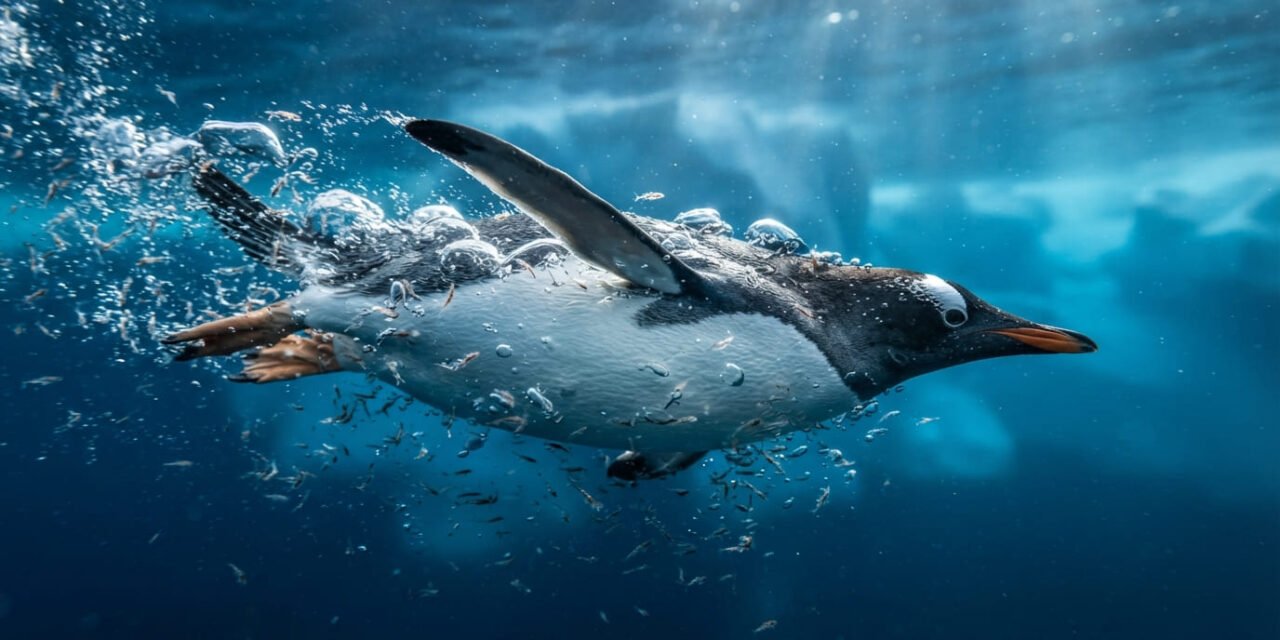
If you saw a Gentoo Penguin on land, you would see a clumsy bird that waddles and occasionally trips over its own feet. But once it hits the water, that clumsiness disappears. The Gentoo Penguin is the fastest swimming bird on the planet. It can reach speeds of 22 miles per hour. To put that in perspective, most Olympic swimmers top out at about five miles per hour.
This bird lives in the cold waters around the Antarctic Peninsula and the sub-Antarctic islands. It has to be fast because its life depends on it. It hunts small fish and krill while trying to avoid being eaten by leopard seals and killer whales. Its survival is a result of high-speed engineering.
Reducing Drag with Air Bubbles
Water is much denser than air. Moving through it quickly requires a body that creates very little resistance. The Gentoo Penguin is shaped like a torpedo. Its head, neck, and body form a smooth, continuous line that lets water flow past it without creating turbulence.
The secret to its top speed lies in its feathers. Penguins have more feathers than almost any other bird. These feathers are short, stiff, and overlap like shingles on a roof. This creates a waterproof barrier that keeps the bird’s skin dry and warm. But these feathers do something else. They trap a thin layer of air against the penguin’s body.
When the penguin wants to accelerate, it releases this trapped air. The tiny bubbles act as a lubricant between the bird’s body and the water. This process is called “bubble lubrication.” It reduces the friction, or drag, by as much as 50 percent. By essentially “flying” through a cloud of its own bubbles, the Gentoo can double its speed in an instant. This is how it launches itself out of the water and onto the ice to escape a predator.
Wings Built for Propulsion
Most birds use their wings to create lift in the air. The Gentoo Penguin uses its wings as oars. These wings are not flexible like those of a hawk or a robin. They are stiff, flat flippers made of solid bone and strong muscle.
The penguin moves its flippers in a figure-eight motion. This creates power on both the upstroke and the downstroke. It doesn’t just “paddle” through the water; it flies through it. The muscles that power these flippers are massive. They make up about 25 percent of the bird’s total body weight. These muscles are anchored to a large breastbone, providing the leverage needed to push through the heavy resistance of the ocean.
Survival in the Deep
Gentoo Penguins are not just fast; they are deep divers. They regularly dive to depths of 600 feet to find food. At these depths, the water pressure is intense. It is enough to crush the lungs of a land animal.
To survive this, the penguin has a rib cage that can collapse. As the bird dives deeper and the pressure increases, its lungs fold down. This prevents the bones from snapping. Because the bird has already stored the oxygen it needs in its blood and muscles rather than its lungs, it can continue to function even when its lungs are compressed.
The penguin’s blood contains high levels of hemoglobin, and its muscles are packed with myoglobin. These are proteins that hold onto oxygen. This allows the Gentoo to stay underwater for up to seven minutes at a time. While you would be gasping for air after a minute, the penguin is calmly hunting in the dark, high-pressure depths of the Southern Ocean.
Managing the Heart Rate
Oxygen is a finite resource during a dive. To make its oxygen supply last as long as possible, the Gentoo Penguin uses a trick called “bradycardia.” This is the intentional slowing of the heart rate.
When the penguin is resting on the surface, its heart beats around 80 to 100 times per minute. The moment it tucks its head and dives, its heart rate drops. During a deep dive, it can fall to as low as 20 beats per minute.
By slowing its heart, the bird reduces the amount of oxygen its organs use. The body shunts blood away from non-essential parts, like the stomach and skin, and sends it directly to the brain and the skeletal muscles. This biological “power-saving mode” ensures that the bird doesn’t run out of fuel before it reaches the surface.
Vision in the Dark
The ocean is a dark place, especially 600 feet down. To hunt effectively, the Gentoo Penguin has eyes that are specifically adapted for underwater sight.
Human eyes are designed to see in the air. When we open our eyes underwater, everything is blurry because water bends light differently than air does. The Gentoo Penguin has a flat cornea. This flat shape allows the eye to focus light perfectly while submerged.
They also have a high density of color-sensing cells that are tuned to the blue and green light that penetrates deepest into the water. This gives them high-contrast vision, allowing them to spot the silvery flash of a fish or the shimmer of krill in the dim light of the deep sea.
Regulating Temperature
The water in the Antarctic is often near the freezing point. A Gentoo Penguin has to maintain a body temperature of around 100 degrees Fahrenheit to stay active. If its body temperature drops, its muscles will slow down, and it will lose its speed.
To prevent heat loss, the penguin uses a counter-current heat exchange system in its legs and flippers. The warm blood leaving the heart travels in arteries that are wrapped closely around the veins, bringing cold blood back from the extremities. The warm blood heats the cold blood before it reaches the core. This keeps the bird’s internal organs warm while allowing its feet to stay cool, which prevents the bird from melting the ice it stands on and losing heat to the ground.
Thermal Insulation
Aside from the air-trapping feathers, the Gentoo has a thick layer of blubber under its skin. This fat acts as a primary insulator. It is also a fuel source. During the breeding season, when penguins have to spend long periods on land guarding their nests, they live off this stored fat.
This insulation is so effective that penguins sometimes have the opposite problem: they get too hot. If a penguin gets overheated while running on land, it will fluff out its feathers to release the trapped air or hold its flippers away from its body to let heat escape from the thinly feathered skin underneath.
The Social Speedster
Gentoos are the most social of the Antarctic penguins. They hunt in groups, which helps them confuse their prey and spot predators more easily. When a group of Gentoos is swimming at top speed, they often “porpoise.” This is when they leap out of the water while swimming.
Leaping through the air is faster and takes less energy than swimming through the water because air has less resistance. By jumping every few yards, the penguins can maintain their 22 mph speed for longer periods. It also allows them to take quick breaths without stopping their forward momentum.
Why the Gentoo Matters
The Gentoo Penguin is a bio-indicator. Because they rely on specific temperatures and food sources like krill, their health tells us about the health of the entire Antarctic ocean.
Engineers study the Gentoo’s wing shape and feather structure to create more efficient hulls for ships and better designs for underwater turbines. We are learning how to move through water by watching a bird that has been perfecting the art for millions of years.
The Gentoo Penguin proves that you don’t need to be a fish to own the ocean. With the right set of “gears”—stiff flippers, air-lubricated feathers, and a heart that can slow down on command—this bird has become the ultimate underwater flyer. It is a reminder that nature values efficiency and speed, and that sometimes, the best way to survive is to be the fastest thing in the water.
When you look at a Gentoo on the ice, remember you are looking at a high-speed machine waiting for its next launch. It is not just a bird; it is a masterpiece of hydrodynamics.