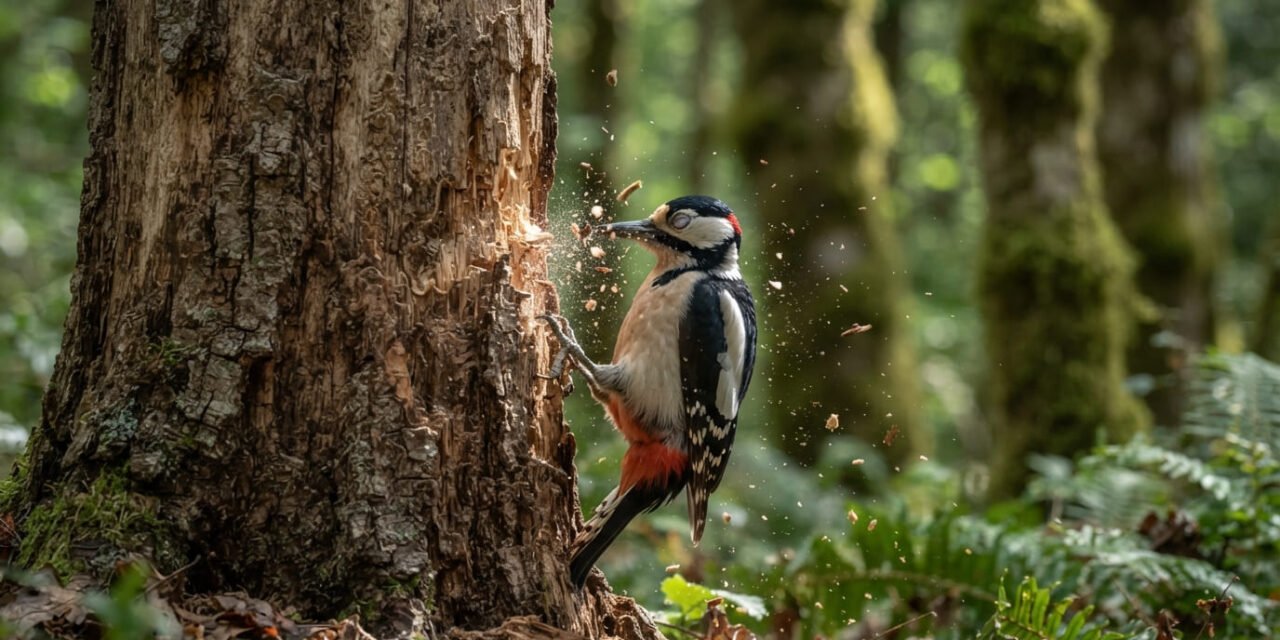
If you hit a tree trunk at fifteen miles per hour, you would suffer a severe brain injury. If you did it twenty times in one second, you would likely die. The Pileated Woodpecker does this for hours every day to find ants or carve out a nest.
This bird is a lesson in structural engineering. It handles forces that turn a human brain into mush without using a helmet or external padding. Its entire anatomy is a shock absorber.
The Physics of the Hit
When a woodpecker strikes a tree, its head experiences a deceleration of 1,200g. For context, humans get concussions at about 80g to 100g. The woodpecker deals with forces twelve times higher than what it takes to break a person.
The bird hits the wood with a straight, linear strike. This is the first reason it survives. It does not twist its head. If the head rotated during impact, the shearing forces would tear brain tissue. The woodpecker’s neck muscles are strong and stay perfectly rigid during the strike. It hits the tree like a professional boxer throws a jab—straight and controlled.
The Tongue as a Seatbelt
The most unusual part of the woodpecker’s anatomy is its tongue. It is not just for grabbing bugs. In a Pileated Woodpecker, the tongue is so long that it cannot fit in the mouth in a normal way.
Instead, the base of the tongue wraps around the back of the bird’s skull, goes over the top, and anchors near the nostrils. This structure is called the hyoid apparatus. It consists of bone and muscle. When the bird prepares to strike, this tongue-anchor tightens. It acts like a seatbelt for the brain. It holds the skull and the brain in place so they do not rattle during high-speed impact.
The hyoid bone is not a single rigid piece. It is a series of small, articulated bones connected by elastic muscle fibers. When the beak makes contact, these muscles contract in a specific sequence. This sequence draws the tongue back and pulls the entire skull forward against the neck. This creates a tension system that prevents the brain from shifting inside the skull.
A Specialized Skull
The woodpecker’s skull is not a solid, brittle box. It is made of spongy bone. Under a microscope, you can see a mesh-like structure concentrated in the forehead and the back of the head. This bone is flexible. It absorbs the vibrations of the impact before they reach the brain.
The brain itself is packed in tight. Humans have a layer of cerebrospinal fluid around the brain. During an impact, our brain sloshes through that fluid and hits the inside of the skull. Woodpeckers have almost no fluid. Their brain fits snugly against the bone. Since there is no room to move, there is no slosh and no concussion.
The shape of the skull also matters. It is relatively flat at the point where it meets the neck. This allows the force to move in a straight line from the beak, through the skull, and into the large neck muscles. In humans, our rounded skulls cause force to dissipate in many directions, which increases the chance of internal tearing.
The Two-Part Beak
The beak is the frontline of the impact. If the beak were one solid piece, the shock would travel straight into the skull. The Pileated Woodpecker has a beak made of two layers. The outer layer is a tough keratin sheath, while the inner layer is dense bone.
The upper and lower parts of the beak are of different lengths. The lower beak is slightly longer and bears the brunt of the initial force. This diverts the vibration away from the brain and sends it down into the neck and body. The beak also has a self-sharpening design. As the bird hammers, the friction keeps the tip at a chisel-like point.
The keratin in the beak is arranged in a microscopic scale-like pattern. These scales overlap and can slide slightly against one another. This movement allows the beak to compress slightly during the strike, acting as a high-speed spring. This compression takes place in less than a millisecond, but it reduces the peak force of the impact.
Protecting the Eyes
When you hammer into wood, wood chips fly at high speeds. A single splinter in the eye would blind a bird. Woodpeckers have a nictitating membrane, or a third eyelid.
A millisecond before the beak hits the tree, this membrane closes over the eye. It acts as safety goggles. It also keeps the eye from popping out of the socket. The pressure of the impact is so great that without this membrane holding the eyeball in place, the force could dislodge it. The bird blinks at the exact moment of impact every single time.
This membrane is transparent, so the bird is never technically flying blind. It can see the target even as the eyelid closes. This allows for mid-strike corrections if the wood splits or the bird slips.
Muscular Reinforcement
The neck of a Pileated Woodpecker is massive compared to its body size. These muscles are not just for power; they are for stabilization. The bird has specialized tendons that lock the vertebrae of the neck into a rigid column during the strike.
When the head moves forward, the chest muscles also engage. The woodpecker uses its stiff tail feathers as a third leg, pressing them against the tree to create a tripod. This stable base allows the bird to put its entire body weight into the strike without losing balance. This distributed force prevents any single joint from taking too much stress.
Practical Applications
Scientists study woodpeckers to design better safety equipment for humans. Football helmets and flight helmets are being redesigned based on the woodpecker’s spongy bone and seatbelt tongue.
We are learning that the best way to handle an impact is not to build a harder shell. It is about managing how energy moves through a system. The woodpecker does not fight the force. It redirects it. It turns its whole body into a spring. Engineers are now creating microscopic mesh materials that mimic the woodpecker’s skull to protect electronics in high-impact environments.
The Daily Routine
A Pileated Woodpecker can hammer up to 12,000 times in a single day. They look for carpenter ants deep inside the wood. They can hear the ants moving inside the tree, much like an owl hears a vole under the snow.
They are the primary excavators of the forest. Because they are good at breaking wood, they create large, rectangular holes. These holes are unique to the Pileated Woodpecker. Once the woodpecker moves on, these holes become homes for other birds like wood ducks or screech owls that cannot carve their own nests. The woodpecker is the construction crew of the woods.
Without the Pileated Woodpecker, many other species would have nowhere to breed. In some forests, over 70 percent of nesting cavities are originally carved by woodpeckers.
The Cost of Living
This lifestyle requires a lot of energy. Hammering into a tree is a full-body workout. The bird must eat a massive amount of protein to keep its muscles working and its brain functioning. A single bird can eat thousands of ants in one sitting.
Because they are specialized, they are sensitive to changes in the forest. They need large, dead trees to find enough food. When people remove dead standing timber to clean up a forest, the woodpeckers lose their food and their home. They are a sign of a healthy ecosystem. If you see a Pileated Woodpecker, it means the forest is old enough and complex enough to support a top-tier predator.
Observing the Carpenter
If you hear a sound like a jackhammer in the woods, it is likely a Pileated Woodpecker. They are large birds, about the size of a crow, with a bright red crest. Their call is a loud, laughing series of notes that can be heard from half a mile away.
Watch them work. You will see the head move in a blur. You will see large chunks of wood flying. It looks violent, but for the bird, it is routine. They are calm because their biology has already solved the problem of the impact. They do not show signs of dizziness or disorientation after a long session of drilling.
The Pileated Woodpecker reminds us that there is a solution for every physical challenge if evolution has enough time. They took a dangerous activity, hitting a wall with their face, and turned it into a career. They are a combination of a chisel, a shock absorber, and a safety harness. As long as there are trees to hammer, the woodpecker will be out there, proving you do not need a helmet if your head is built to take the hit.
You should care about this bird because it shows how nature manages extreme physics. By understanding how the woodpecker protects its brain, we can develop better ways to protect our own. Our job is to keep the forests standing so they have a place to work. Every dead tree is a potential home and a vital part of the engineering cycle of the woods.