If you ever find yourself in the southern Kalahari Desert of South Africa, you will quickly notice how hard it is to get a decent meal. The landscape is a harsh expanse of red sand dunes, thorny acacia trees, and dry grasses. Water is scarce, and the sun beats down without mercy. For the small animals that live here, finding food is a full-time job that requires constant digging and intense focus.
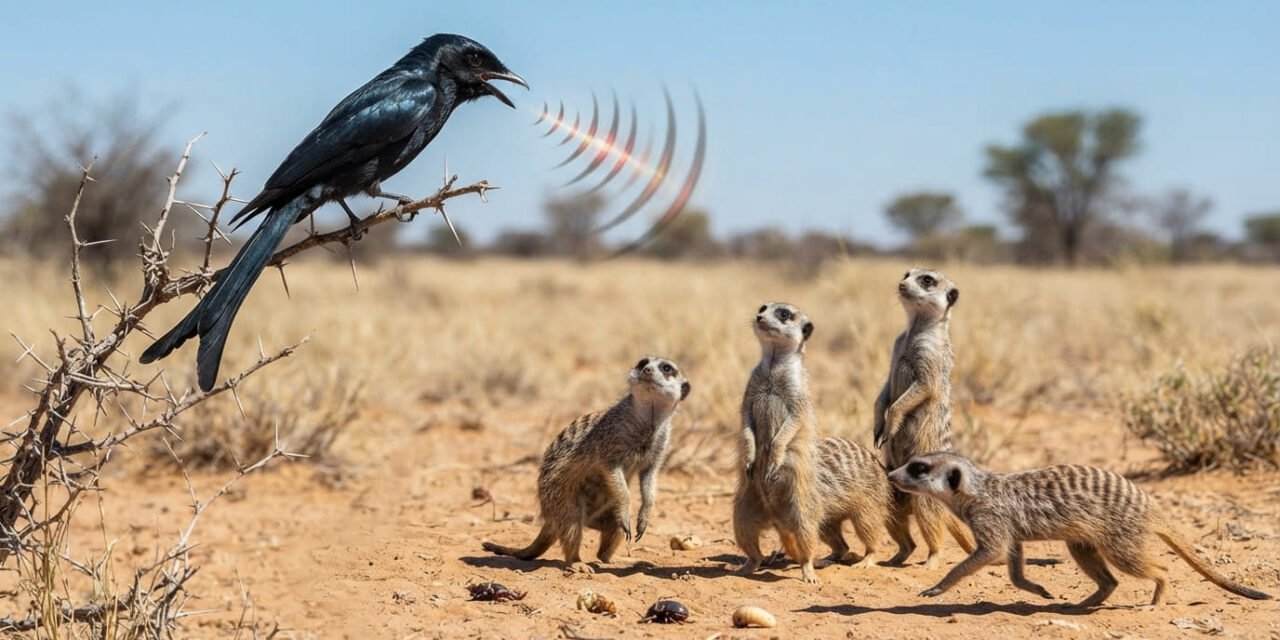
In this dry environment, there is a glossy black bird with blood-red eyes and a deeply forked tail. It is the fork-tailed drongo (Dicrurus adsimilis). If you watch one, it might look like any other insect-eating bird. It sits on a high branch, scanning the ground for movement. But the drongo is not just a hard-working hunter. It is the Kalahari’s most successful con artist. Instead of doing the hard work of digging for food, the drongo spends a massive portion of its life running a complex protection racket. It stalks meerkats and small birds, gains their trust, and then uses vocal identity theft to steal their dinners.
The Art of Kleptoparasitism
Biologists have a very specific name for this behavior: kleptoparasitism. It literally means “parasitism by theft.” In the animal kingdom, many creatures steal food when the opportunity arises. A seagull might snatch a French fry from your hand, or a hyena might push a cheetah off a fresh kill. But these are usually crimes of opportunity or simple physical bullying.
The fork-tailed drongo has taken the practice of theft and turned it into an intellectual pursuit. It does not rely on size or physical strength to rob its neighbors. It uses psychology.
Drongos are highly active during the winter when the desert gets cold, and insects are hard to find. Digging into the frozen sand to find grubs or scorpions requires a lot of energy. Meerkats (Suricata suricatta) are excellent diggers. They have long, curved claws designed to excavate deep tunnels and unearth fat, juicy prey. The problem for the meerkat is that when its head is buried in a hole, it cannot watch the sky for predators like eagles, hawks, or jackals.
This is where the drongo steps in. The bird will follow a foraging meerkat mob, perched on a branch just above them. It acts as an unpaid bodyguard.
Building a Racket of Trust
To pull off a successful scam, you first have to build trust. The drongo understands this perfectly. When it sits above the foraging meerkats, it keeps a sharp eye on the sky. If a real predator, like a martial eagle, sweeps over the dunes, the drongo sounds a loud, frantic alarm call.
The meerkats hear the warning, drop whatever they are doing, and run for the safety of their underground burrows. Once the danger passes, they emerge, safe and sound. The drongo has just saved their lives. It repeats this helpful behavior several times, proving to the meerkats that its voice is a reliable source of safety.
Once the meerkats trust the bird, the drongo changes its strategy. It waits patiently for a meerkat to dig up something valuable. This is usually a large item that takes time to process, like a scorpion or a plump lizard. The meerkat cannot just swallow this in one gulp; it has to bite off the stinger or chew it into pieces.
Just as the meerkat is about to take its first bite, the drongo unleashes a false alarm. It screams the same warning call it used when the eagle was present. The meerkat, operating on pure survival instinct, drops the scorpion and dashes for the nearest hole. The drongo then swoops down from its perch, snatches the abandoned meal, and flies back up to the trees to eat it in peace.
The Liar’s Dilemma
If the story ended there, the drongo would eventually starve. In the classic fable of the boy who cried wolf, the villagers eventually stopped believing the boy because he lied too often. The same logic applies in the Kalahari.
Meerkats and other desert birds, like the grey-backed sparrow-lark or the pied babbler, are not stupid. If a drongo sounds its own specific alarm call and no predator appears, the victims eventually catch on. They start to ignore the bird’s voice. In fact, researchers have found that if a drongo uses its own alarm call to lie to a group of birds more than two or three times in a row, the target birds will completely ignore the warning. They will stay right where they are and keep eating their food.
The drongo solves this “liar’s dilemma” through a staggering display of vocal mimicry. It does not just have one alarm call. A team of scientists led by Dr. Tom Flower from the University of Cape Town spent years tracking individually marked, habituated drongos in the southern Kalahari. They recorded the birds and analyzed their calls.
They discovered that the fork-tailed drongo has a library of up to 51 different alarm calls. Only a few of these are the drongo’s native calls. The rest are perfect imitations of the warning cries of other animals. The drongo can mimic the alarm of a starling, a plover, a pied babbler, and even the specific warning bark of a meerkat sentinel.
Rotating the Lies
When a drongo wants to run a scam on a meerkat that has grown skeptical of the drongo’s own voice, it simply switches characters.
Imagine a meerkat has just dug up a fat beetle grub. It heard the drongo’s false alarm ten minutes ago and ignored it. This time, the drongo does not use its own voice. It mimics the alarm call of the meerkat group’s own lookout. This is a sound the colony hears and trusts every single day. When the foraging meerkat hears its own family member sounding the alarm, it does not hesitate. It drops the grub and runs.
If the meerkats start to doubt that specific sentinel call, the drongo will switch again. On the next attempt, it might mimic the panic cry of a pied babbler that is feeding nearby. By constantly rotating its lies, the drongo prevents its victims from ever getting used to the deception. It keeps the scam fresh. The targets are trapped in a state of perpetual uncertainty, never knowing if the voice they are hearing is a real warning from a friend or a fake call from the black bird sitting in the acacia tree.
The Math of Deception
Dr. Tom Flower’s research showed just how much the drongos rely on this lifestyle. He tracked 50 different color-banded drongos over several years. He found that these birds spend about a quarter of their daily active time following other species.
This is not a casual hobby. The food the drongos steal from meerkats and babblers accounts for over 20 percent of their total daily calorie intake. When the weather gets cold and insects are scarce, that number can jump even higher. The stolen meals are often high-value items that the drongo would struggle to catch on its own. A drongo’s beak is not designed for digging into hard sand, so it cannot reach the buried scorpions and grubs that meerkats find easily. The meerkats act as the bird’s hands, and the bird uses its brain to reap the rewards.
The research also showed that the drongos do not use their mimicry randomly. They are highly tactical. They assess their target’s level of suspicion. If the target has ignored a previous call, the drongo is much more likely to switch to a mimicked call on the next attempt. It is a dynamic, responsive communication system that is incredibly rare in the animal world.
Why the Victims Keep Falling for It
It might seem strange that meerkats and babblers continue to let themselves be tricked by a bird. But from an evolutionary standpoint, their gullibility is actually a highly logical strategy. It comes down to a simple mathematical calculation of risk.
If a meerkat ignores a false alarm, it keeps its scorpion. It gets a nice meal. But if the meerkat ignores a real alarm, it gets eaten by an eagle. The cost of a false positive running away when there is no danger, is just a lost lunch and a bit of wasted energy. The cost of a false negative, staying still when a predator is actually there, is death.
Because the stakes are so asymmetrical, the meerkats must err on the side of caution. Even if they suspect the drongo might be lying, they cannot afford to take the chance. Their survival depends on their willingness to run first and ask questions later. The drongo exploits this biological loophole, using the meerkats’ own survival instincts as a tool to feed itself.
Fearless and Territorial
The drongo’s intelligence is paired with an absolutely fearless personality. Even though they are relatively small birds, they are highly territorial and will not hesitate to attack animals many times their size.
If a large bird of prey, like a goshawk or an owl, enters a drongo’s nesting territory, the drongo will dive-bomb and mob the predator until it leaves. They have even been known to chase jackals and small wildcats. This aggressive reputation is part of why other animals trust their alarm calls in the first place. When a drongo screams, the rest of the desert listens, because they know the bird is not afraid of anything.
This courage also helps them when they are stealing food. If a smaller bird, like a babbler, refuses to drop its prey after a false alarm, the drongo will sometimes drop down and physically attack the bird to force it to release the food. They are versatile criminals, willing to use physical force if their psychological tricks fail.
Final Thoughts
The fork-tailed drongo challenges the way we think about animal communication. We often assume that animal calls are simple, honest signals of emotion or instinct, a scream of fear or a song of love. The drongo proves that a bird brain is capable of strategic, flexible deception. It manages a complex library of sounds, monitors the behavior of its neighbors, and adjusts its lies to keep its territory profitable.
The next time you hear a bird singing outside your window, take a moment to really listen. It might be defending its territory, or it might be looking for a mate. But if it is a drongo in the Kalahari, it is probably just figuring out the best way to lie to its neighbors to get a free lunch. It is a quiet, feathered mastermind, proving that in the battle for survival, a clever lie is often more powerful than a sharp claw.