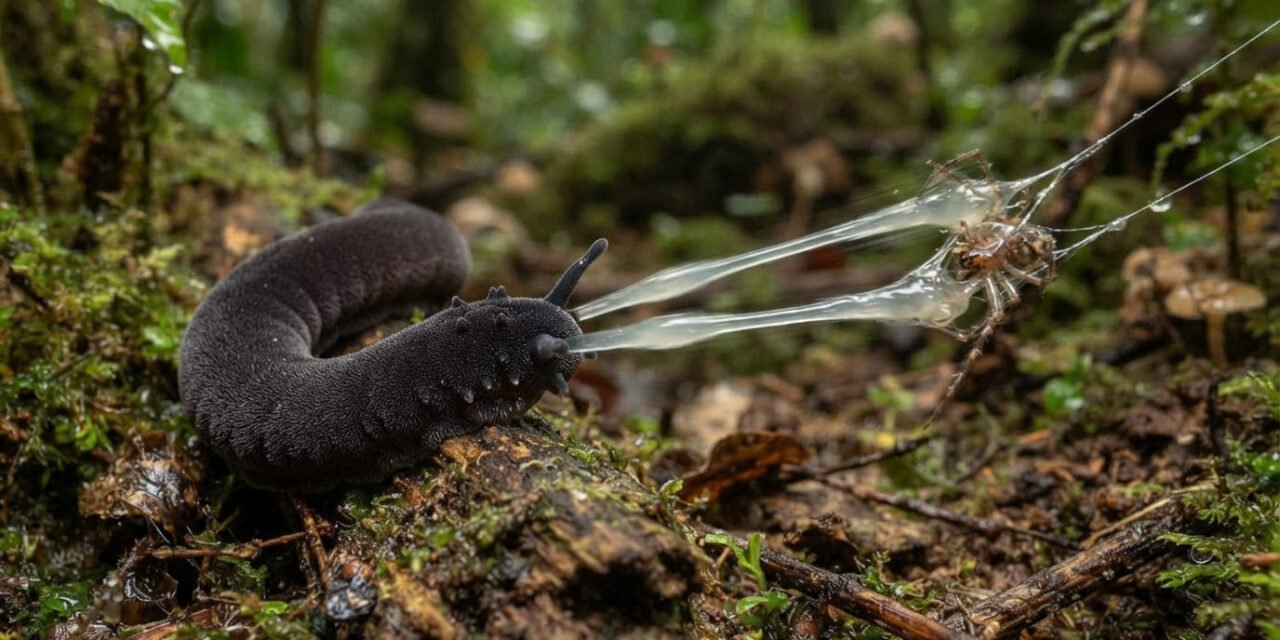
Imagine walking through a damp, dark forest in the middle of the night. The ground is covered in rotting leaves, mossy logs, and a quiet layer of soil that seems almost completely still. If you shine a flashlight onto a wet log, you might spot a creature that looks like a cross between a caterpillar and a slug. It has a soft, velvety body, dozens of stubby, unjointed legs, and two long, sensitive antennae waving slowly in the air. It moves with a slow, almost comical grace, looking entirely harmless and defenseless.
This is the velvet worm, a member of the ancient phylum Onychophora. Velvet worms are living relics of a bygone era. Their ancestors crawled through the oceans over 500 million years ago, long before the first dinosaurs walked the Earth. While other animals evolved hard shells, wings, and complex joints, the velvet worm kept its soft, squishy body largely unchanged.
Yet, if a fast-moving cricket or a heavily armored beetle wanders too close, this slow, soft-bodied creature transforms into a lethal predator. In a fraction of a second, the velvet worm fires two high-velocity jets of liquid glue from specialized glands on its head. The liquid crisscrosses in the air, forming a chaotic, sticky net that traps the prey in milliseconds. The worm did not solve the problem of catching fast prey with speed or claws. It solved it with a brilliant display of fluid physics and smart chemistry.
The Problem of the Slow-Moving Hunter
To understand why the velvet worm needs such a specialized weapon, you have to look at its physical limitations. The velvet worm is incredibly slow. It cannot run, jump, or pounce. Its body is supported not by a hard skeleton, but by a fluid-filled cavity under constant pressure. Its legs are simple, fleshy nubs that push against the ground in a slow, rhythmic crawl.
Its prey, on the other hand, consists of fast-moving forest insects like crickets, spiders, and woodlice. These creatures have jointed legs, rapid reflexes, and hard exoskeletons. If a velvet worm tried to sneak up and grab a cricket with its mouth, the cricket would hear the vibration and hop away long before the worm could make a move.
Even if the worm managed to get close, it lacks the physical strength to wrestle a struggling insect. It has no venomous fangs, no pinching claws, and no crushing jaws. To survive, the velvet worm needed a way to immobilize its prey from a distance. It needed a weapon that could travel faster than a cricket can jump and hold a thrashing insect in place.
The Physics of the Runaway Garden Hose
The velvet worm’s weapons are located on either side of its head, just below its eyes. These are the oral papillae, a pair of short, flexible nozzles connected to massive, internal slime glands that stretch down the entire length of the worm’s body. These glands store a large reservoir of liquid protein dope.
When the worm spots a target, it aims its nozzles and contracts the powerful muscles surrounding the slime glands. This creates immense internal pressure, forcing the liquid out of the oral papillae at high speeds.
But if you watch a high-speed video of a velvet worm firing its slime, you will notice something bizarre. The worm does not fire two straight, neat streams of liquid. Instead, the streams whip back and forth violently, creating a wide, chaotic, zigzagging web of glue that covers a broad area. For a long time, scientists assumed that the worm was rapidly shaking its head or wiggling its nozzles to spread the spray.
A study published by researchers who analyzed the firing mechanism under high-speed cameras revealed a much more elegant truth. The worm does not move its head at all. The oscillation is entirely passive.
It works on the same principle as a loose garden hose left on the lawn under high water pressure. When water flows through a flexible hose fast enough, the force of the exiting water causes the tip of the hose to buckle and whip back and forth. In physics, this is known as a fluid-structure instability.
By evolving a nozzle with a highly flexible tip and a rigid base, the velvet worm exploits this instability. As the pressurized slime rushes through the flexible nozzle, the tip naturally oscillates at a staggering rate, usually between 30 and 60 cycles per second. This passive whipping motion turns two simple streams of liquid into a complex, overlapping net of glue in a fraction of a second. The worm does not have to waste energy or brainpower steering the spray; the laws of physics do the work for it.
The Smart Chemistry of the Trap
The physical delivery of the slime is only half of the trick. The liquid itself is a masterpiece of biochemistry. When the slime is stored inside the worm’s glands, it is a fluid, low-viscosity liquid that flows easily. If it remained in this state after hitting the prey, the insect would simply wipe it off and walk away.
But as soon as the slime leaves the nozzle and travels through the air, its behavior changes completely. The slime is a shear-thinning, non-Newtonian fluid that reacts to mechanical force.
The liquid is made of water, lipids, and long, coiled proteins. When the slime is fired, it experiences extreme shear stress as it is forced through the narrow nozzle and whipped through the air. This mechanical stress causes the coiled proteins to unroll and align with one another.
When the slime hits the target, the prey’s frantic struggling applies even more mechanical force to the mixture. As the insect thrashes, it stretches and pulls the liquid threads. This stretching forces the proteins to bind tightly together, squeezing out the water molecules and causing the liquid to rapidly transition into a solid, rubbery, and incredibly sticky state.
Within seconds, the liquid turns into a matrix of tough, glassy fibers. The more the prey struggles, the tighter and harder the glue becomes. The insect is trapped in a straightjacket of its own making, pinned to the leaves or soil by a net that gets stronger with every movement.
Digestion, Feast, and Recycling the Weapon
Once the prey is securely pinned, the velvet worm crawls slowly toward its prize. It does not have to worry about the insect escaping; the glue is strong enough to hold beetles and spiders several times the worm’s weight.
Because the worm has a soft mouth and no teeth, it cannot chew the insect’s hard shell. Instead, it uses its sharp, claw-like inner jaws to slice a small hole in the prey’s cuticle. It then injects a cocktail of highly potent digestive enzymes directly into the insect’s body.
These enzymes go to work immediately, liquefying the insect’s internal organs, muscles, and tissues into a nutrient-rich soup. While the prey is dissolving, the velvet worm begins to eat. But it does not just drink the liquefied insect. It also eats its own slime.
Synthesizing a massive reservoir of complex proteins and lipids is incredibly expensive from an energy standpoint. If the velvet worm left its sticky net behind after every hunt, it would quickly starve from the cost of reproducing the weapon. By eating the hardened slime along with the prey, the worm recycles nearly 100 percent of the proteins. It takes the raw materials back into its body, refuels its glands, and prepares its weapons for the next night’s hunt.
Lessons in Fluid Engineering
You should care about the velvet worm because its elegant solution to the spraying problem is highly relevant to human technology. Modern manufacturing and chemical industries rely heavily on spray nozzles to distribute liquids, paint, fuel, and agricultural chemicals.
To get a wide, even spray, human machines usually require complex, moving mechanical parts, like rotating nozzles or electronic shaking mechanisms. These moving parts are prone to wearing out, clogging, and breaking down under high pressure.
By studying how the velvet worm uses passive fluid-dynamic oscillation, engineers are learning how to design smart, flexible nozzles that can create wide, oscillating spray patterns without any moving parts. We can apply this simple, low-energy design to build more reliable fuel injectors for jet engines, more efficient 3D printers that can distribute materials over large areas, and agricultural drones that can spray crops evenly with minimal wear and tear on their components.
Final Thoughts
The velvet worm is a reminder that some of the most sophisticated engineering in the world is happening right under our feet, in the quietest corners of the forest floor. It is a creature that has survived multiple mass extinctions, watched the continents drift apart, and outlasted the grandest predators in Earth’s history.
It did not achieve this longevity by being the biggest, the loudest, or the fastest. It survived by turning the simple physics of a whipping nozzle and the smart chemistry of a reactive fluid into a lifetime guarantee of a free meal. When you look at this soft, velvety worm, you are looking at a quiet master of fluid dynamics, proving that sometimes a clever physical shortcut is far more effective than a heavy claw.