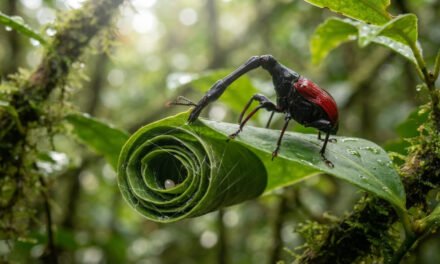
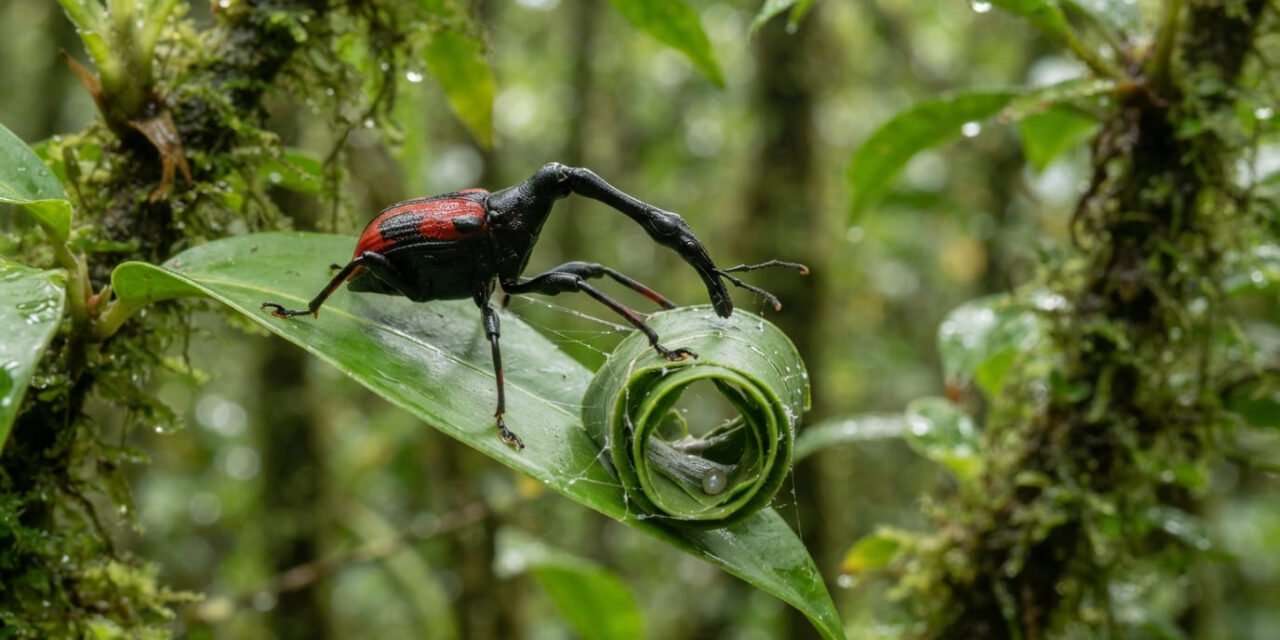
If you go to the rainforests of Madagascar, you will find a creature that looks like a mistake. It is a beetle about an inch long with a bright red shell and a neck that seems to belong to a different animal. This is the Giraffe Weevil. It is one of those species that makes you realize evolution isn’t always about being sleek or fast. Sometimes, it’s about having a very specific tool for a very specific job.
The Giraffe Weevil lives on a handful of tree species in the dense forests of the island. It doesn’t bite, it isn’t venomous, and it spends most of its life moving very slowly. But despite its strange appearance, every millimeter of that elongated neck serves a practical purpose.
The Sexual Dimorphism of the Neck
The first thing you notice is that the males have necks two to three times longer than the females. In the world of beetles, when you see a body part that is exaggerated like this, it usually means one thing: fighting.
Male Giraffe Weevils are surprisingly aggressive. They don’t fight over territory or food. They fight over access to females. When two males meet on a leaf, they don’t use pincers or horns like Stag beetles. Instead, they use their necks. They swing them like cranes, trying to knock their opponent off the leaf.
The physics of this are interesting. A longer neck provides more leverage. By swinging their heads, they generate enough force to flip a rival over. The loser falls into the leaf litter below, and the winner gets to stay. It is a slow-motion wrestling match. Because they are beetles, they aren’t actually hurting each other. They are just testing who has the more dominant physical structure.
The Female’s Engineering Masterclass
While the males use their necks for combat, the females use theirs for something much more complex. The female’s neck is shorter, but it is a vital tool for the survival of her offspring.
A Giraffe Weevil doesn’t just lay an egg on a leaf and walk away. That would be a death sentence. Predators like ants and spiders would find the egg in minutes. Instead, the female creates a protective cradle.
First, she selects a specific leaf from the Dichaetanthera tree. She uses her mandibles to cut tiny slits into the leaf, effectively scoring the material so it becomes flexible. Then, using her neck and legs, she begins to roll the leaf into a tight cylinder.
Imagine trying to roll a cigar using only your chin and your feet. That is essentially what she is doing. Her neck allows her to reach over the top of the roll and pull it tight, tucking the edges in so it won’t unravel. Once the roll is halfway finished, she lays a single egg inside. Then she finishes the roll and seals the ends.
The result is a perfect, green tube that protects the egg from the rain, the sun, and predators. Eventually, the tube falls to the forest floor. When the larva hatches, it eats the decaying leaf roll from the inside out until it is ready to pupate. It is one of the most sophisticated examples of nest-building in the insect world.
Why Madagascar?
You won’t find this beetle anywhere else. Madagascar is an island that has been isolated for about 88 million years. Because of this, it has become a laboratory for strange evolutionary paths.
In a standard continental forest, a beetle with a neck this long might be too easy for a bird to catch. But in Madagascar, the Giraffe Weevil found a niche where its strange shape was a benefit rather than a liability. It doesn’t need to be fast because its primary food source is abundant and stationary. It doesn’t need to be invisible because its bright red back warns predators that it might be unpleasant to eat.
The long neck is a high-cost investment. It takes energy to grow and energy to move. But in this specific environment, the benefits of winning fights and building better nests outweigh the metabolic cost.
Anatomy of a Living Tool
To understand how this beetle functions, you have to look at the joints. The neck isn’t a single, rigid tube. It is a series of segmented plates made of chitin, the same material that forms the rest of the exoskeleton. These plates are reinforced with extra layers of protein to prevent snapping during a fight.
The muscles inside the neck are surprisingly powerful. If you tried to hold a male Giraffe Weevil, you would feel the strength of its neck as it tried to push your fingers away. This strength allows the beetle to maintain its posture even while carrying its own head at the end of a long lever.
The weight distribution is another feat of balance. Most of the beetle’s weight is concentrated in its thorax and legs. This gives it a low center of gravity. When a male swings its neck at a rival, its legs act as anchors, gripping the leaf surface with tiny hooks. Without this grip, the force of the swing would pull the beetle right off the plant.
Life in the Rainforest Canopy
The day-to-day life of a Giraffe Weevil is quiet. They spend most of their time on the underside of leaves to avoid the direct tropical sun. Their diet consists exclusively of the leaves of two or three specific tree species. This specialization means they don’t have to wander far to find food.
Because they are so specialized, their life cycle is tied to the health of the forest. If these trees disappear, the weevils disappear with them. This makes them a great indicator species for the health of Madagascar’s biodiversity. When you find a healthy population of Giraffe Weevils, you know you are in an area of the forest that hasn’t been heavily disturbed by logging or agriculture.
They are most active during the warmer months when the trees are producing fresh, supple leaves. This is when the breeding season begins, and the forest floor becomes littered with the tiny leaf rolls made by the females.
The Practical Reality of Observation
Watching these beetles in the wild is a lesson in patience. They don’t scurry. They move with a deliberate, mechanical gait. If you disturb one, it doesn’t fly away immediately. It usually just freezes, relying on the fact that from a distance, its long neck looks like a dry twig or a bit of plant debris.
If you look closely at the joints of the neck, you can see how they are reinforced. It isn’t a single long bone; it is a series of specialized plates that allow for a surprising range of motion. The male can tuck his head down or swing it almost 180 degrees. This flexibility is what allows them to navigate the crowded canopy of the rainforest without getting stuck in the foliage.
Lessons in Biological Specialization
The Giraffe Weevil is a perfect example of niche construction. It doesn’t just live in the forest; it actively manipulates its environment to ensure the next generation survives.
We often think of beetles as simple machines that just eat and reproduce. But the Giraffe Weevil shows a level of craftsmanship that we usually associate with much larger animals. The female has to understand the tension of the leaf, the placement of the egg, and the mechanical strength of the roll. She isn’t just following an instinct; she is performing a complex physical task that requires precise coordination.
Consider the amount of trial and error evolution that went through to arrive at this point. If the neck were too long, the beetle would be too top-heavy. If it were too short, the male couldn’t win fights, and the female couldn’t roll the leaves as tightly. Nature found the exact middle ground where the length of the neck provides the maximum benefit for the minimum energy cost.
The Threat of Habitat Loss
While the Giraffe Weevil has spent millions of years perfecting its shape, it is currently facing a challenge it didn’t evolve for: humans. Madagascar has lost over 80% of its original forest cover. The Dichaetanthera trees that the weevils rely on are being cleared for charcoal production and subsistence farming.
When a patch of forest is cleared, the weevils don’t move to a new area. They are too slow and too specialized to migrate across open land. They simply die out. Conservation efforts on the island are focused on protecting these specific pockets of forest. By saving the trees, we save the weevil.
Final Observations
In the end, the Giraffe Weevil is a reminder that there is no correct way for an animal to look. If a trait helps you win a fight or protect your children, nature will keep it, no matter how ridiculous it looks to us.
The next time you think about animal intelligence or engineering, remember this tiny red beetle in Madagascar. It isn’t a mistake of evolution. It is a highly specialized, successful machine that has been rolling leaves and winning neck-wrestling matches long before humans ever arrived on the island. It found a way to make a long neck the most practical tool in the forest.
We can learn a lot from how this beetle manages its resources. It doesn’t overproduce; it lays one egg in one carefully crafted roll. It doesn’t fight to kill; it fights to displace. It is an efficient, quiet resident of a very complex world. As long as the forests of Madagascar stand, this strange, red-backed engineer will continue its work, one leaf roll at a time.