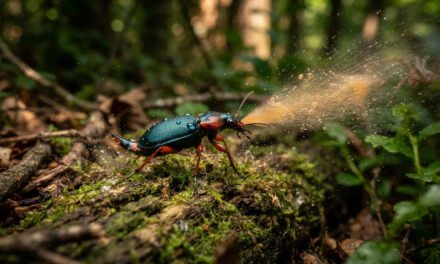
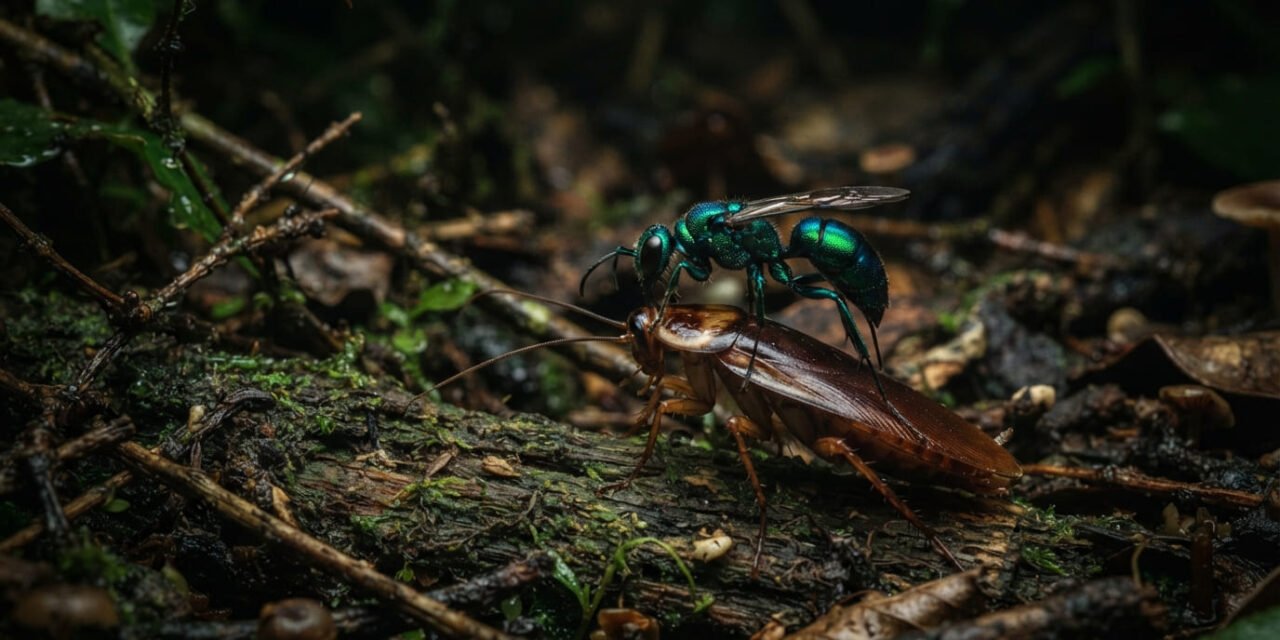
If you ever see an emerald jewel wasp (Ampulex compressa) in the tropical forests of South Asia, Africa, or the Pacific Islands, you will probably admire its appearance first. It is a stunning insect. Its body glitters in the sunlight with metallic shades of emerald green, royal blue, and deep purple. It looks like a flying piece of expensive jewelry. But behind this beautiful exterior lies one of the most calculated and terrifying survival strategies on the planet. This wasp does not just kill its prey to feed its young. It performs highly precise, targeted brain surgery on a creature twice its size, turning it into a living, walking zombie.
We often think of parasites as simple creatures that take advantage of a host’s weakness. The emerald jewel wasp is different. She is a master neurosurgeon. Her target is the American cockroach (Periplaneta americana). Instead of using brute force or a lethal venom that kills the cockroach instantly, the female wasp uses a chemical cocktail designed to manipulate the cockroach’s brain. She turns off the cockroach’s drive to escape, takes control of its nervous system, and leads it to its doom.
The Problem of the Giant Prey
To understand why the wasp needs to be a brain surgeon, you have to look at the scale of the challenge. The female jewel wasp is relatively small, usually measuring about two centimeters in length. The American cockroach is a giant by comparison. It is often twice the size and several times the weight of the wasp. It has thick, armored plates and powerful, spiny legs that can kick a wasp away with ease. It is also incredibly fast, equipped with wind-sensitive hairs on its rear that trigger a high-speed escape reflex at the slightest vibration.
If the wasp tried to fight the cockroach using simple physical strength, she would lose. Even if she managed to sting the cockroach in a random spot, a generic paralyzing venom would not work well. If she completely paralyzed the cockroach, she would be left with a heavy, lifeless body that she could never hope to carry back to her nest. The wasp needed a way to make the cockroach move itself. Her solution was not to destroy the cockroach’s ability to walk, but to destroy its free will.
The First Strike: The Quick Fix
The hunt begins when the female wasp spots a cockroach. She drops down from the air and grabs the cockroach’s thorax with her jaws. The cockroach immediately fights back, thrashing its body and kicking with its legs. The wasp must act quickly.
She delivers her first sting into the middle section of the cockroach’s body, the thorax. This first injection contains a high concentration of gamma-aminobutyric acid, or GABA, along with other chemicals. This mixture acts as a rapid, short-acting sedative. Within seconds, the cockroach’s front legs go completely limp.
This first sting is not the main event. It is simply a setup. The temporary paralysis of the front legs prevents the cockroach from kicking the wasp off or running away. It holds the giant prey still for just a couple of minutes. This is the exact amount of time the wasp needs to perform the delicate second stage of her operation.
The Second Strike: Precision Neurosurgery
With the cockroach temporarily immobilized, the wasp bends her abdomen under the cockroach’s head. She carefully inserts her long, flexible stinger through the soft membranes of the cockroach’s neck. This is where the true brain surgery happens.
The wasp’s stinger is not just a needle. It is a highly sensitive sensory probe. The tip of the stinger is equipped with tiny chemical and mechanical sensors. As she pushes the stinger upward into the cockroach’s head cavity, she uses these sensors to feel her way through the brain tissue. She is searching for a very specific target: the subesophageal ganglion, or SEG. This is the part of the cockroach’s brain that controls its walking and escape behaviors.
Once the stinger locates the SEG, the wasp delivers her second, highly targeted injection. This venom cocktail is incredibly complex. It contains a specific mix of blockades, including dopamine and octopamine blockers. These chemicals target the receptors that the cockroach’s brain uses to initiate movement.
The wasp knows exactly how deep to go. If she pushes the stinger too far, she could kill the cockroach. If she does not go deep enough, the venom will not take effect. When researchers watched this process under high-speed cameras, they found that the wasp moves her stinger around inside the cockroach’s head for several minutes, feeling for the exact boundaries of the brain before releasing the chemicals. It is a level of precision that human surgeons can only match with advanced imaging technology.
The Living Zombie
Once the brain surgery is complete, the wasp removes her stinger. Within a few minutes, the temporary paralysis from the first sting wears off. The cockroach can now stand up. Its legs work perfectly. It has all the muscle power it needs to run, jump, or fly away. But it does neither of those things. It simply sits there.
The second sting has turned off the cockroach’s motivation to escape. If you touch a normal cockroach, it runs away in milliseconds. If you touch a zombified cockroach, it might take a single step forward, but then it stops. It has lost the ability to initiate its own escape behavior. It is fully capable of movement, but its brain no longer registers the desire to run from danger.
While the cockroach sits in this passive state, the wasp does something surprising. She does not run. She stands next to her victim and begins to groom herself. She spends fifteen to twenty minutes cleaning her antenna, her wings, and her legs. She is in no rush because she knows her prey cannot go anywhere.
Once she is clean, she turns her attention back to the cockroach. She bites the ends off the cockroach’s two long antennae. She drinks a few drops of the cockroach’s blood, or hemolymph, from the cut ends. This gives her a quick boost of energy for the hard work ahead.
She then grabs the stump of one of the antennae with her jaws and begins to walk backward. The cockroach, lacking any will of its own, follows her obediently. It walks forward on its own six legs, acting like a dog on a leash. The wasp does not have to carry the heavy insect; she simply guides it to her chosen nesting site.
The Underground Nursery
The wasp leads the cockroach to a small burrow in the ground or a crack in a tree trunk. She pulls the passive insect inside the dark chamber. Once they are deep in the hole, the wasp lays a single, small white egg and glues it directly to the cockroach’s leg.
She then climbs out of the burrow, leaving the cockroach inside. To ensure no other predators find her nursery, she gathers small twigs, leaves, and pebbles. She spends up to an hour sealing the entrance of the hole, creating a solid wall of debris.
Inside the dark tomb, the cockroach is still alive. It stands in the dark, breathing slowly. It has plenty of food and water stored in its body to survive for several weeks. It could easily dig its way out of the sealed burrow, but its brain will not allow it to make the effort. It simply waits in the dark for its own destruction.
The Larval Feast
After a few days, the wasp egg hatches. A tiny, legless larva emerges. It does not kill the cockroach immediately. It begins by biting a small hole in the cockroach’s leg cuticle and sucking out its hemolymph.
As the larva grows, it chews its way inside the cockroach’s body cavity. It lives inside the cockroach, eating its internal tissues. It is highly selective. It eats the fat bodies and non-vital organs first. It leaves the heart and the nervous system for last. By keeping the cockroach alive, the larva ensures that its food supply remains fresh and does not rot.
Finally, after about three to four weeks, the larva consumes the last of the cockroach’s internal organs, killing the host. It spins a thick silk cocoon inside the hollow shell of the cockroach’s body. A few weeks later, a fully grown adult jewel wasp, glittering in metallic green and blue, chews its way out of the cocoon, breaks through the cockroach’s dry exoskeleton, and digs its way out of the burrow to find a mate and start the process again.
Lessons for Human Neurology
The relationship between the jewel wasp and the cockroach is more than just a terrifying horror story. It is a valuable subject of study for human scientists. Neurologists and chemists are fascinated by the wasp’s venom.
Most human drugs that affect the brain are very general. They affect the whole brain and often have severe side effects. The jewel wasp’s venom is incredibly specific. It targets only the precise receptors that control voluntary movement while leaving involuntary systems, like breathing and basic muscle reflexes, completely intact.
By studying the chemical structure of the wasp’s venom, researchers hope to understand how to design better treatments for human neurological disorders, such as Parkinson’s disease. The wasp has spent millions of years refining a chemical tool that can turn off specific behavioral pathways without damaging the rest of the nervous system. She has solved a problem that human medicine is still trying to figure out.
Final Thoughts
The emerald jewel wasp is a reminder that nature does not care about our comfort. It is a creature that combines absolute beauty with absolute brutality. Her survival depends on an act of precise biological manipulation that seems too complex to be real.
When you look at this glittering green wasp, you are looking at more than just a predator. You are looking at a master engineer who has turned another animal’s brain into its own personal nursery. It is a quiet, stunning hunter that has spent thousands of generations proving that a clever chemical sting is far more powerful than a heavy claw.