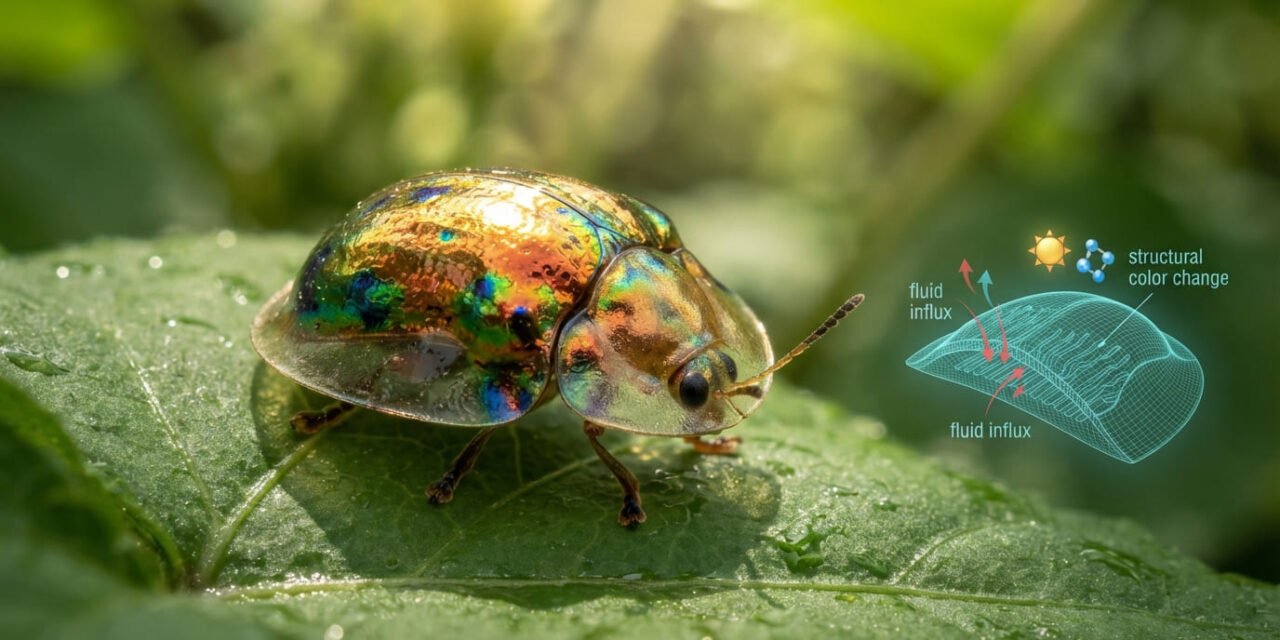
If you are walking through a quiet backyard garden or an open woodland on a warm summer morning, you might spot something shimmering on the underside of a sweet potato leaf. It looks like a tiny, misplaced drop of liquid gold. It is about the size of a single pencil eraser, dome-shaped like a miniature tortoise, and so reflective that you can see your own face in it. It looks like a piece of high-end jewelry that someone dropped in the dirt.
But if you reach out and gently touch this golden dome, something magical happens. Within seconds, the brilliant gold shine begins to fade. It turns into a pale silver, then a warm orange, and finally settles into a dull, matte red with tiny black spots. In under two minutes, the polished gold coin has transformed into what looks like a common ladybug.
This is the golden tortoise beetle (Charidotella egregia). Found throughout the Americas, this tiny insect has fascinated nature lovers and scientists for generations. While many animals can change color to match their surroundings, the tortoise beetle does it using a method that is incredibly rare in the animal kingdom. It does not rely on shifting pigment cells like a chameleon or an octopus. Instead, it uses a built-in liquid plumbing system to control how light bounces off its shell. It is a living mood ring, using the movement of its own body fluids to switch its armor from a perfect mirror to a transparent window.
The Illusion of the Golden Mirror
To understand how the tortoise beetle changes color, you first have to understand why it looks gold in the first place. If you were to grind up a blue jay’s feather, it would turn into a grey powder because its blue color is created by the way light bounces off the microscopic structure of the feather, not by blue paint. The same thing is true for the tortoise beetle. There is absolutely no gold pigment in its shell.
If you look at the beetle’s outer wing covers, called the elytra, under a powerful microscope, you will find that they are made of a tough, transparent material called chitin. This is the same organic material that makes up the shells of crabs and other insects. The shell is not just one solid layer. It is built like an incredibly dense, multi-layered sandwich, consisting of anywhere from twenty to forty microscopic sheets stacked on top of one another.
At the bottom of this stack lies a deep layer of red pigment. But when the beetle is resting and calm, you cannot see this red color at all. That is because the stack of microscopic layers above it is acting like a high-performance mirror.
When sunlight hits the transparent shell, it enters these layers. Because the layers are extremely thin and packed tightly together, the light waves bounce off the different surfaces and collide with one another. When they collide, most colors of the spectrum cancel each other out, but the yellow and orange wavelengths are amplified. The light bounces back to your eyes as a bright, metallic gold. It is a process called structural coloration, and it is the same reason a soap bubble or a patch of oil on a wet road shimmers with different colors.
The Microscopic Water Works
The secret to the beetle’s color-switching trick lies in the spaces between these microscopic layers. The layers are not fused solid; they are separated by tiny, nanometer-sized grooves and channels.
When the tortoise beetle is calm and healthy, its body pumps a clear fluid, called hemolymph, into these microscopic channels. This fluid is the insect version of blood. Because the fluid has the exact same optical properties as the chitin layers themselves, filling the channels with liquid makes the entire stack perfectly uniform and smooth.
Think of it like looking through a frosted glass window. When the glass is dry, the rough, uneven surface scatters the light, and you cannot see through it. But if you rub a thin layer of oil or water onto the frosted glass, the liquid fills in the microscopic valleys. The surface becomes smooth, and suddenly you can see right through the glass.
In the beetle’s case, when the liquid fills the channels, the layers become a perfect, seamless mirror. The light bounces off the wet layers cleanly, creating the brilliant gold reflection. But when the beetle is stressed, touched, or threatened by a predator, its nervous system triggers a change. It quickly draws the fluid out of the shell’s layers, pulling it back into its body.
Without the liquid, the channels empty out. The microscopic spaces collapse or fill with air, and the smooth structure of the mirror is ruined. The light can no longer bounce off the layers cleanly. Instead of acting like a mirror, the shell becomes a transparent window, allowing the light to pass straight through the layers. The light hits the dark red pigment sitting at the very bottom of the stack, and the beetle instantly turns a dull, matte red.
A Two-in-One Defense Strategy
This color-changing trick is not just for show. It is a highly effective survival strategy designed to deal with different types of threats at different distances.
When the beetle is sitting quietly on a leaf in its gold state, it is using a form of passive camouflage. In the hot, humid tropical forests where these beetles live, the leaves are often covered in shiny drops of morning dew or rainwater. When sunlight hits a wet leaf, the dewdrops reflect the light, creating bright, shimmering highlights.
To a hungry bird flying high above, a shiny gold beetle sitting on a leaf looks exactly like a harmless drop of water reflecting the sun. The intense glare of the gold shell disguises the beetle’s outline, allowing it to blend in with the wet vegetation.
However, if a predator gets too close or tries to grab the beetle, the disguise changes. The physical contact triggers the beetle to draw the fluid out of its shell, transforming it into a red bug with black spots.
This sudden shift serves two purposes. First, the rapid change from shiny gold to dull red can startle an approaching predator, giving the beetle a split second to drop off the leaf and escape into the dense undergrowth. Second, the red and black pattern is a classic warning signal in the insect world. Many toxic or foul-tasting insects, like ladybugs, use bright red and black colors to warn birds that they are not safe to eat. By turning red, the harmless tortoise beetle is pretending to be a dangerous, bitter-tasting meal. It is a clever double-bluff: blend in like a raindrop when the enemy is far away, and act like a toxic ladybug if they get too close.
The Shield of the Young
The adult golden tortoise beetle is a master of clean, high-tech optical defense. But its offspring have to rely on a much dirtier, more physical survival strategy.
When the beetle’s eggs hatch, the young larvae do not have the beautiful, color-changing shell of their parents. They are small, soft-bodied, and highly vulnerable to hungry ants, spiders, and bugs. To stay safe, the larvae build a physical defense system called a fecal shield.
The larva has a specialized, flexible structure at its rear end called an anal fork. As the larva grows, it saves its shed skins and mixes them with its own waste material, constructing a dark, spiny umbrella that it carries over its back.
If an ant tries to attack, the larva moves its anal fork forward, waving the smelly, toxic shield in the predator’s face. The shield is highly effective at turning away small predators, acting like a biological shield made of garbage. It is only when the larva pupates and undergoes its final transformation into an adult that it discards this dirty defense and grows the clean, magnificent, liquid-controlled armor.
Lessons from the Goldbug
The golden tortoise beetle is a reminder that some of the most advanced engineering on Earth is happening on the undersides of leaves in our own backyards. It took millions of years for evolution to perfect a material that can change its optical properties in a matter of seconds using nothing but a tiny amount of moisture.
Today, materials scientists and engineers are studying the tortoise beetle to build better human technology. We are trying to copy the beetle’s microscopic liquid channels to design smart windows that can automatically darken or become reflective to keep buildings cool in the summer.
We can also use this design to build advanced sensors that change color when they detect the presence of specific liquids or gases, or to create secure, color-shifting packaging that cannot be easily counterfeited. The tiny beetle has proven that with the right arrangement of microscopic layers and a little bit of water, you can turn a simple insect shell into a high-tech tool for survival.
Final Thoughts
The next time you are in a garden or a park, take a moment to look closely at the leaves of sweet potato plants, morning glories, or wild vines. If you are lucky, you might just spot a tiny speck of gold shining in the sun.
If you see one, remember the incredible journey of change that brought it there. It is an animal that spent its youth carrying a shield of waste, only to grow up into a creature that can manipulate the physics of light with its own breath and blood. It is a living jewel that reminds us that beauty is often a shield, and that sometimes, the best way to stay safe in a dangerous world is to completely change how you reflect the light around you.