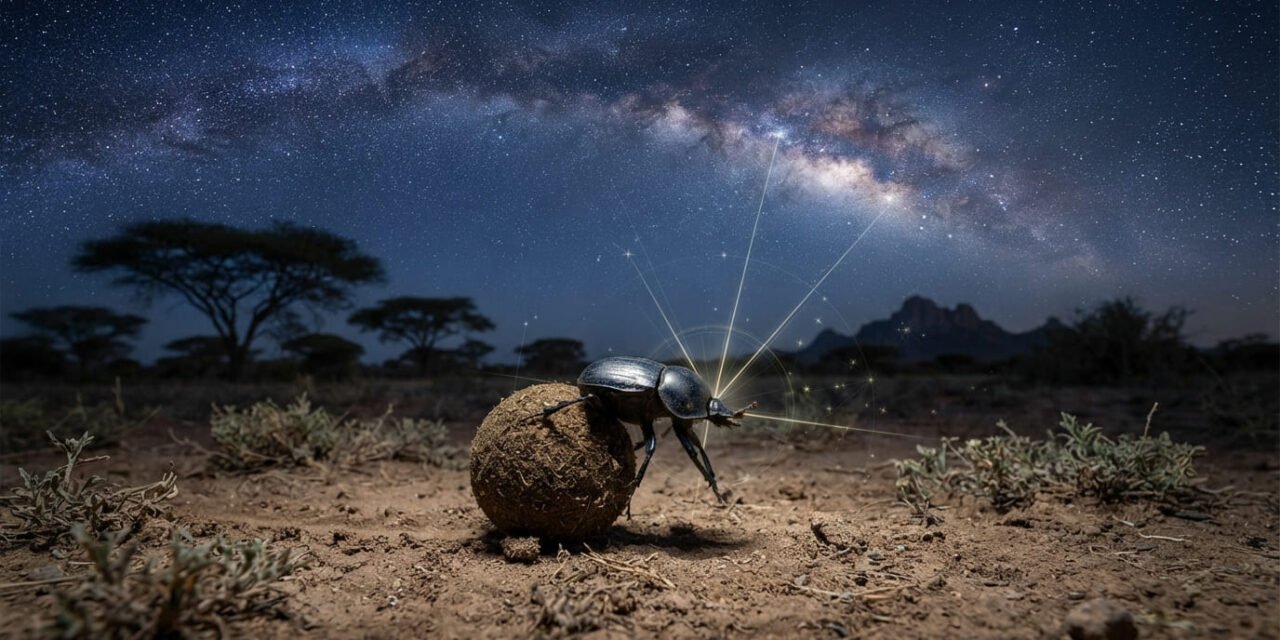
Imagine standing in the middle of the South African bush veldt at midnight. The moon has set, leaving the sky in a deep, inky blackness. Around you, the air is thick with the sounds of nocturnal predators, the rustling of acacia leaves, and the distinct, heavy smell of fresh elephant dung. If you look down at a pile of that dung, you might witness one of the most remarkable acts of navigation on earth. A small, dark beetle, barely the size of a walnut, rolls a perfectly spherical ball of waste across the uneven dirt. It does not wander or drift. It moves in a straight line, steering with a level of accuracy that seems impossible for a creature with a brain the size of a grain of rice.
This is the nocturnal dung beetle (Scarabaeus satyrus). While most animals rely on landmarks like trees, rivers, or mountains to find their way, this insect ignores the earth entirely. On moonless nights, when the landscape is too dark to see, the dung beetle looks up. It uses the glowing stripe of the Milky Way galaxy as its compass. It is the first animal in the world proven to navigate using the vast, diffuse light of our galaxy.
The Poop Rush: Why Straight Lines Matter
To understand why a dung beetle needs to be an expert navigator, you have to understand the brutal reality of the dung pile. When a large herbivore like an elephant or a rhino leaves a fresh deposit on the savannah, it triggers a biological gold rush. Within minutes, thousands of dung beetles descend on the pile. The air becomes thick with buzzing wings and frantic legs. Every beetle wants a piece of the prize because dung is their only source of food and the nursery for their future offspring.
The competition is chaotic. Beetles fight, bite, and push each other to claim a portion of the pile. Once a beetle manages to carve out a chunk of dung and roll it into a neat ball, its priority changes instantly. It must get away from the pile as fast as possible.
If the beetle lingers near the main pile, other beetles will try to steal its hard-earned ball. The most efficient way to escape this zone of chaos is to move in a straight line. If the beetle travels in a straight line, it moves away from the danger in the shortest possible distance and time. If it walks in a curve or a loop, it risks winding up right back at the pile, where its ball will be stolen by aggressive rivals.
But walking in a straight line is incredibly difficult when you are pushing a heavy ball backward with your hind legs while your head is pointing down toward the dirt. The beetle cannot see where it is going. It is essentially walking in reverse, blind to the road ahead. To maintain its course, it needs a reliable compass.
The Orientation Dance
Before a dung beetle begins its journey, it performs a behavior that puzzled biologists for decades. Once it finishes shaping its ball, the beetle climbs on top of the sphere. It stands on the summit of its prize and performs a brief, spinning dance, turning in circles before climbing down and pushing the ball away.
For a long time, people thought the beetle was simply showing off or checking for predators. But research has shown that this “dance” is a vital navigation procedure. While on top of the ball, the beetle is taking a snapshot of the sky. It rotates its body to locate the available light sources and align its internal compass.
The beetle’s eyes are sensitive to the polarization of light. Even when the sun or moon is not visible, the light bouncing through the atmosphere creates a pattern of polarized light that the beetle can detect. During its dance, the beetle reads this pattern and decides on a direction. Once it commits to a heading, it climbs down and starts rolling. If the beetle hits an obstacle, like a thick tuft of grass or a deep hoofprint, and loses its footing, it will climb back on top of the ball and perform the dance again to recalibrate its path.
The Planetarium Experiment
The discovery of the dung beetle’s celestial compass is the result of a series of clever experiments conducted by a team of Swedish and South African researchers, led by Professor Marie Dacke. They wanted to know how these insects could roll in straight lines on moonless nights when there was no obvious light source to guide them.
The researchers set up a circular arena with a flat dirt floor in South Africa. They placed a dung pile in the center and timed how long it took the beetles to roll their balls to the outer edge, which was about four feet away. On clear, starry nights, the beetles reached the edge in about 40 seconds, moving in straight lines.
To test if the stars were the key, the team placed tiny cardboard caps on the beetles’ heads. These caps acted like visors, blocking the insects’ view of the sky but allowing them to see the ground. With their view of the stars blocked, the beetles began to wander aimlessly. They looped and turned, taking over two minutes to reach the edge of the circle, if they made it at all.
Next, the researchers took the beetles to a planetarium in Johannesburg. This allowed them to control the night sky. When they projected a full starlit sky onto the dome, the beetles navigated perfectly. But the real surprise came when they turned off all the individual stars and left only the diffuse, glowing band of the Milky Way. The beetles rolled their balls in straight lines just as fast as they did under a full sky.
When the researchers did the opposite—turning off the Milky Way and leaving on only a few of the brightest individual stars—the beetles lost their way. This proved that the insects were not tracking individual stars like ancient human sailors did. Instead, they were using the collective, glowing stripe of the galaxy as a directional guide.
Low-Resolution Eyes with High-Sensitivity
The reason dung beetles use the Milky Way rather than individual stars has to do with the design of their eyes. An insect’s compound eye is made of thousands of tiny lenses. While these eyes are excellent at detecting motion and polarized light, they have very low resolution. To a dung beetle, the night sky does not look like a collection of sharp, twinkling points of light. It looks like a blurry smear of dark and light zones.
Because individual stars are too dim and sharp for their lenses to resolve, the beetles cannot use them for tracking. However, the Milky Way is a massive, continuous band of light that stretches across the sky. To the beetle’s low-resolution vision, this band appears as a bright, glowing highway against a dark background.
This is a beautiful example of evolutionary efficiency. The beetle does not need a complex brain or high-definition vision to process thousands of separate stars. It only needs to detect the contrast between the glowing band of our galaxy and the dark space around it. This simple system is robust, requires very little energy, and works even when the atmosphere is slightly hazy.
The Heat of the Ball: Multi-Sensory Backups
Navigation is not the only problem a dung beetle faces on the African plains. The ground can get incredibly hot, especially during the day. While nocturnal beetles avoid the worst of the sun, the soil can still retain enough heat to damage their delicate legs.
To survive this, dung beetles have developed a secondary use for their dung balls. When a beetle’s feet get too hot, it climbs onto its ball and rubs its face and front legs against the moist dung. The moisture in the dung evaporates into the dry air, which cools the ball down. The ball acts as a portable air conditioning unit. By climbing onto the ball, the beetle can cool its body down by several degrees before climbing back down to continue its run.
This behavior shows how closely connected the beetle is to its prize. The ball is its food, its nursery, its air conditioner, and the platform for its celestial dance. Every aspect of the beetle’s biology is designed to maximize the utility of this single sphere.
Lessons for Human Technology
You might wonder why scientists spend so much time watching beetles roll poop in the dark. The answer lies in the future of human technology. Modern robots and self-driving cars rely on heavy, expensive computers and cameras to navigate their surroundings. They have to process gigabytes of visual data every second to avoid hitting walls or getting lost.
This approach requires a massive amount of power. A drone, for example, can only fly for a short time before its battery dies, partly because its computer is working so hard to process its flight path.
The dung beetle solves the navigation problem using a nervous system that runs on almost zero energy. By studying how the beetle’s brain combines simple light cues, wind direction, and internal memory, roboticists are learning how to build smarter, lighter machines. We can build autonomous drones that navigate using simple light gradients rather than complex maps. The beetle proves that you do not need a supercomputer to find your way in the dark; you just need to know how to read the sky.
Final Thoughts
The dung beetle is a reminder that we should never judge a creature by its lifestyle. It is an insect that spends its entire existence searching for the waste of other animals, yet it is guided by the light of a hundred billion stars. It links the lowest dirt of the earth to the highest peaks of the cosmos.
When you look up at the Milky Way on a clear summer night, remember the beetle. Remember that while we use the stars to ponder our place in the universe, a tiny insect on the African plains is using that same light to get its dinner home. It is a quiet masterpiece of natural design, proving that even in the darkest, most competitive environments, there is always a way to find a straight path forward.