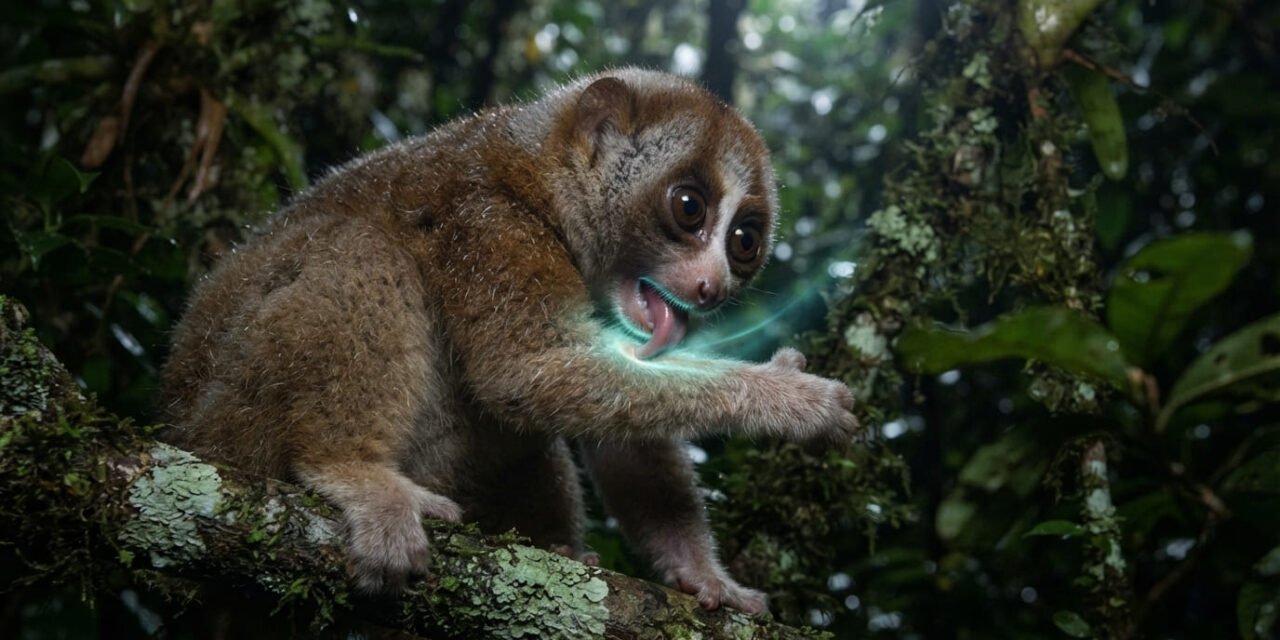
If you spend any time on social media, you have probably seen a video of a slow loris. It is a tiny primate with massive, golden eyes, a round head, and soft, thick fur. In these videos, they often look like living plush toys. You might see one holding a tiny umbrella or raising its arms while a human tickles its belly. It looks incredibly cute. But behind those innocent eyes lies one of the most bizarre and dangerous defense systems in the mammal world. The slow loris is the only known venomous primate on Earth. If you get too close, that adorable face can deliver a bite that causes flesh to rot, muscles to waste away, and humans to go into life-threatening shock.
The slow loris (Nycticebus) lives in the dense, humid rainforests of Southeast Asia. It is a nocturnal creature that moves slowly and deliberately through the canopy. Because it cannot run away quickly like a monkey or fight back with massive claws, it had to find another way to defend itself. It solved this problem by turning its own body into a chemical weapons factory. But it does not produce venom in its mouth. To arm its bite, the slow loris has to perform a strange ritual: it must lick its own elbows.
The Chemistry of the Elbow Secretion
The process of creating the venom starts in the crook of the slow loris’s inner arm. Here, near the elbow, the animal has a specialized sweat gland called the brachial gland. This gland constantly secretes a clear, oily fluid. On its own, this fluid is relatively harmless. It has a strong, musky smell that the loris uses to mark its territory, but it is not toxic.
To activate the weapon, the slow loris must mix this oil with its own saliva. When the loris licks its elbow, the chemical compounds in the oil combine with the enzymes in its mouth. This chemical reaction creates a highly toxic, active venom.
Scientists who studied the chemical structure of this venom found a surprising connection to domestic cats. The main protein in the slow loris’s brachial secretion is almost identical to Fel-d1, the protein in cat saliva and dander that triggers cat allergies in humans. In the slow loris, this protein is highly concentrated and paired with other active compounds. When it mixes with the loris’s saliva, it becomes a severe allergen that acts as a potent toxin.
This mixture is highly volatile. It evaporates quickly, carrying the sharp, toxic scent through the air. For a predator with a sensitive nose, simply sniffing a slow loris can be enough to cause irritation and breathing difficulties.
The Toothcomb: A Living Syringe
Once the venom is activated in the mouth, the slow loris needs a way to inject it. It does not have hollow fangs like a snake. Instead, it has a specialized dental structure called a toothcomb.
The toothcomb is located at the front of the lower jaw. It consists of the incisors and canine teeth, which are long, narrow, and crowded tightly together. They point forward like the teeth of a hair comb. Wombats and lemurs use similar structures for grooming their fur or scraping tree bark. The slow loris uses its toothcomb as a delivery system for its venom.
When the slow loris licks its arm and activates the toxin, the venomous saliva fills the narrow gaps between these teeth through capillary action. The saliva clings to the grooves of the toothcomb, turning the front of the mouth into a series of tiny, poison-tipped needles.
When the loris bites, the toothcomb punctures the skin of the victim, and the venom flows directly into the wound. Because the teeth are so thin and sharp, they can easily bypass thick fur or skin to deliver the toxin deep into the muscle tissue.
The Festering Damage of a Loris Bite
The effects of a slow loris bite are horrific. In other slow lorises, a bite wound does not heal like a normal cut. The venom destroys the surrounding cells, leading to a condition called necrosis. This is where the tissue dies and rots while the animal is still alive.
A bite wound often becomes a festering, painful sore that gets infected and spreads across the body. In the wild, fights between slow lorises often result in permanent scarring, loss of ears, or slow, painful deaths from these non-healing wounds.
For humans, the danger is even more immediate. A bite from a slow loris is an immunological emergency. Because the venom is closely related to a severe allergen, it triggers an immediate and massive allergic reaction in many people. Within minutes of a bite, a human can experience extreme swelling, difficulty breathing, and a drop in blood pressure.
In severe cases, the victim goes into anaphylactic shock. This is a condition where the throat swells shut, and the heart can stop beating. A retrospective study of medical records in Asia showed that nearly half of the patients who arrived at hospitals with slow loris bites required emergency treatment for severe allergic shock rather than basic wound care.
Why Make Venom? The Battle for Territory
You might expect a venomous animal to use its weapon to catch food. Snakes use venom to paralyze mice, and spiders use it to liquefy insects. But the slow loris does not use its venom for hunting. It is a slow, patient browser that eats fruit, tree sap, insects, and small lizards. It can catch these animals easily without needing to paralyze them first.
Instead, the primary use of the venom is against other slow lorises. They are highly territorial animals that do not tolerate rivals. During the mating season, males and females will fight viciously to defend their trees. The venom is their main weapon in these territorial disputes. It is a way to inflict permanent, debilitating damage on competitors to ensure they do not return.
The slow loris also uses the venom to protect its offspring. When a mother slow loris must leave her baby to go find food, she licks her own elbows to gather a fresh dose of venom. She then grooms her baby, covering its fur in the toxic mixture.
If a predator like an owl or a civet finds the baby while the mother is away, the predator is met with a mouthful of bitter, toxic fur. This chemical shield is highly effective at keeping the defenseless babies safe during the most vulnerable weeks of their lives.
The Cobra Mimic
The slow loris’s defense system goes beyond its toxic bite. Some scientists believe that the slow loris evolved to mimic one of the most feared reptiles in Asia: the spectacled cobra.
When a slow loris is threatened, it does not cower or run. It stands on its hind legs and raises its arms above its head, clasping its hands together. In this position, the loris’s upraised arms, combined with the dark markings around its eyes and down its back, look remarkably like the expanded hood of an angry cobra.
To make the illusion even more convincing, the slow loris can hiss. It produces a deep, breathing sound that is almost identical to the warning hiss of a cobra. It also has an extra vertebra in its spine, which allows its body to twist and undulate in a serpentine fashion.
During the Miocene epoch, about eight million years ago, a shift in climate replaced many of Southeast Asia’s dense tropical forests with open, savanna-like woodlands. This forced the slow loris to spend more time on the ground, where it was exposed to new predators. Mimicking a cobra,a snake that most forest animals avoid at all costs, would have been an incredibly effective way to stay safe in the open grass.
The Tragedy of the Pet Trade
The very traits that make the slow loris so unique have also put the species in extreme danger. The viral videos of “cute” lorises have fueled a massive illegal pet trade. People see these animals on the internet and want to keep them in their homes, unaware of the reality of their biology.
To make the slow loris safe for humans to touch, poachers perform a cruel and painful procedure. They use wire cutters or pliers to pull out the animal’s sharp toothcomb without any anesthesia. This destroys the loris’s primary defense system and often leads to severe dental infections, blood loss, and death. Even if the animal survives, it can no longer eat its natural diet of insects and tree sap, and it is prone to malnutrition.
Furthermore, the “tickling” videos that look so cute are actually depictions of animal cruelty. When a slow loris raises its arms during tickling, it is not enjoying the contact. It is entering its “venom pose.” It is trying to reach its brachial glands to activate its venomous bite because it is terrified. The animal is in a state of extreme stress, freezing in place because it has no other way to escape.
Final Thoughts
The slow loris is a reminder that nature does not care about our standards of cuteness. It is a creature that has survived for millions of years by turning its own sweat and spit into a toxic shield. Its big eyes and slow movements are not designed to be adorable; they are tools for a nocturnal life in the high canopy.
When you look at a slow loris, do not see a pet. See a master of chemical defense. See a primate that can crush its rivals with a toxic bite and scare off predators by acting like a cobra. It is a complex, delicate, and dangerous survivor that deserves to be left alone in the forests where it belongs.