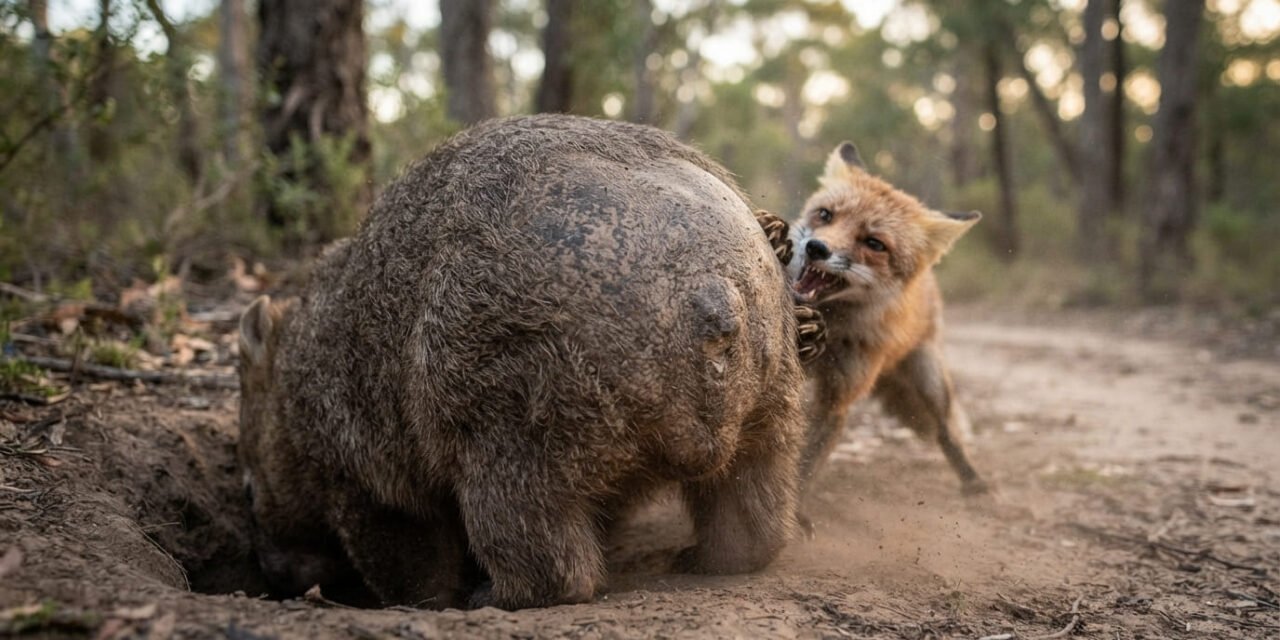
You might look at a wombat and see a slow, fuzzy mammal. It has a round body and short legs. It looks like it would be easy prey for a dingo or a fox. This is a mistake. The wombat is a biological tank. It lives in the Australian bush and survives by using a specific set of physical tools. Its most effective tool is its rear end. While most animals defend themselves with teeth or claws, the wombat uses a reinforced plate of cartilage on its backside to stay alive.
The wombat is a marsupial and the largest burrowing mammal on the planet. There are three species: the Common Wombat, the Southern Hairy-nosed Wombat, and the Northern Hairy-nosed Wombat. They spend most of their lives building and maintaining tunnels. These tunnels can reach 30 meters in length. Because the wombat is a subterranean specialist, its greatest threat comes from predators that follow it into its hole. To handle this, the wombat evolved a rear end that acts as a door and a weapon.
The Anatomy of the Cartilage Shield
The back of a wombat is not soft. Beneath the skin and fur of its rump lies a thick plate made of cartilage and bone. In a mature adult, this shield is up to 5 centimeters thick. It is extremely hard and lacks significant nerve endings. When a predator like a dingo bites the rear of a wombat, its teeth hit a surface that feels like a wooden board. The predator cannot get a grip. It cannot puncture the skin to reach vital organs.
The wombat has almost no tail. Evolution removed the tail to get rid of a vulnerability. Predators often grab tails to pull animals out of burrows. The wombat has a tiny nub hidden under its armored plate. This ensures there is nothing for a hunter to latch onto. When a wombat senses a threat, it runs into its burrow and blocks the entrance with its rear. The smooth, hard surface fills the diameter of the tunnel. The predator is left staring at a wall it cannot bite or scratch.
The Mechanics of the Skull Crush
The armored rear is not just for blocking. The wombat uses it for a lethal maneuver often called a “bum-crunch.” This happens when a predator sticks its head into the tunnel to try and find a way around the shield. The wombat reacts with extreme force. It lowers its head and front legs to the floor of the tunnel. Then it uses its powerful hind legs to thrust its armored rump upward against the roof of the burrow.
If the predator’s head is caught between the wombat’s cartilage plate and the hard dirt ceiling, the bones in the predator’s skull will break. The wombat can deliver enough force to crush the jaw or snout of a fox. This is a calculated strike. The wombat uses the leverage of the tunnel walls to maximize the impact. Many predators that survive an encounter with a wombat leave with shattered bones and never return to that burrow.
The Science of Cubic Waste
While the rump keeps the wombat safe, its waste products have made it a subject of intense scientific study. The wombat is the only animal in the world that produces cube-shaped droppings. It produces between 80 and 100 of these cubes every night. For years, people thought the wombat had a square-shaped exit. This is incorrect. The shape is formed by the intestines.
In 2018, researchers used a physical model to understand this process. They found that the final 8 percent of the wombat’s intestine has unique properties. Most mammal intestines expand and contract evenly. The wombat’s intestine has two stiff regions and two flexible regions. As the waste moves through, the stiff sections resist stretching while the flexible sections expand. This creates flat sides on the waste.
You should care about this because it serves a practical purpose. Wombats are territorial. They use their droppings to mark the boundaries of their home. They place their waste on high ground, like rocks or fallen logs, so the scent travels further. If the droppings were round, they would roll off. The cubes stay exactly where the wombat puts them. This is a biological way to mark a property line without needing to be physically present.
Digging Power and Metabolism
A wombat is built for manual labor. Its claws are wide and flat like shovels. Its muscles are concentrated in its shoulders and hips. A wombat can move several tons of dirt in a single year to build its home. These burrows are essential for the survival of other species. During Australian bushfires, the temperature inside a deep wombat burrow stays cool and stable. Animals like lizards, wallabies, and birds use these tunnels as fire shelters. The wombat provides a service to the entire community by building these underground networks.
Digging requires a massive amount of energy. To compensate, the wombat has a very slow metabolism. It can take up to 14 days to digest one meal. It eats tough, fibrous grasses that other animals cannot process. This slow digestion allows the wombat to stay inside its burrow for long periods. It reduces the amount of time the animal spends in the open, where it is vulnerable to hunters.
Speed and Physical Force
Do not assume a wombat is slow because it is round. If a wombat is threatened in the open, it can run at 40 kilometers per hour for short bursts. This is faster than a human sprinter. It uses this speed to reach the safety of its burrow. Once it gets inside, it turns around and presents its shield.
The animal is also very strong. A Common Wombat can weigh up to 35 kilograms. If it decides to move an object, it uses its entire body weight as a ram. They have been known to knock down fences and move heavy rocks that get in the way of their tunnels. This raw physical force is what makes their “bum-crunch” maneuver so effective. They are not just pushing; they are striking with the weight of a solid brick.
Social Behavior and Territorial Marking
Wombats live solitary lives. They do not share their burrows with other wombats. They use their sense of smell to communicate. The cubic droppings are the primary way they tell others to stay away. By sniffing a cube, a wombat can determine the sex and health of the animal that left it. This reduces the need for physical fights.
If a fight does happen, it usually involves pushing. Wombats will use their armored rears to shove an intruder out of a tunnel. They also use vocalizations like deep grunts and hisses. These sounds warn other wombats that a specific tunnel is occupied. Most of their social life happens in the dark, and it is governed by the placement of their square waste.
Threats and Conservation
Wombats face serious threats from human activity and disease. Cars are a major cause of death. Because wombats are low to the ground and move at night, they are hard for drivers to see. They are solid animals, and hitting one can cause significant damage to a vehicle. Another major threat is sarcoptic mange. This is a skin disease caused by parasitic mites. It causes the wombat to lose its hair and develop thick, painful crusts on its skin. If it is not treated, the wombat will die.
You can help by being aware of wildlife during dawn and dusk hours when wombats are most active. Many local groups in Australia work to treat wild wombats for mange. The Northern Hairy-nosed Wombat is particularly vulnerable. It is one of the rarest animals on earth. At one point, the population dropped to only 35 individuals. Because of strict protection and habitat management, the numbers have grown to over 300.
Final Observations
The wombat is a reminder that strength comes in many forms. It does not have the speed of a cheetah or the size of an elephant. It has a hard rear end and a square gut. It used these tools to survive for millions of years in a harsh environment.
When you see a wombat, you are looking at a master of defensive engineering. The cartilage plate is a perfect shield. The cubic waste is a perfect marking tool. The digging claws are perfect shovels. The wombat is a resilient and essential part of the wild. It has turned its own body into a fortress and its waste into a territorial boundary. It is an animal that knows exactly how to hold its ground.