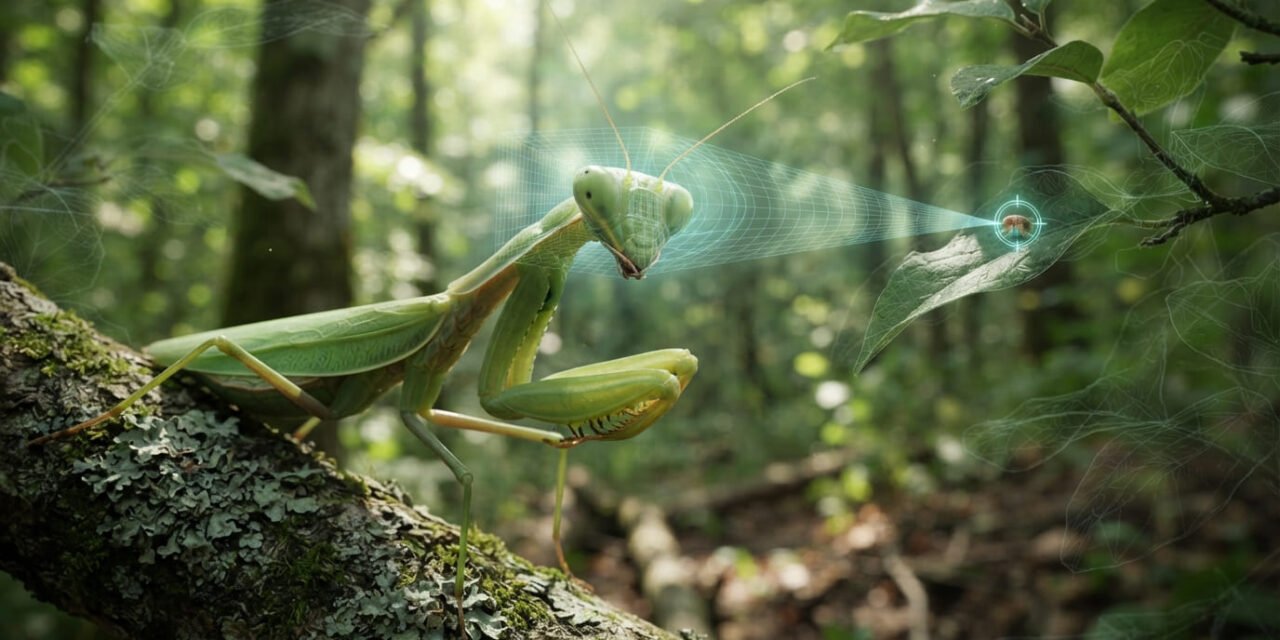
You have probably stared at a praying mantis and felt like it was staring right back at you. Most insects have eyes on the sides of their heads that don’t seem to focus on anything specific. The mantis is different. It pivots its triangular head and tracks your movement with a precision that feels almost human. This isn’t your imagination. The praying mantis is the only insect in the world known to see in three dimensions. While you use depth perception to catch a ball or drive a car, the mantis uses it to time a lethal strike that happens in a fraction of a second.
The mantis has two large compound eyes that dominate its head. These eyes are packed with up to 10,000 individual light sensing units called ommatidia. In the center of these eyes is a specialized area called the fovea. This is the insect version of high definition. When a mantis spots a fly, it turns its head so the image of the prey falls directly on the fovea of both eyes. This overlapping view is the secret to its 3D vision, or stereopsis.
The Science of 3D Vision
Human 3D vision works by comparing the slightly different images from your left and right eyes. Your brain looks at the details and textures to figure out how far away an object is. Mantis vision works on a completely different principle. They don’t care about the details or the texture of a static object. They only care about movement.
In 2016, researchers at Newcastle University conducted a famous experiment to prove this. They created tiny 3D glasses for mantises using beeswax to attach the lenses. They showed the insects 3D movies of moving dots. The mantises tried to strike at the dots that appeared to be floating in front of them. This proved they were seeing in 3D.
However, when the researchers showed them static 3D images, the mantises ignored them. This is because mantis stereopsis is based on motion. Their brains look for changes in light and shadow over time. If an object isn’t moving, it is invisible to their 3D sense. This is an incredibly efficient way to process data. It allows a brain smaller than a grain of rice to perform complex depth calculations that would normally require a much larger nervous system.
Strike Mechanics and Speed
You should care about mantis vision because it powers one of the fastest movements in the animal kingdom. Once the mantis uses its 3D vision to confirm that a target is within reach, it launches its raptorial forelegs. This strike takes about 30 to 50 milliseconds. To put that in perspective, a human eye takes 100 milliseconds to blink. By the time you see the mantis move, the prey is already caught.
The mantis uses its depth perception to decide exactly when to strike. If it strikes too early, it misses and alerts the prey. If it waits too long, the prey might fly away. The 3D vision provides a “kill zone” map. As soon as the prey crosses the invisible line into that zone, the nervous system triggers the legs.
The forelegs are equipped with sharp spines that interlock like a trap. The mantis doesn’t just grab the prey; it impales it. Because the strike is so fast and accurate, the mantis can catch flies, moths, and even small hummingbirds or frogs. It relies on the absolute certainty provided by its 3D eyes.
A Three Hundred Degree Field of View
While the fovea provides high definition 3D vision in the front, the rest of the compound eye provides a massive field of view. A mantis can see about 300 degrees around its body. It has almost no blind spots. This is vital for a creature that is both a predator and a target. While it tracks a fly in 3D, it uses its peripheral vision to watch for birds or lizards that might want to eat it.
You might notice a dark spot in the eye of a mantis that looks like a pupil. This is called a pseudopupil. It isn’t a real pupil like yours. It is an optical illusion caused by the way the ommatidia absorb light. The spot appears to move as you move, making it look like the mantis is always watching you. This allows the mantis to monitor its environment without moving its head and giving away its position.
Efficient Brain Processing
The way a mantis processes 3D images is much simpler than the way humans do it. Human brains have to match up millions of pixels from two different images. This takes a lot of energy and brainpower. The mantis’ brain only looks at the points of the image where the brightness is changing.
This “change detection” system is so efficient that computer scientists are studying it to build better robots. We can use the mantis model to create 3D vision for drones or self driving cars that use very little electricity. The mantis proves that you don’t need a massive computer to navigate a complex 3D world. You just need the right algorithm.
The Role of Camouflage and Patience
Vision is only half of the mantis’s strategy. The other half is staying invisible. Most mantises are shaped like leaves, sticks, or flowers. They spend hours sitting perfectly still. This is where their motion based 3D vision becomes a huge advantage. Because they are stationary, any movement in their field of view stands out immediately.
When a mantis moves, it often sways back and forth. This looks like a leaf blowing in the wind, but it also serves a visual purpose. This swaying movement, called “peering,” provides the eyes with different angles of the same object. This helps the mantis gather more 3D data before it decides to strike. It is a physical way to enhance its depth perception.
Hunting in Different Light
The mantis can adjust its vision based on the time of day. During the day, their eyes are often light green or tan. At night, their eyes turn a dark, chocolate brown. This color change is caused by pigments moving within the eye to allow more light to hit the sensors.
Even in low light, the 3D vision remains functional. Many mantis species are active at night and can catch moths in near total darkness. They use their 3D sense to track the flutter of a wing against the stars. This flexibility makes them effective hunters 24 hours a day.
Why the Mantis Matters to You
You should care about the praying mantis because it is a biological guardian of your garden. They are generalist predators that eat almost any pest that moves. They eat aphids, caterpillars, and grasshoppers that destroy your plants. They do this without the need for toxic chemicals or human intervention.
They are also a reminder that there is more than one way to see the world. We often assume that our way of seeing in 3D is the “correct” way. The mantis shows us that a different, simpler system can be just as effective. It is a masterpiece of mini engineering that has been refined over 150 million years.
Final Observations
The praying mantis is a mechanical marvel hidden in a green body. It combines the patience of a statue with the speed of a bullet. Its 3D vision is the core of its success. It allows a small insect to act with the calculated intent of a much larger predator.
When you see a mantis in your yard, take a moment to look at its eyes. You are looking at 10,000 lenses working together to create a 3D map of the world. You are looking at an animal that uses motion to measure distance and speed to guarantee its next meal. It is a silent, high tech hunter that has mastered the art of seeing in three dimensions.