
In the murky, slow-moving waters of Southeast Asia, survival is usually a race of speed and reaction times. For a small fish, safety depends on a split-second decision made by a highly specialized bundle of nerves. When a predator lunges, the water shifts, pressure waves ripple through the pond, and the fish instantly shoots in the opposite direction. It is a simple, elegant system that has kept aquatic prey alive for hundreds of millions of years.
But one predator has found a way to turn this life-saving reflex against the fish.
The tentacled snake, Erpeton tentaculatum, is a unique aquatic reptile that lives in the freshwater swamps, sluggish rivers, and flooded rice paddies of Thailand, Vietnam, and Cambodia. At first glance, it does not look like a master hunter. It is small, rarely growing past 3 feet in length, and spends most of its time mimicking a water-logged branch. It moves slowly, breathes air, and possesses two bizarre, fleshy appendages protruding from its snout.
These tentacles are not stingers, and they are not lures. Instead, they are highly sensitive tools designed to map out a dark, muddy world. More importantly, they are part of a predatory strategy that is as much about psychological warfare and neurological hijacking as it is about physical speed.
To understand how the tentacled snake hunts, you first have to understand the mind of its prey.
The Neurology of the Escape
When a fish is threatened, it does not stop to think. If it had to process the sight of a predator, decide which way to turn, and then signal its muscles to move, it would already be dead. The delay of sensory processing in the brain is simply too slow for survival.
To bypass this delay, fish rely on a hardwired escape mechanism called the C-start reflex.
Deep inside the fish’s brain stem are two giant neurons called Mauthner cells. Each cell controls one side of the fish’s body. These cells are connected directly to the fish’s lateral line, a system of sensory organs running along its flanks that detects microscopic changes in water pressure.
When a sudden pressure wave hits the left side of the fish, the right Mauthner cell fires instantly. This electrical impulse travels down the spinal cord, bypassing the conscious brain entirely. It causes all the muscles on the right side of the fish’s body to contract at once. The fish bends violently into a tight “C” shape, pulling its head away from the source of the pressure. An instant later, its tail sweeps back, launching the fish forward and away from danger.
This entire process occurs in about 5 to10 milliseconds. It is one of the fastest reflex loops in the animal kingdom. Because it is involuntary, the fish cannot choose to ignore it. If the pressure wave comes from the left, the fish must turn to the right.
This reflex is normally foolproof. But the tentacled snake has spent millions of years studying the code of this biological software, and it has found a devastating glitch.
Setting the Hook
The tentacled snake does not chase fish. In the muddy, vegetation-choked waters of its habitat, chasing a fast, agile fish is a waste of precious energy. Instead, the snake relies on stillness and positioning.
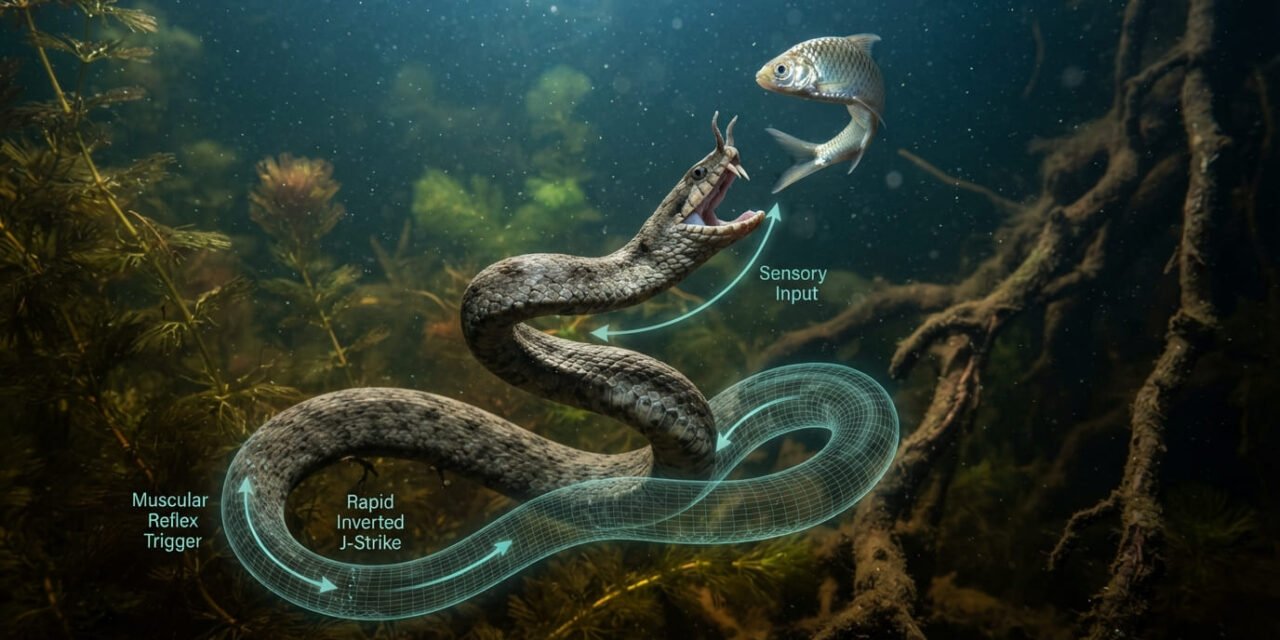
When hunting, the snake anchors its tail to a submerged root or plant stem and drapes its body into a very specific shape. It bends its neck and upper body into a curve that resembles the letter “J” or a fishing hook. The snake remains completely motionless, blending in with the surrounding debris.
Its tentacles, extended forward, feel the subtle vibrations of the water. They tell the snake exactly where a target is, even in pitch-black darkness or thick mud.
Eventually, an unsuspecting fish swims into the curved space inside the “J.” This is the danger zone.
An ordinary snake would strike directly at the fish. But an ordinary strike would create a pressure wave as the snake’s head moved through the water. The fish’s lateral line would detect this wave, the Mauthner cells would fire, and the fish would shoot away, escaping the jaws.
The tentacled snake does something entirely different. It does not start the strike with its mouth.
Instead, it twitches a section of its body located on the opposite side of the fish’s head.
This twitch is tiny, but it is enough to send a sharp pressure wave through the water. To the fish’s lateral line, this wave feels like a massive, incoming threat from the open side of the curve. The fish’s brain registers danger on its flank.
Its Mauthner cells fire. The muscles contract. The fish performs a perfect, lightning-fast C-start.
And because of the direction of the pressure wave, the fish launches itself directly into the path of the snake’s waiting mouth.
The Predictive Strike
This is where the genius of the hunt truly reveals itself.
The tentacled snake does not react to the fish’s movement. If the snake waited to see where the fish went before striking, it would be too slow. The escape reflex of the fish is faster than the visual processing speed of the snake.
Instead, the snake’s strike is entirely predictive.
When the snake twitches its body to trigger the fish’s escape, it already knows exactly where the fish will go. It has calculated the trajectory of the C-start in advance. As it triggers the false alarm with its body, the snake launches its head toward the empty space where the fish will be in 20 milliseconds.
Biologists studying this phenomenon in laboratory settings have used high-speed cameras to capture the interaction. The footage reveals an astonishing sequence. The snake’s mouth begins moving toward the landing zone before the fish has even finished turning. In many cases, the fish literally swims headfirst into the open jaws of the snake.
It is a tragedy of evolutionary design. The very reflex that evolved to save the fish is the exact mechanism that seals its fate. The fish does not make a mistake. It does exactly what its biology designed it to do. It simply has no choice.
Innate Math and Early Learning
This level of predictive hunting requires a staggering amount of sensory integration. The snake must assess the position of the fish, calculate the distance, determine which side of the fish to startle, and aim its strike at a point in empty space.
For a long time, researchers wondered if this was a learned behavior. Did young snakes have to miss hundreds of fish before they figured out how to aim ahead of their prey?
To find out, scientists tested newborn snakes that had never seen a live fish before.
The results were clear. From the very first hour of their lives, the baby snakes used the exact same predictive strategy. When a fish swam into the curve of their body, the newborns twitched, triggered the C-start, and aimed their heads at the future location of the fish.
The math is hardwired into their genetics. Just as the fish is born with a physical reflex to run, the snake is born with a cognitive reflex to intercept. It is a clean, genetically encoded counter-strategy.
However, the snakes do show an ability to refine their technique. While newborn snakes occasionally make minor errors in timing, mature snakes are incredibly efficient. They learn to adjust their predictions based on the size of the fish, as larger fish have slightly slower reaction times and wider turning radiuses than smaller ones. Over time, the snake’s internal calculations become incredibly precise.
The Limits of the Trap
No predatory strategy is completely flawless, and the tentacled snake does face challenges.
If a fish enters the snake’s strike zone at an odd angle, or if it is already moving quickly, the pressure wave from the snake’s body might not trigger the reflex correctly. If the fish fails to perform the C-start, the snake’s strike will miss entirely, because the snake has aimed at empty space rather than the fish’s current position.
To prevent this, the snake is highly selective about when it initiates the trick. It waits until the fish is in the optimal position, parallel to its neck and within the sweet spot of the curve. If the alignment is off, the snake simply waits, pretending to be a stick, relying on its camouflage to keep it hidden until the perfect moment arrives.
The tentacled snake reminds us that nature does not always favor the strongest or the fastest. Sometimes, the most successful predator is the one that understands its prey’s instincts better than the prey understands itself. By turning a life-saving reflex into a predictable trap, this quiet reptile of the Southeast Asian swamps has claimed a unique, fascinating niche in the evolutionary story.