For a long time, we believed that humans were the only creatures on earth that knew how to use fire. We thought that rubbing sticks together or striking flint was the dividing line between us and the rest of the animal kingdom. But if you spend any time in the northern territories of Australia during the dry season, you will see a bird that proves us wrong. The Black Kite, along with a few of its relatives, has figured out that fire is not just something to run away from. It is a tool.
In the Australian Outback, wildfires are a natural part of the cycle. When the grass gets waist-high and bone-dry, a single lightning strike can set miles of land ablaze. Most animals panic. They smell the smoke and bolt for the horizon. But the Black Kite does the opposite. It flies toward the smoke. It has learned that fire is a dinner bell.
The Buffet in the Flames
A wildfire creates a “killing zone” at its edge. As the flames move through the grass, they flush out thousands of small creatures. Mice, lizards, grasshoppers, and snakes are forced to leave their hiding spots and run into the open.
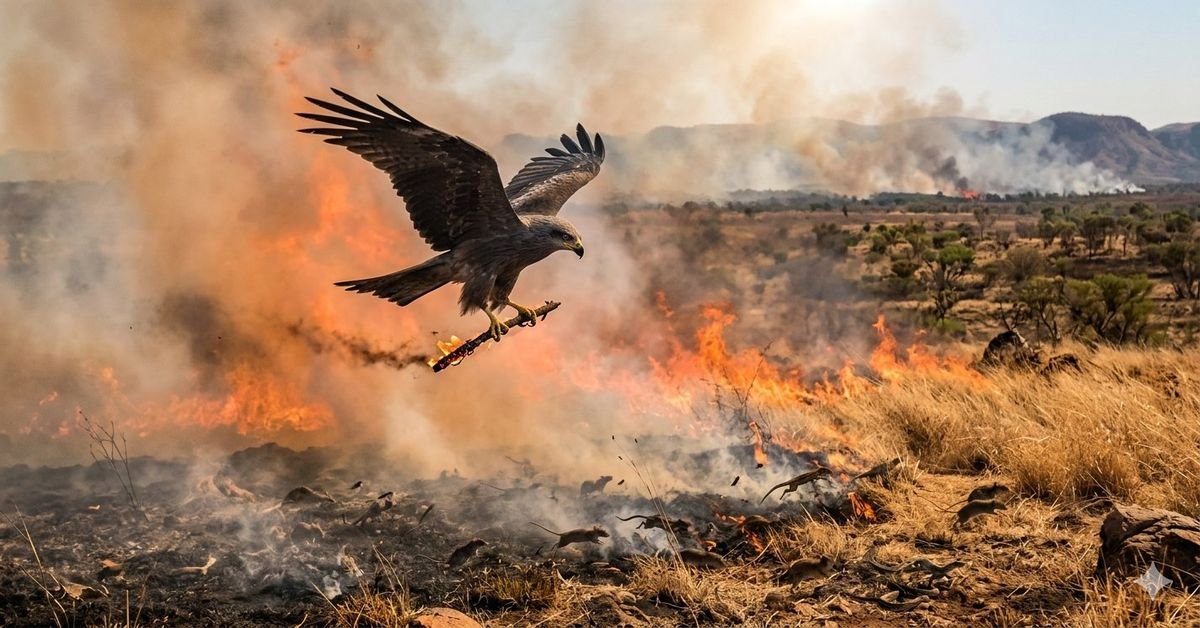
The Black Kites gather by the hundreds at these fire fronts. They soar just above the smoke, wait for a terrified mouse to dash across a clearing, and then dive. For the birds, it is the easiest hunting they will do all year. It is a buffet served on a silver platter of ash.
But sometimes, the fire doesn’t move fast enough. Or maybe it hits a patch of damp ground or a rocky creek and starts to die out. This is when the Black Kite stops being a passive hunter and starts being an arsonist.
Picking Up the Torch
Rangers and indigenous people in Australia have reported this behavior for decades, but Western scientists were skeptical until recently. They have watched Black Kites fly down to the edge of a burning bush and find a stick that is glowing red or already on fire.
The bird picks up the burning stick in its talons or its beak. It then flies over a nearby patch of unburnt, dry grass and drops the “torch.” If the first stick doesn’t start a new fire, the bird will go back, grab another one, and try again.
They are intentionally spreading the fire. By starting a new blaze in a fresh area, they create a brand-new “killing zone.” They force a new set of animals out of hiding so they can keep eating. This isn’t an accident. It is a calculated move to manipulate the environment for their own benefit.
Beyond Simple Instinct
We often write off animal behavior as “instinct.” We assume they are just reacting to what they see. But spreading fire requires a higher level of thinking.
First, the bird has to understand cause and effect. It has to know that “Point A” (the fire) causes “Point B” (the prey running out). Second, it has to have the foresight to see that if the fire stops, the food stops. Third, it has to physically manipulate a dangerous object—a burning stick—without getting hurt.
This behavior shows a level of planning that we usually only associate with primates or humans. The birds aren’t just using a tool they found, like a crow using a stick to get a bug. They are using a chemical process. They are harnessing energy.
The “Firehawk” Legends
The indigenous people of Northern Australia have known about these “Firehawks” for thousands of years. Their traditional stories and ceremonies often feature birds carrying fire. In some cultures, the birds are even credited with teaching humans how to use fire in the first place.
When scientists began interviewing residents, they found dozens of witnesses who had seen the same thing. Some people reported seeing a single kite move a fire across a river that acted as a natural firebreak. The bird essentially bypassed the obstacle to keep the hunt going. This isn’t just one “genius” bird; it is a behavior that seems to be passed down through generations.
The Risks of the Trade
Hunting with fire is dangerous work. The smoke is thick and can choke a bird just as easily as it can a human. The heat can singe feathers and damage wings.
Black Kites have adapted to this. They have incredible aerial agility that allows them to dip in and out of the heat quickly. They also have eyes that are protected by a “third eyelid” (a nictitating membrane) that helps them see through the stinging smoke.
They also have to be careful not to get trapped. If the wind shifts, the fire can turn on them. They have to constantly monitor the wind direction and the speed of the flames. It is a high-stakes game of chicken with one of the most destructive forces in nature.
Why This Changes Everything
The discovery that birds use fire forces us to rethink the history of intelligence. We used to think that the “Stone Age” was a big leap forward for life on Earth. But if birds were using fire millions of years ago, maybe the “Fire Age” started much earlier than we thought.
It also changes how we manage land. If we are trying to put out a wildfire to protect a forest, we have to account for the fact that the birds might be working against us. They don’t care about our firebreaks or our containment lines. They want the fire to keep moving.
The Global Impact
While the most famous “fire-starting” happens in Australia, Black Kites are found all over the world. They live in Europe, Africa, and Asia. Scientists are now looking for evidence of this behavior in other places.
If it’s happening in Australia, there is a good chance it’s happening in the African savanna or the grasslands of India. We might find that many predatory birds have a much more complex relationship with fire than we ever realized.
Living with the Firehawk
In Australia, the relationship between people and these birds is complicated. Ranchers often see the kites as a nuisance because they can bring a fire toward a barn or a herd of cattle. On the other hand, the birds are respected as powerful symbols of the land’s natural cycles.
If you are ever in a place where a brushfire is burning, look up. You might see the Black Kites circling. Most of them will be diving for food. But if you watch closely, you might see one fly down, grab a glowing branch, and take it for a ride. You are watching a creature that has mastered a force that we still struggle to control.
Final Thoughts
The Black Kite is a reminder that we are not as unique as we like to think. We are part of a very crowded, very smart planet. The dividing line between “human” and “animal” gets thinner every time we look closer at the world around us.
These birds aren’t just survivors. They are innovators. They took a natural disaster and turned it into a strategy. They looked at a wall of flame and saw an opportunity.
We can learn something from the Firehawk. It shows us that intelligence isn’t just about having a big brain; it’s about how you use what you have. The Black Kite has two wings and a beak, and it uses them to become the master of the flame. As long as the grass is dry and the lightning is striking, the Firehawk will be there, waiting for its chance to light the way.