Picture the Australian Outback in the middle of summer. The sun beats down relentlessly, baking the red sand until it is hot enough to blister bare skin. The air is so dry it crackles, and the temperature easily pushes past 100 degrees Fahrenheit on a regular afternoon. Out here in the Great Sandy and Gibson Deserts, survival isn’t just about finding food. It is entirely about finding water in a place where lakes and streams simply don’t exist.
If you or I were stranded out there without a canteen, we wouldn’t last long. But the thorny devil, scientifically known as Moloch horridus, doesn’t just survive in this brutal environment. It thrives. And it manages this feat using one of the most bizarre and brilliant evolutionary hacks in the entire animal kingdom: it drinks water through its feet.To understand how wild this is, you first have to look at the lizard itself.
A Walking Fortress of Spikes
If you stumbled across a thorny devil in the wild, you might think you’d found a tiny, angry dragon left over from the time of the dinosaurs. They aren’t massive; a fully grown adult might only stretch to about eight inches long, but they look incredibly intimidating. Their entire body is covered in hard, sharp, conical spikes made of keratin, the same protein that makes up your fingernails.These spikes serve a very clear defensive purpose. Out in the scrubland, predators like bustards, goannas, and snakes are always looking for an easy meal. If a predator tries to swallow a thorny devil, the lizard immediately tucks its real head down between its front legs. This exposes a fleshy, spiky knob on the back of its neck that looks exactly like a second head. The predator gets confused, grabs a mouthful of sharp keratin spikes, and usually decides to look for lunch somewhere else.Beyond the armor, they also have a brilliant method of camouflage. They don’t just blend into the red and yellow sand; they can actually change their colors based on the temperature and their mood. During the cool mornings, they look dull and olive-brown. But as the desert heats up and they become active, their scales shift to vibrant yellows and reds, perfectly matching the sunbaked clay and sand.When they walk, they use a strange, slow, jerky motion. They take a step, freeze, rock back and forth a bit, and then take another step. To a hungry bird circling overhead, this doesn’t look like a lizard at all. It just looks like a dry leaf skittering across the sand in the desert breeze.
The Physics of a Desert Sponge
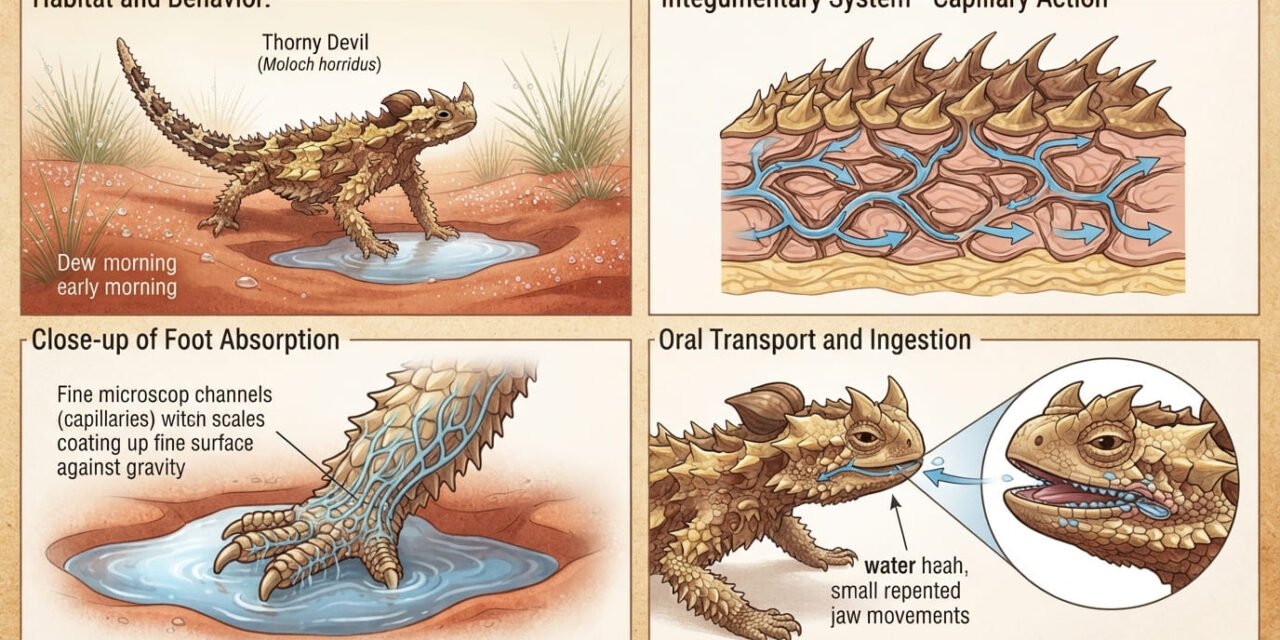
So, the lizard is perfectly camouflaged and heavily armored. But how does it solve the water problem? That all comes down to the microscopic architecture of its skin.Between every single one of those terrifying spikes are tiny, microscopic grooves. These channels connect, forming an intricate, web-like network that covers the lizard from the tip of its tail all the way up to its snout. When the thorny devil encounters moisture, any moisture at all, it doesn’t try to lap it up with its tongue. Instead, it lets its skin do the work.When water touches the lizard’s skin, it gets pulled into these microscopic channels through a process called capillary action. You have probably seen capillary action at work in your own kitchen. If you spill a drop of water on the counter and touch the corner of a paper towel to it, the water quickly races up into the paper, defying gravity.The grooves on the thorny devil’s skin act the same way, just on a much more complex level. The channels are so incredibly narrow that water is forced to move forward and upward. If the lizard steps in a damp patch of sand, the water gets sucked up through its feet. It travels up the legs, across the belly and back, and moves steadily toward the head, completely defying gravity without the lizard having to pump or swallow a thing.Eventually, this skin-highway directs all the gathered moisture to pool right at the corners of the lizard’s mouth. When it’s ready for a drink, the thorny devil just moves its jaws in a slight chewing motion. This opens and closes the corners of the mouth, creating a tiny bit of suction that pulls the pooled water off the skin and down its throat.
Harvesting Water from Thin Air
Having a sponge for skin is great, but the lizard still has to find the moisture in the first place. Over thousands of years, the thorny devil has mastered three specific ways to pull water out of an environment that seems completely bone-dry.First, they are early risers. Even in the scorching desert, nighttime temperatures can drop drastically. This rapid cooling often creates a very fine layer of morning dew on the rocks and the tough spinifex grass. Before the sun gets high enough to burn it off, the thorny devil will deliberately wander through the thickest patches of grass it can find. It physically brushes its spiky body against the wet blades, scraping the dew off the plants. The skin channels instantly suck up the moisture.Second, they know how to dig for a drink. When the sun is blaring and the surface sand is blazing hot, the dirt a few inches below the surface often holds onto a tiny bit of trapped moisture. The thorny devil will use its feet to kick this cooler, damp sand up onto its back. It will also press its belly flat against the freshly exposed dirt. The capillary skin simply wicks the water directly out of the sand grains, leaving dry dirt behind while the lizard gets a much-needed drink.Finally, there is the rain dance. Rain is incredibly rare in the Australian Outback, but when a storm finally does break, the thorny devil knows exactly how to capitalize on it. The lizard will find a shallow depression in the ground, stand perfectly still, and splay its legs out as wide as possible. It flattens its body against the wet earth, maximizing the amount of skin touching the ground. During a good downpour, a thirsty thorny devil can absorb almost a third of its entire body weight in water through this method.
A Strict Diet of Ants
You can’t survive in the desert on water alone. You need energy. But just like its drinking habits, the thorny devil’s eating habits are highly specialized. It is what biologists call an obligate myrmecophage. That is just a fancy way of saying it eats ants, and absolutely nothing else.If a juicy beetle or a fat caterpillar walks right past its face, the thorny devil won’t even blink. It is entirely focused on hunting specific ants, almost exclusively targeting the Iridomyrmex and Ochetellus genera.These particular ants are very small, but they move in massive, dense columns across the desert floor. When a thorny devil gets hungry, it doesn’t waste precious energy chasing prey around the hot sand. Instead, it finds a busy ant highway, sets up camp right next to it, and waits.When an Iridomyrmex or Ochetellus ant wanders a bit too close, the lizard unleashes a short, sticky tongue. It snaps the ant up in a fraction of a second. It eats them one at a time, but it works fast. A hungry adult can easily snap up 45 ants in a single minute. Over the course of a day, a single lizard might consume anywhere from 1,000 to 3,000 of these tiny insects.Eating that many bugs requires some specialized hardware. The exoskeletons of Iridomyrmex and Ochetellusants are made of tough chitin. To deal with this, the thorny devil has modified mandibular teeth designed specifically to crush the hard shells before swallowing.This hyper-specific diet actually serves a dual purpose. While the ants provide the calories the lizard needs to move and survive, the insects’ bodies also contain trace amounts of internal fluids. By eating thousands of them every single day, the lizard supplements its hydration. It’s a perfect, low-energy cycle: sit still, eat bugs, and let your skin slowly pull moisture out of the dirt.When you look at the thorny devil, you are looking at a masterclass in adaptation. It doesn’t fight the harshness of the Australian Outback. Instead, it has evolved to use every single quirk of the desert to its advantage. From mimicking a blowing leaf to literally soaking up puddles through its feet, Moloch horridus proves that life finds incredibly creative ways to keep moving forward, even in the most unforgiving places on the planet.