Imagine you are walking through a dense, humid rain forest in Borneo or Southern Thailand. The air is thick with the scent of damp moss, giant ferns, and tropical blooms. High above, sixty feet in the air, the canopy is a chaotic tangle of green leaves and thick woody vines. Suddenly, you hear a sharp rustle. You look up, expecting to see a bird or maybe a gliding squirrel. Instead, a slender, three-foot-long green snake launches itself off a branch into the open air.
Your survival instincts might tell you to brace for a heavy, falling reptile. But the snake does not fall. It does not drop like a stone. Instead, it flattens its body into a ribbon, starts swimming through the empty air with wide, undulating curves, and glides gracefully over your head. It covers a distance of more than fifty feet before landing softly on a trunk of a tree further down the path.
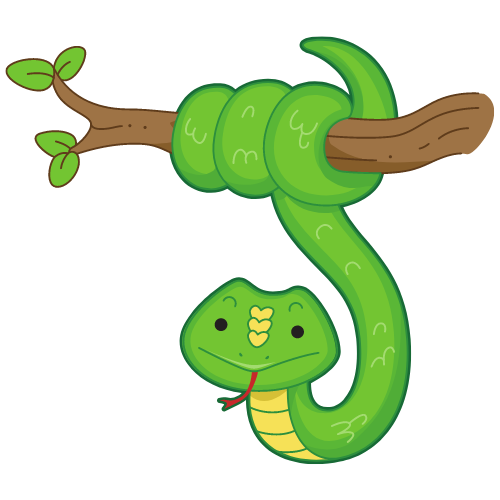
This is the paradise tree snake (Chrysopelea paradisi). It is one of five closely related species of gliding snakes found in the forests of Southeast Asia. To anyone who grew up believing that flight requires wings, feathers, or broad membranes of skin, this creature looks like a physical impossibility. It has no limbs, no flaps of skin, and no feathers. It is, quite literally, a tube of muscle and bone. Yet, it can glide through the air with a level of control that rivals many winged animals.
The Great Aerodynamic Puzzle
To appreciate the snake’s accomplishment, you have to look at the other animals that travel through the air without wings. Gliding squirrels have a wide, furry membrane of skin called a patagium that stretches between their front and back legs, acting like a built-in parachute. Gliding lizards have elongated ribs that push outward to support wide, colorful wings of skin. Even gliding frogs use massive, webbed feet to catch the air.
These animals are essentially living kites. They rely on flat, broad surfaces to create drag and lift. A snake has none of these things. If you throw a normal garden hose or a stick through the air, it will tumble, rotate, and fall straight down. A cylinder is one of the worst aerodynamic shapes possible; it cannot generate lift, and it easily becomes unstable in a breeze.
For a long time, early naturalists thought that these snakes were simply falling with style, perhaps using a lucky gust of wind or their initial jump speed to carry them across a gap. But high-speed video analysis and wind tunnel tests have revealed a much more exciting truth. The paradise tree snake does not just drop. It is a highly active, shape-shifting glider that manipulates its own skeleton to turn its entire body into a functional wing.
The Transformation: Squeezing the Ribbon
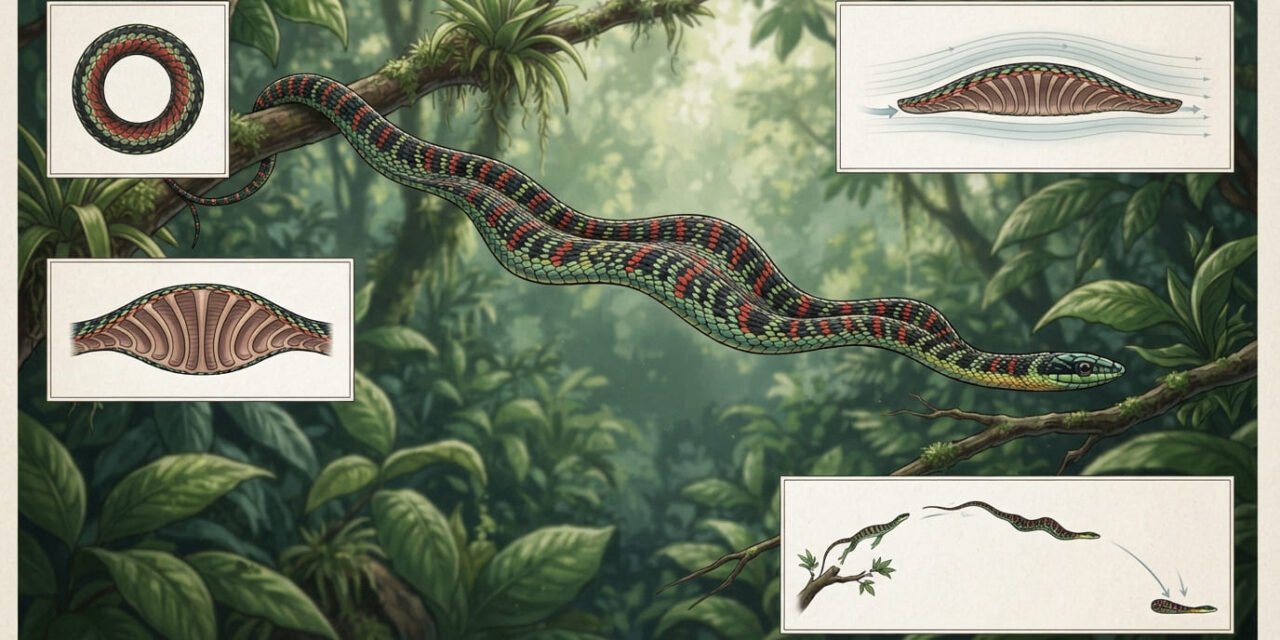
The snake’s transformation begins the moment it leaves the branch. In a fraction of a second, the paradise tree snake changes its body shape from a cylinder into a flat, concave ribbon. It does this through a brilliant bit of skeletal manipulation.
A snake’s body is mostly made of a long spine and hundreds of pairs of highly flexible ribs. When the paradise tree snake launches into the air, it uses specialized muscles to rotate its ribs forward and upward. This rotation spreads the ribs wide, almost like the frame of an umbrella.
At the same time, the snake sucks its belly inward and upward toward its spine. This movement pulls the lower skin of the snake flat, creating a deep, hollow groove along the entire underside of its body.
Under a microscope, you can see that the snake’s cross-section has changed from a perfect circle into a flat, C-shaped, or U-shaped profile. In the world of aerodynamics, this shape is known as an under-cambered airfoil. It is the same design used in early hang gliders, parachute canopies, and the wings of the Wright brothers’ first airplanes.
This concave shape is incredibly efficient at creating lift. As the flat ribbon of the snake plunges through the air, the hollow groove on its belly traps a pocket of air. This trapped air builds up a zone of high pressure underneath the snake. Meanwhile, the air flowing over the rounded top of the snake’s back moves much faster, creating a zone of low pressure.
The difference between the high pressure underneath and the low pressure on top generates lift. By flattening its body, the snake effectively doubles its width, turning its entire three-foot frame into a continuous, lift-producing wing.
The Secret of the S-Curve
Reshaping the body into a wing is only the first part of the trick. If the snake flattened itself and stayed completely rigid, it would tumble out of control within a few feet. To maintain a stable glide, the snake must keep moving. It does this by slithering through the air.
If you watch high-speed footage of a paradise tree snake in flight, it looks like it is crawling across an invisible pane of glass. It moves its body back and forth in wide, horizontal S-curves. This movement is called lateral undulation, and it is the same motion the snake uses to swim through water or crawl across the grass.
For a long time, scientists wondered why the snake kept wriggling. Some thought it was just a nervous reflex, the snake trying to walk because it did not know it was in the air. But a team of mechanical engineers and biologists at Virginia Tech decided to test this movement in a laboratory.
They set up a series of high-speed cameras and used 3D motion-capture technology to track every bend and twist of the snake’s body during a glide. They then built a complex computer model to simulate what would happen if the snake stopped wriggling.
The results were surprising. The S-curve is not a useless reflex; it is a vital stabilization technique. When a flat, light object glides through the air, it is highly prone to two types of instability: roll and pitch. Roll is when the object spins along its length like a rolling log. Pitch is when the nose of the object dips down or tips up, causing a stall or a dive.
By constantly waving its body side to side, the snake prevents these forces from taking over. The movement creates a series of dynamic vortices, little whirlpools of air, along the curves of its body. These vortices stabilize the airflow, keeping the snake upright and preventing it from rolling over.
Additionally, the S-curve allows the snake to shift its center of mass in real time. If the nose starts to dip, the snake can send a wave down its body to shift its weight backward, pulling the front end back up. It uses its tail as a dynamic rudder, twisting it up and down to adjust its direction and glide angle. The snake is not just a passive glider; it is actively piloting its body through the air, adjusting its course with every wiggle.
The J-Loop Launch
To get the speed needed to start this shape-shifting glide, the snake must launch itself with power. It cannot just crawl off a branch and hope for the best.
Before a jump, the snake travels to the end of a high branch. It hangs down from the wood, bending the front section of its body into a tight, anchor-like “J” loop. It grips the bark tightly with its tail and rear body, using the rough scales to keep its footing.
Once it selects a target, the snake contracts its powerful abdominal muscles. It pulls its body up and launches itself forward and upward, pushing off the branch with incredible force. This launch is similar to how a human jumper uses a starting block.
By pushing off with a J-loop, the snake gains enough initial speed to start the airflow over its body. Within milliseconds of leaving the branch, before gravity can pull it into a vertical drop, the snake rotates its ribs, flattens its belly, and begins its S-curve dance. It goes from a crawling reptile to an aerodynamic glider in the blink of an eye.
Lessons for the Future of Drone Technology
The paradise tree snake’s elegant solution to wingless flight is highly relevant to modern engineering. Traditional human aircraft rely on rigid, fixed wings. This design is excellent for flying fast and far in a straight line, but it is terrible for navigating tight, cluttered spaces like a dense forest or the inside of a collapsed building.
Engineers are trying to build search-and-rescue drones that can operate in these difficult environments. A traditional drone with spinning blades can easily clip a wall or a tree branch, causing it to crash and break. Fixed-wing drones are too fast and cannot make sharp turns.
By studying the snake, roboticists are developing a new field of technology called soft, morphing robotics. Researchers have built snake-like robots made of flexible, pressurized materials that can crawl up trees, squeeze through tight rubble, and then shape-shift to glide down to the ground.
These bio-inspired robots do not have rigid wings that can break. They use active skeletal manipulation to change their shape based on their needs, crawling when they are on the ground and gliding when they need to cross a gap. The paradise tree snake proved that you do not need a heavy, complex wing to conquer the sky; you just need to know how to bend your own body to meet the wind.
Final Thoughts
The paradise tree snake is a reminder that evolution does not follow a straight path. It is a creature that took a body plan designed for the ground—a long, legless tube built for crawling under logs—and turned it into a master of the sky.
It did not achieve this by evolving complex new limbs or massive wings. It achieved it by using the bones and muscles it already had, rearranging them in a fraction of a second to exploit the physics of air pressure. When you look at this green ribbon gliding through the canopy, you are looking at a masterclass in natural design, proving that sometimes, the best way to move forward is to completely reshape how you face the world.