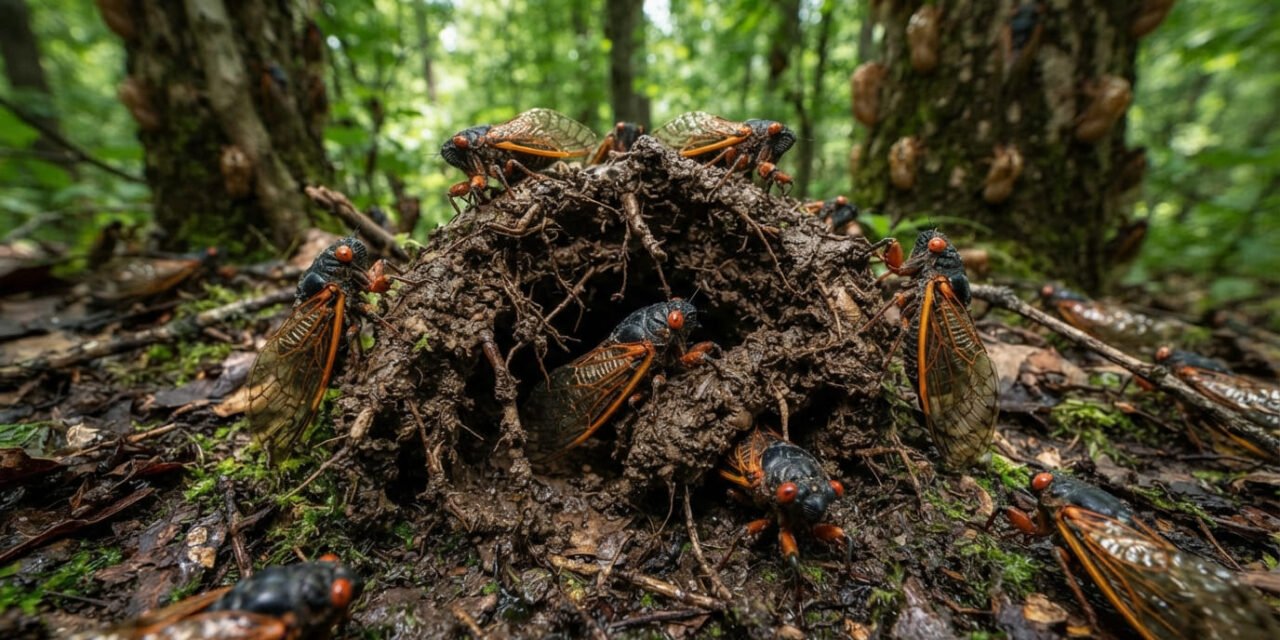
If you live in the eastern United States, you might have experienced a summer where the ground literally crawls. Millions of insects with red eyes and orange-veined wings emerge from the earth at once. They scream at a volume that can reach 100 decibels. Then, after four or five weeks of noise and mating, they die. The woods go quiet again. They won’t return for another 17 years.
This is not a random event. The periodical cicada (Magicicada) follows a strict mathematical schedule. Some broods emerge every 13 years, while others emerge every 17 years. Biologists and mathematicians have spent decades trying to figure out why these insects chose these specific numbers. The answer lies in prime numbers and the brutal logic of survival.
The Power of Prime Numbers
A prime number is a number that you can only divide by one and itself. Numbers like 13 and 17 are prime. Numbers like 12, 14, 15, or 16 are not. If you are an insect trying to stay alive, prime numbers are your best defense against predators.
Imagine a bird or a squirrel that has a population cycle of two, three, or four years. If the cicadas emerged every 12 years, every predator with a cycle that is a factor of 12 (2, 3, 4, or 6) would hit a “jackpot” every time the cicadas came out. The predator populations would sync up with the cicadas, grow huge on the easy food, and wipe them out.
By choosing a prime number like 17, the cicadas make it almost impossible for predators to sync their cycles. A predator with a 2-year cycle would only meet the 17-year cicada every 34 years. A predator with a 3-year cycle would only see them every 51 years. By the time the predators encounter the cicadas again, their own population has likely crashed or shifted. The cicadas use math to stay “out of phase” with anything that wants to eat them.
Life in the Dark
For 16 years and nine months, the cicada is a nymph living underground. It doesn’t sleep or hibernate. It is active, tunneling through the soil and sucking sap from tree roots. It goes through five growth stages, shedding its skin each time it gets bigger.
The cicada counts the years by monitoring the tree. When a tree grows leaves in the spring, the sap flows differently than it does in the winter. The cicada senses these chemical changes in the fluid it drinks. It keeps a count of these seasonal pulses. When the count hits 17, and the soil temperature reaches exactly 64 degrees Fahrenheit at a depth of eight inches, the insect knows it is time to move.
They emerge in such massive numbers that predators cannot possibly eat them all. This is called “predator satiation.” Even if every bird, cat, and copperhead snake in the forest eats until it is sick, 99 percent of the cicadas will still be alive to mate. It is a strategy of pure volume. They don’t have stingers or venom. They don’t even try to hide. They simply overwhelm the system.
The Cost of the Long Wait
This 17-year cycle is a massive investment. The cicadas spend over 99 percent of their lives underground just for a few weeks of sunlight. During this time, they are vulnerable to fungal infections and changes in the soil. If a forest is cleared for a parking lot, the underground nymphs die, and that brood is gone forever.
The transition from the ground to the air is the most dangerous part of their lives. When the nymphs crawl out of the soil, they must find a vertical surface—like a tree trunk or a fence post—to shed their final nymphal skin. This process takes about an hour. During this time, their new bodies are soft and white. They cannot fly. They are “soft-shell” snacks for anything with a mouth. It takes several hours for their new exoskeleton to harden and turn black.
The Physics of the Scream
Once they harden, the males begin to sing. They don’t use vocal cords. They have specialized organs on the sides of their abdomens called tymbals. These are thin, ribbed membranes that the cicada buckles and unbuckles using strong muscles.
Think of the sound a plastic soda bottle makes when you crinkle it. The cicada does this 300 to 400 times per second. Their hollow abdomen acts as a resonance chamber, amplifying the clicking sound into a deafening roar. In a heavy emergence, the noise is loud enough to cause permanent ear damage to a human standing too close. The noise serves one purpose: it tells the females where the males are.
The females do not sing. They respond by flicking their wings, which makes a small clicking sound. The males hear this and move closer. After mating, the female uses a sharp organ called an ovipositor to slit the bark of young tree branches. She lays her eggs in these slits. A few weeks later, the adults die, and the ground is littered with their bodies. Their decaying remains act as a massive fertilizer boost for the very trees that fed them for 17 years.
The Next Generation
When the eggs hatch, the tiny nymphs look like small white ants. They drop from the tree branches to the ground and immediately begin digging. They disappear into the soil, find a root, and start the 17-year countdown again.
You should care about this cycle because it is one of the most stable biological clocks on the planet. Scientists study cicadas to understand how climate change affects seasonal timing. If the soil warms up too early or trees bud twice in one year due to extreme weather, the cicadas can get “tricked” into emerging a year early. Since they rely on the “safety in numbers” strategy, an early emergence is usually a death sentence. There aren’t enough insects to saturate the predators, and the entire group gets eaten.
Observations for Your Backyard
If you are in a “cicada year,” you will see thousands of brown shells stuck to your trees and the siding of your house. These are the discarded nymph skins. You will also see “flagging” on your trees. This is when the tips of branches turn brown and die because the female cicadas laid eggs in them. This doesn’t kill the tree. It is actually a natural pruning process that helps the tree grow more branches the following year.
The insects are harmless to humans. They don’t bite or sting. They are clumsy fliers and will often land on you because they think you are a tree. If you pick one up, it might vibrate its body to try to scare you, but it can’t hurt you.
Final Thoughts
The 17-year cicada is a testament to the power of mathematics in nature. It doesn’t survive because it is fast or strong. It survives because it can count. By staying underground and waiting for a prime number of years, it avoids the boom-and-bust cycles of the animals that want to eat it.
It is a slow-motion success story. For nearly two decades, these insects wait in total darkness for their one month in the sun. When they finally emerge, they turn the forest into a chaotic, noisy celebration of survival. They are a reminder that sometimes, the best way to win a race is to wait 17 years before you start running.