Imagine you are a small predator trying to survive in a crowded forest. Producing powerful chemical weapons inside your own body requires a massive amount of metabolic energy. You have to build complex organs, manufacture delicate proteins, and make sure you do not accidentally poison yourself in the process. Most venomous creatures spend millions of years evolving specialized internal factories to produce a single drop of toxin.
Now imagine a shortcut. What if, instead of manufacturing your own weapons, you could eat a poisonous animal, take its toxins intact, and load them directly into your own armor?
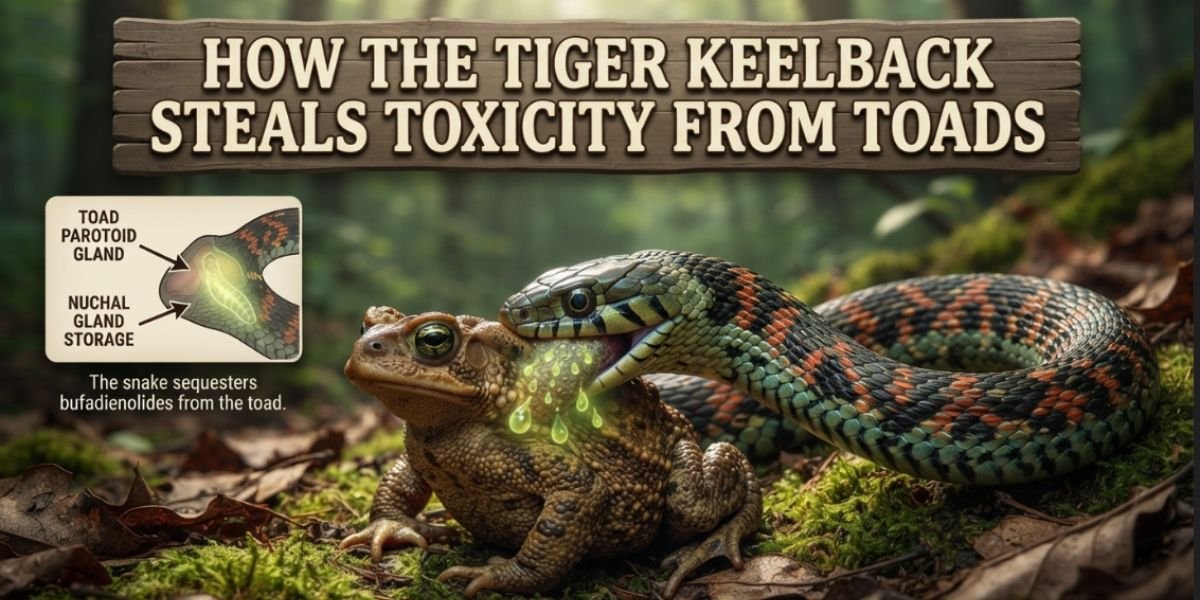
This sounds like something out of a science fiction film, but it is the daily reality for a striking reptile living across East Asia. This is the tiger keelback snake, known scientifically as Rhabdophis tigrinus. Found in the wet fields, marshes, and mountain streams of Japan, China, Korea, and eastern Russia, this colorful snake holds a unique title in the animal kingdom. It is one of the very few creatures on Earth that practices kleptotoxism, which is the biological act of stealing toxicity from its prey and using it for its own defense.
The Toxic Toad Buffet
To understand how the tiger keelback pulls off this heist, you first have to look at its favorite prey: the Asian toad.
Toads are notoriously slow, plump, and easy to catch. They cannot hop away quickly, and they do not have sharp claws or teeth. To protect themselves from being eaten by birds, mammals, and other reptiles, toads carry a heavy chemical shield. Behind their eyes, toads have large, bumpy structures called parotoid glands. When a predator grabs a toad, these glands squeeze out a thick, milky white fluid filled with potent cardiac toxins known as bufadienolides.
These toxins are extremely dangerous. They target the heart muscles of any animal that bites the toad, causing rapid heart palpitations, severe vomiting, cardiac arrest, and death within minutes. For almost every predator in the forest, taking a bite of a toad is a fatal mistake.
Most snakes avoid toads entirely, or if they accidentally swallow one, they get violently ill and regurgitate the meal. But the tiger keelback snake looks at a poisonous toad and sees two things at once: a satisfying dinner and a fresh shipment of biological ammunition.
The Resistance and the Immune Advantage
How can the tiger keelback swallow a creature filled with heart-stopping poison without dying on the spot?
The first step in the snake’s secret strategy is physiological resistance. Over millions of years of co-evolution with Asian toads, the tiger keelback modified the sodium-potassium pump receptors in its own heart tissue. In most animals, bufadienolide toxins lock onto these cellular receptors like a key in a lock, jamming the electrical signals that tell the heart to pump.
In the tiger keelback, the shape of these cellular receptors has shifted just enough that the toad’s chemical key no longer fits comfortably. The snake can swallow a toad packed with enough heart toxin to kill several large animals, and its own heart keeps beating smoothly without missing a single pulse.
While other snakes would die from the internal chemical burn, the tiger keelback digests the toad without any trouble. But the real miracle is what happens to the poison after the toad hits the snake’s stomach.
The Internal Plumbing of the Neck Glands
When a typical animal digests food, its stomach acids and digestive enzymes break down the prey’s tissues, proteins, and chemical compounds into basic nutrients. If a normal predator eats something toxic, its liver and kidneys work overtime to break down the toxins and flush them out of the body through waste.
The tiger keelback does something completely different with bufadienolides. Its digestive system has evolved a specialized transport mechanism that isolates the toad’s heart toxins during digestion.
Instead of breaking down the toxins or flushing them out as waste, the snake’s body absorbs the bufadienolide molecules intact into its bloodstream. Specialized transport proteins then carry these dangerous molecules directly up toward the neck area.
Located on the back of the snake’s neck, just beneath the skin, is a series of paired organs called nuchal glands. A tiger keelback usually has about ten to twenty pairs of these small, sac-like glands running down its nape. As the toad toxins flow through the bloodstream, the nuchal glands pull the bufadienolides out of circulation and store them inside small internal chambers.
The snake essentially uses its own skin as a storage vault for stolen weapons. The toxins sit inside the nuchal glands under pressure, fully active and ready for action, without ever harming the snake’s own organs.
The Neck-Arching Bluff and Blast
Having a neck full of stolen poison is useless if you do not know how to use it when danger arrives. The tiger keelback’s defensive behavior is completely customized around its neck armor.
When a typical snake feels threatened by a predator like a hawk, a crow, or a heavy mammal, it usually turns around, spreads its jaw, hisses loudly, or attempts to bite. Some snakes try to slither away into the tall grass as fast as possible.
The tiger keelback takes a completely different approach. When an attacker approaches, the keelback flattens its neck horizontally and arches its spine forward toward the enemy, bowing its head down toward the ground.
This posture presents the back of its neck directly to the predator’s face. The skin on the back of the neck stretches tight, pushing the raised bumps of the nuchal glands outward.
If the persistent predator bites or pecks at the snake’s neck, the pressure immediately ruptures the thin outer wall of the nuchal glands. The stored bufadienolides squirt out in a fine, pressurized mist directly into the predator’s eyes, mouth, and nostrils.
The result for the attacker is instant and traumatic. The stolen toad toxins cause intense burning in the mucous membranes of the mouth and eyes, followed by numbness, nausea, and disorientation. The predator drops the snake instantly and spends the next several minutes trying to wash its mouth out in the grass or dirt. Meanwhile, the tiger keelback quietly lowers its neck and slithers away into the brush, completely unharmed.
Mother’s Gift: Inherited Poison
One of the most mind-blowing discoveries about the tiger keelback snake involves how female snakes care for their young before they are even born.
In the wild, baby snakes are born small, soft, and defenseless. A newborn tiger keelback has not yet had the chance to hunt its first toad, which means its nuchal glands should logically be empty and useless.
However, when researchers examined newborn tiger keelback hatchlings in laboratory settings, they found something remarkable. Many of the baby snakes were born with their nuchal glands already fully loaded with potent bufadienolide toxins.
How did a newborn snake that had never eaten a meal in its life get a full supply of toad poison?
The answer lies with the mother. When a pregnant female tiger keelback eats toads during her pregnancy, she does not just store the stolen toxins in her own neck. She actively routes a portion of those absorbed bufadienolides into the developing yolks of her eggs.
As the baby snakes grow inside their eggs, they absorb the mother’s stolen toxins into their developing tissues, directing the poison straight into their newly formed nuchal glands. When the tiny snakes hatch from their shells, they emerge into the world equipped with a full defensive shield from their mother’s recent meals.
If a female snake has access to plenty of toxic toads while preparing her eggs, her offspring are born fully armed and ready to defend themselves against birds and small mammals from their very first day of life.
Behavioral Plasticity and the Power of Choice
Nature is rarely uniform. In some parts of East Asia, such as certain islands in Japan, there are no toxic toad species present. In these toad-free regions, tiger keelback snakes must survive on a diet of fish, harmless frogs, and tadpoles.
Because these snakes cannot eat toads, they cannot steal bufadienolide toxins. As a result, their nuchal glands remain empty. They are functionally non-poisonous.
This difference created a fascinating natural experiment for biologists. How does a snake behave when its defensive vault is empty versus when it is fully loaded?
Researchers placed snakes from toad-rich islands alongside snakes from toad-free islands and introduced them to simulated predator threats.
The results were crystal clear. The snakes that possessed full stores of stolen toad toxins stood their ground when threatened. They confidently arched their necks forward, showed off their nuchal glands, and prepared to spray their chemical shield. They knew their defenses worked.
The snakes from the toad-free islands, which had empty nuchal glands, behaved completely differently. They did not arch their necks or show off their nuchal glands. Instead, they immediately turned around, slithered away at top speed, or attempted to bite the attacker with their teeth.
This shows that the tiger keelback is not operating on a simple, brainless reflex. The snake appears to possess an internal awareness of its own chemical state. It adjusts its defensive behavior based on whether its neck glands are stocked with stolen poison or empty.
Evolutionary Shortcuts and Nature’s Genius
The tiger keelback snake is a brilliant reminder that biological survival is not always about brute force or building complex systems from scratch. Sometimes, the most effective strategy is finding a clever shortcut that exploits the work of others.
By combining physiological resistance, specialized internal transport plumbing, and inherited maternal care, this colorful Asian reptile turned its primary food source into an unbeatable defensive shield. It proved that in the high-stakes game of predator and prey, you do not always need to manufacture your own weapons. Sometimes, all it takes is the ability to steal the right poison from your dinner and turn your enemy’s strength into your ultimate defense.
The story of the tiger keelback reminds us how interconnected life in the forest truly is. A chemical produced by a slow, bumpy toad travels through a snake’s stomach, moves into its neck, gets passed down into an egg, and ultimately protects a newborn hatchling resting on a leaf miles away. It is a quiet, continuous chain of survival that highlights the incredible creativity of the natural world.