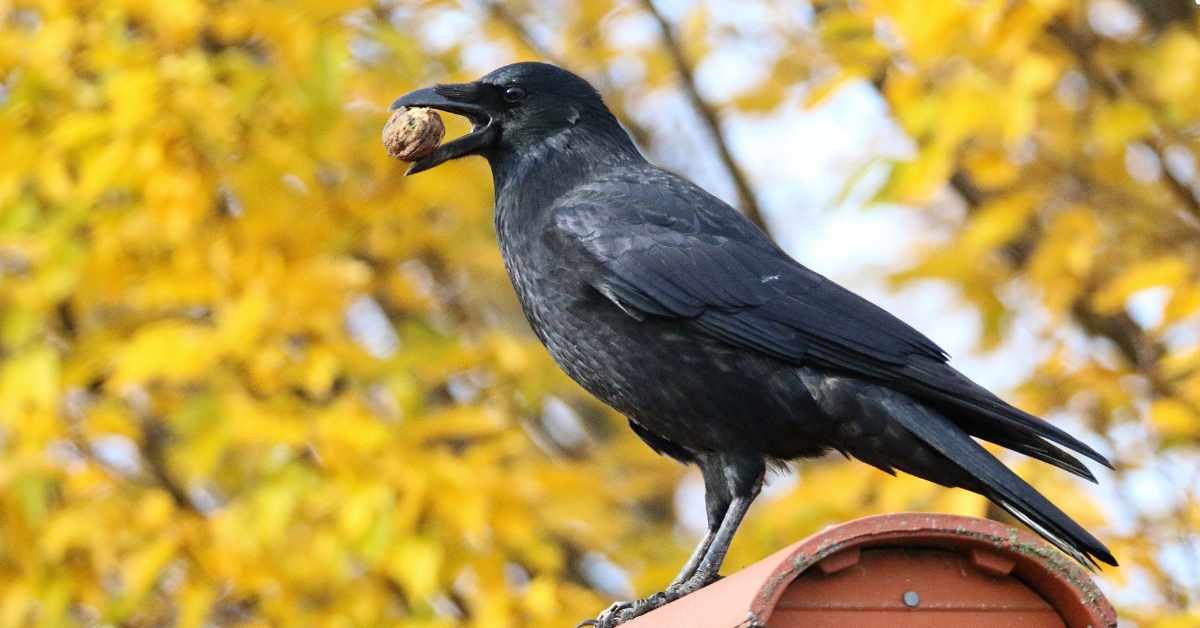
If you spend any significant time in your garden, you have likely felt the weight of a gaze from high above. You look up, and there they are: large, obsidian-winged figures with a confident, rolling gait and a voice that demands attention. Crows are ubiquitous, yet they remain one of the most polarising figures in the avian world.
For some gardeners, they are the neighbourhood “mobsters”—noisy, disruptive, and prone to pulling up freshly planted seedlings. For others, they are “flying primates,” fascinatingly complex neighbours who offer a window into a level of non-human intelligence that is frankly a bit humbling.
Regardless of where you fall on the spectrum of “Crow Fan” to “Crow Foe,” one thing is scientifically undeniable: crows are incredibly smart. To live with them is to participate in a cross-species social experiment. By shifting our perspective from “managing a pest” to “understanding a neighbour,” we can unlock a much more rewarding gardening experience.
1. The Corvid Mind: Why They Aren’t “Just Birds”
To coexist with a crow, you must first accept that you are being watched by an animal with the cognitive capacity of a seven-year-old human or a Great Ape. Crows belong to the family Corvidae, which includes ravens, magpies, and jays. Scientists often refer to them as “feathered apes” because of their remarkable problem-solving abilities.
The Neurobiology of Brilliance
While a crow’s brain is small in absolute terms, it is densely packed with neurons. Their nidopallium, the part of the brain responsible for higher-level processing, is functionally similar to the prefrontal cortex in humans. This allows them to:
- Plan for the future: They don’t just react; they anticipate.
- Exert self-control: In “marshmallow tests” adapted for birds, crows have shown the ability to forgo a small immediate snack for a better one later.
- Understand Analogies: They can perceive relationships between objects (e.g., “this circle is to that square what this big triangle is to that small triangle”).
Facial Recognition and Social Learning
One of the most legendary aspects of crow intelligence is their ability to recognise human faces. In a landmark study at the University of Washington, researchers wore specific masks while trapping and banding crows. Years later, those same crows (and their offspring!) would “scold” and dive-bomb anyone wearing that specific mask, while ignoring people in different masks.
The Takeaway: If you are kind to your crows, they will remember you. If you are the person who throws rocks at them, they will not only remember you—they will tell their friends and children that you are a “high-risk” individual.
Tool Use and Innovation
Crows are among the few animals on Earth known to manufacture tools. While the New Caledonian Crow is the world champion of this—fashioning hooks from twigs to extract grubs—our local American and Carrion crows are no slouches. They have been observed using sponges to carry water, using breadcrumbs as “bait” to fish for minnows, and, famously, using cars as nutcrackers by placing walnuts in traffic lanes and waiting for the light to turn red to retrieve the shattered remains.
2. Why Your Garden is “Prime Real Estate”
Crows aren’t in your yard to spite you. They are there because your garden is a highly efficient survival hub. Like any savvy real estate mogul, they look for three things: Location, Resources, and Security.
A Diverse Buffet
Crows are opportunistic omnivores. While we see them as scavengers, they are actually highly skilled foragers. Your garden provides:
- Invertebrates: Grubs, beetles, worms, and caterpillars.
- Vegetable Matter: Grains, seeds, fruits, and nuts.
- Human Leftovers: Compost, pet food, and trash.
High Vantage Points
Crows value “the high ground.” A tall oak tree or a sturdy telephone pole serves as a reconnaissance tower. From here, they can spot a neighbourhood cat three houses away or keep an eye on when you refill the bird feeder.
The Social Network (Roosting)
Crows are intensely social. During the day, they operate in small family units (usually a mated pair and their “teenaged” helpers from previous years). At night, especially in winter, they may join massive communal roosts numbering in the thousands. Your garden might be the “daytime hangout” for a specific family that has claimed your block as their territory.
3. The Hidden Benefits: Nature’s Security and Janitors
It is easy to focus on the “caw” at 6:00 AM, but having a resident crow family is actually a massive asset to a healthy garden ecosystem.
Integrated Pest Management (IPM)
If you see a crow pecking at your lawn, your first instinct might be to worry about the grass. However, they are usually hunting for white grubs (the larvae of Japanese beetles) or leatherjackets (crane fly larvae). These pests eat grass roots and can ruin a lawn far more effectively than a bird’s beak ever could.
- Fact: A single crow family can consume tens of thousands of insects during the nesting season to feed their hungry chicks. By hosting crows, you are essentially hiring a 24/7, chemical-free pest control squad.
The Neighborhood Watch
Crows have a specific “alarm call” for different predators. If you listen closely, you can tell when a hawk, an owl, or a stray cat is nearby. This “mobbing” behaviour—where crows team up to harass a predator until it leaves—is a huge benefit to other songbirds and your own backyard chickens.
Carrion and Sanitation
Crows are the “clean-up crew” of the suburbs. By consuming roadkill or fallen fruit that might otherwise rot and attract flies or rodents, they help prevent the spread of certain diseases and keep the local environment tidy.
4. Solving Common Conflict Points
Even the most “pro-crow” gardener hits a breaking point. Here is how to handle common issues using biology and psychology rather than aggression.
Problem A: They Are Eating My Harvest
Whether it’s corn, strawberries, or tomatoes, crows know when the “good stuff” is ripe.
- The Solution: Physical barriers are the only 100% effective method. Bird netting is excellent, but ensure it is pulled taut so birds don’t get tangled.
- The “Scare” Factor: Traditional scarecrows are useless. Crows will eventually realise the “human” hasn’t moved in three days and use his hat as a perch. Instead, use variable motion. Reflective “flash tape,” old CDs, or even metallic pinwheels work because the light patterns are unpredictable. Move them every 3–4 days to prevent “habituation.”
Problem B: The Trash Explosion
Crows are experts at finding the “weak point” in a trash bag.
- The Solution: This is about containment. Use bins with locking lids or heavy-duty bungee cords. If you compost, ensure you are using a “brown” layer (dried leaves/straw) to cover “green” kitchen scraps, which masks the scent and visual appeal.
Problem C: The Noise
Crows are loudest during two times: breeding season (spring) and when a threat is present.
- The Solution: You cannot stop a crow from communicating, but you can stop “inviting” the noise. If they are congregating in one specific tree and being excessively loud, look for the attractant. Is there a bird feeder they can easily access? Is there a neighbourhood cat they are yelling at? Removing the “trigger” usually dampens the volume.
5. Myths, Legends, and Hard Truths
Crows have suffered from bad PR for centuries, largely due to their black plumage and presence at historical battlefields. Let’s clear the air.
| Myth | Reality |
| Crows are a “bad omen” or mean death. | This is pure superstition. Crows are associated with death because they are scavengers; they don’t cause it, they just clean it up. |
| A group of crows is a “Murder.” | While poetically true, this term comes from 15th-century “terms of venery.” In biology, we simply call them a flock or a family group. |
| Crows live for 100 years. | In the wild, the average lifespan is 7–10 years. In captivity, they can reach 30, but the “century-old crow” is a myth. |
| They steal shiny objects for nests. | While they are curious about new objects, the idea that they “hoard” jewelry is mostly anecdotal. They are more likely to investigate a shiny object to see if it’s edible. |
6. How to Be a Good “Crow Neighbor”
If you want to live in harmony—or even foster a “friendship”—there are rules to the road.
Don’t Make Them Pets
While it is tempting to try to hand-feed a crow, it is generally discouraged. Tame crows can become aggressive toward other humans who don’t have treats, or they may lose their healthy fear of cars and dogs. It is better to be a “benevolent background character” in their lives.
The “Crow Buffet” Done Right
If you do want to offer food to keep them away from your vegetable patch, do it strategically:
- High-Quality Protein: Unsalted peanuts (in the shell), scrambled eggs, or dried mealworms.
- No Bread: Bread has zero nutritional value for birds and can cause “Angel Wing” or other developmental issues.
- The “Safety Tax”: Place the food in a flat, open area away from cover where a cat could hide.
Provide a “Crow Bath”
Crows are surprisingly clean. Because of their size, standard small birdbaths are often too shallow and flimsy. A heavy, ground-level stone basin or a large, shallow rubber feed tub is ideal. Watching a crow vigorously bathe is one of the great joys of backyard birding.
7. The Ethics of Coexistence
In many regions, crows are protected under laws like the Migratory Bird Treaty Act. This means it is often illegal to harm them, take their nests, or keep them as pets without heavy-duty federal permits.
Beyond the law, there is a moral argument for their presence. Crows are one of the few wild species that have figured out how to thrive in the world we’ve built. They navigate our traffic, eat our waste, and recognise our faces. They are a mirror of our own success and our own excesses.
A Lesson in Observation
To live with crows is to realise that you are not the only protagonist in your garden. There is a whole drama happening in the canopy:
- The “Helper” crow (an older sibling) is feeding the new fledglings.
- The “Sentinel” crow stays quiet while the rest of the family eats.
- The “Funeral” (a gathering of crows around a deceased comrade), which scientists believe is a way for the survivors to learn about a potential new danger in the area.
The Smartest Guest in the Garden
Living with crows requires a blend of boundaries and respect. They will test your patience, they will outsmart your “bird-proof” feeders, and they will definitely have an opinion about your new lawn mower. But in exchange, they offer a connection to a deep, ancient intelligence.
By securing your trash, netting your prized tomatoes, and perhaps tossing a handful of unsalted peanuts onto a platform feeder once in a while, you transition from being a “baffled homeowner” to a “respected neighbour.” The next time you hear that familiar caw, don’t reach for a broom. Look up, make eye contact, and appreciate the fact that you’ve been recognised by one of the sharpest minds in the natural world.