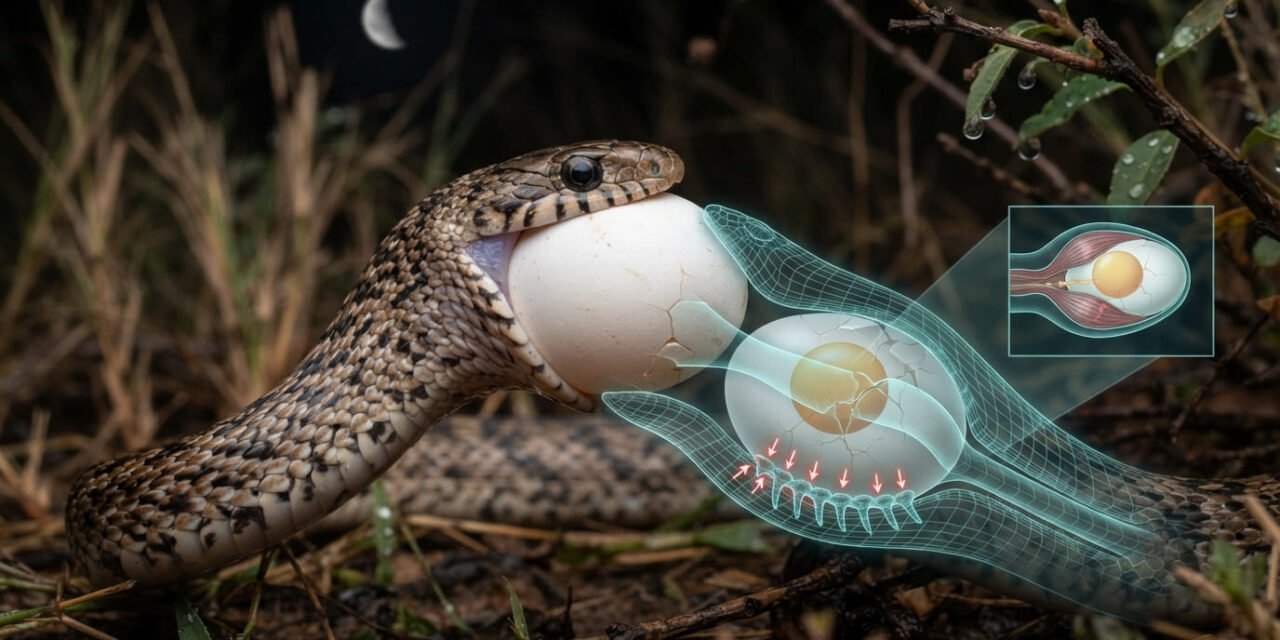
Imagine sitting down for dinner and finding a giant, smooth sphere on your plate that is three or four times wider than your head. It has no handles, it is incredibly slippery, and the shell is so hard you cannot dent it. To make things more difficult, you do not have any hands, arms, or legs. You do not even have any teeth. Your only task is to get that giant sphere inside your body, crack it open, drink the liquid inside, and discard the hard shell without making a mess.
For a human, this sounds like an impossible puzzle. But for a quiet, slender reptile living in the forests and savannas of Africa, this is just a normal Tuesday night.
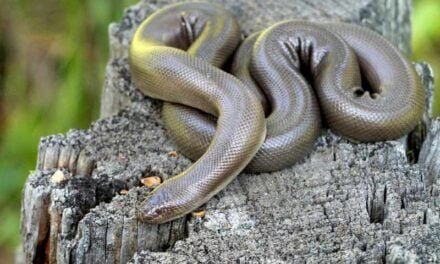
This is the African egg-eating snake, a member of the genus Dasypeltis. It is one of the most highly specialized eaters in the animal kingdom. While most snakes are generalist hunters that will eat mice, frogs, birds, or insects, this snake eats absolutely nothing but bird eggs. It does not drink water often, and it does not chase moving prey.
To survive on this incredibly specific diet, the egg-eating snake had to completely redesign its own body. It got rid of its teeth, turned its skin into a super-stretchy sheet, and developed a built-in can opener inside its own throat.
The Problem with Teeth
If you look inside the mouth of a typical snake, like a garter snake or a python, you will see rows of sharp, backward-pointing teeth. These teeth are vital for catching moving prey. They act like tiny fishhooks, holding onto a struggling mouse or frog and preventing it from sliding out of the mouth.
But if you are a snake that only eats bird eggs, teeth are actually a major design flaw.
If the egg-eating snake had long, sharp teeth, the moment it tried to wrap its mouth around a slippery bird egg, the teeth would puncture the shell. The egg would crack open outside the snake’s mouth, and the valuable liquid yolk and white would spill onto the dirt, leaving the snake with nothing but a sticky mess.
To prevent this waste, the egg-eating snake evolved to be almost completely toothless. It has tiny, useless bumps where teeth used to be, but they are buried deep beneath its gums. Its mouth is a smooth, soft, and rubbery tube designed to seal tightly against the smooth surface of an egg without scratching it. This toothless design ensures that the egg remains perfectly intact until it is safely inside the snake’s body.
The Ultimate Stretchy Sock
Swallowing an egg that is wider than your own body requires an incredible amount of flexibility. Many people believe that snakes can unhinge their jaws to swallow large meals, but the reality is much more elegant.
A snake’s lower jaw is not made of a single, solid bone like ours. Instead, the jaw is split into two separate bones that are joined at the chin by a highly elastic ligament. This ligament acts like a strong rubber band, allowing the two sides of the jaw to spread wide apart.
In the egg-eating snake, this flexibility is taken to an extreme. The skin under the snake’s chin and neck is incredibly loose and elastic, resembling a folded piece of fabric. When the snake finds a bird nest, it nudges the egg with its snout to check its size and freshness. If the egg is suitable, the snake opens its mouth and presses its upper jaw against the top of the egg.
Using a slow, alternating movement, the snake walks its jaws over the egg. The left side of the jaw reaches forward, grips the slippery shell with its elastic skin, and pulls. Then the right side does the same.
As the egg slides into the throat, the snake’s neck stretches so thin that you can actually see the color and pattern of the eggshell right through the translucent skin. The snake looks like a thin woolen sock that has been stretched over a large lightbulb.
This swallowing process takes a lot of physical effort. The snake must push its body forward, using the ground for leverage, while its throat muscles contract in rhythmic waves to force the giant, smooth object downward.
The Spine as a Can Opener
Once the egg is completely inside the snake’s neck, the real magic begins. The egg cannot go any further down the digestive tract because the stomach is too small to handle a solid, unyielding sphere. The snake must crack the shell, but it cannot use its mouth or teeth to do so.
Instead, it uses its spine.
If you look at the skeleton of an egg-eating snake, you will see that the vertebrae in its neck are unlike those of any other snake. A few inches behind the head, the bottom of the spine has several long, downward-pointing bony spikes called hypapophyses. These spikes are tipped with an incredibly hard, enamel-like coating, making them look and function exactly like a row of small, built-in saw teeth.
These bony spikes actually protrude right through the wall of the snake’s throat, sitting directly in the path of the incoming egg.
Once the egg is positioned directly beneath these spine spikes, the snake begins to move its neck in a tight, horizontal S-curve. It presses its neck muscles downward, forcing the egg upward against the bony saw teeth.
The snake slides the egg back and forth against the spikes. The hard, enamel-tipped bones slice a clean line down the length of the eggshell, just like a human using a rotating wheel can opener on a metal tin.
As the shell weakens, the snake collapses its neck muscles with a powerful, sudden squeeze. The egg cracks open, and the rich, nutrient-filled liquid pours out of the shell, flowing smoothly down the throat and straight into the snake’s stomach.
Squeezing the Garbage
At this point in the meal, the snake’s stomach is filled with liquid gold. But it is still left with a major problem: the empty, crushed eggshell is still sitting in its throat.
Eggshells are made of calcium carbonate, which is incredibly difficult to digest. If the snake swallowed the broken pieces of shell, the sharp, jagged edges could easily puncture its delicate stomach lining or intestines, causing fatal internal bleeding. Even if the shell did not hurt the snake, digesting it would take a massive amount of energy and fill the stomach with useless waste.
To solve this, the egg-eating snake uses a specialized muscle system to sort the food from the trash.
Directly behind the spine spikes, the snake’s throat has a muscular valve that acts like a fine-mesh strainer. This valve allows the liquid yolk and white to flow freely into the stomach but blocks the hard pieces of shell from moving any further.
Once the liquid is squeezed out, the throat muscles go to work on the remaining shell. They compress the broken pieces, folding and rolling them together into a tight, compact, and canoe-shaped package.
With a series of gentle, undulating throat movements, the snake lifts its head and opens its mouth. It regurgitates, spitting the crushed, dry packet of shell back out onto the ground. The entire process is incredibly clean. The snake walks away with a full stomach, leaving behind nothing but a small, dry piece of folded white waste that looks like a crumpled piece of paper.
The Viper Bluff
Because the egg-eating snake has evolved to have no teeth and no venom, it is completely defenseless. It cannot bite a predator, and it cannot run away very quickly. To a hungry bird, mongoose, or monitor lizard, this gentle reptile looks like an easy, protein-rich snack.
To stay safe in a dangerous world, the egg-eating snake relies on a brilliant theatrical performance: it pretends to be a deadly killer.
The snake’s scales are colored in dusty shades of brown and gray, with dark, diamond-shaped markings along its back. This pattern looks almost identical to the saw-scaled viper, one of the most venomous and feared snakes in Africa.
When a predator gets too close, the egg-eating snake does not cower. It coils its body into a series of tight, overlapping C-shapes and begins to move in a continuous, sawing rhythm.
Its body scales are rough and rigid, with specialized serrated edges. As the snake moves, these rough scales rub against each other, creating a loud, rasping, and highly convincing hissing sound. It sounds exactly like a deadly viper warning a predator to back off.
To make the bluff even more terrifying, the snake will lunge forward with its mouth wide open, pretending to strike. Because it has no teeth, the strike is completely harmless, but the sight of a gaping mouth and the sound of hissing scales is usually more than enough to scare away even the bravest predators. The snake survives entirely on the reputation of its neighbors.
Final Thoughts
The African egg-eating snake is a wonderful reminder that evolution does not always favor the creature with the sharpest claws or the strongest bite. By focusing its resources on a single, specific food source, this quiet reptile carved out an exclusive niche where it does not have to compete with other hunters.
It took the simple challenge of eating an egg and solved it through a beautiful series of physical adjustments. It turned its mouth into a soft seal, its skin into a stretchy blanket, and its spine into a tool for cracking dinner. It is a quiet, toothless master of efficiency, proving that with the right design, you can turn a hard, slippery obstacle into a perfect, worry-free feast.