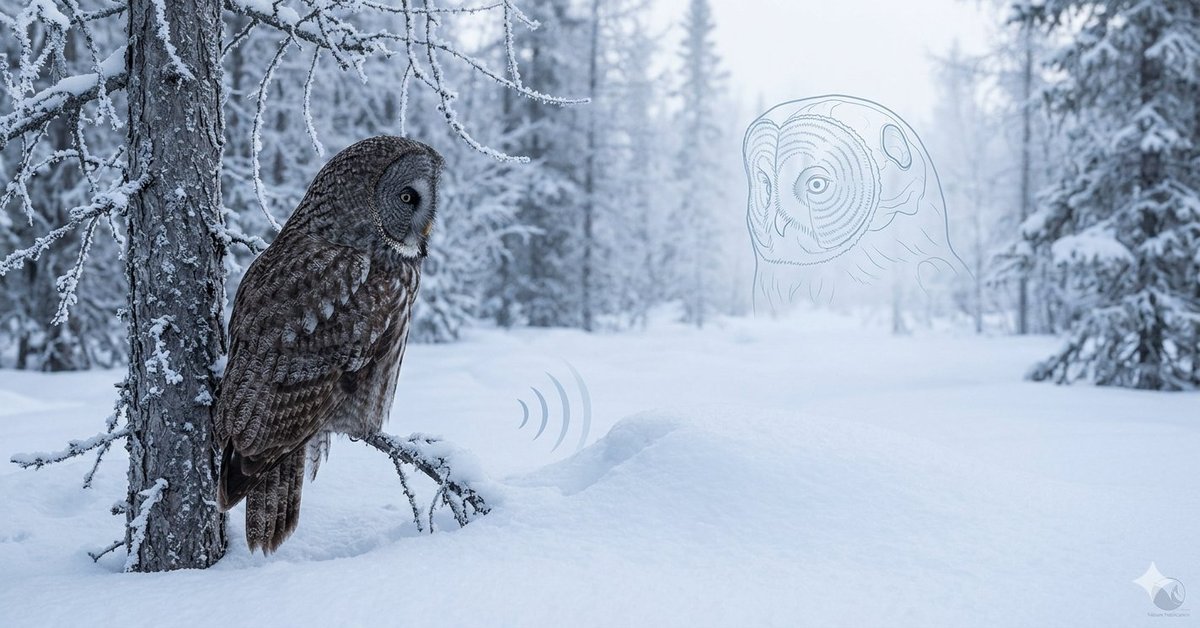
In the northern boreal forests, the winters are silent. The snow piles up until it is several feet deep, burying the world in a thick, white blanket. For most predators, this is a time of starvation. They cannot see what is moving beneath the surface. But the Great Gray Owl is different. This bird can sit on a branch in total darkness, listen to the heartbeat of a tiny rodent under two feet of snow, and strike with the precision of a guided missile.
This is not a bird that relies on its eyes to find food. It uses sound. The Great Gray Owl has the most specialized hearing of any raptor on earth. It has turned its entire face into a biological sensor.
The Satellite Dish Face
When you look at a Great Gray Owl, the first thing you notice is its massive, round face. This is called a facial disc. While other owls have them, the Great Gray’s disc is the largest in the bird world. It is made of stiff, dense feathers that are arranged in concentric circles.
These feathers act like a satellite dish. They capture sound waves from the environment and funnel them directly into the owl’s ear openings. Because the disc is so large, it can pick up incredibly faint noises. If a vole—a small mouse-like creature—takes a single step or nibbles on a root deep under the snow, the owl hears it.
The owl’s ears are also asymmetrical. One ear opening is higher on the skull than the other. This allows the bird to track sound in three dimensions. The sound reaches one ear a fraction of a second before the other. By tilting its head, the owl can pinpoint exactly where the noise is coming from, both horizontally and vertically. It creates a mental map of a world it cannot see.
Piercing the Snow Crust
Once the owl locates its prey, it has to get to it. In mid-winter, the snow isn’t just deep; it often has a hard, icy crust on top. A smaller bird would bounce right off that ice.
The Great Gray Owl is a heavy-duty hunter. It weighs about two to three pounds, but its wingspan can reach five feet. When it dives, it tucks its wings and drops like a stone. Just before impact, it thrusts its legs forward. Its talons are strong enough to punch through a crust of ice that could support the weight of a human.
It hits the snow feet-first. The owl can reach down into the powder to a depth of 18 inches or more. It grabs the vole blindly, relying entirely on the “acoustic snapshot” it took before it left the branch. Most of the time, the owl comes up with its dinner.
The Stealth of Silent Flight
You can stand five feet away from a Great Gray Owl while it takes off, and you will hear nothing. Their flight is perfectly silent.
Most birds have stiff feathers that “whistle” as they cut through the air. You can hear a duck or a hawk coming from a distance. The Great Gray Owl has evolved three specific features to stay quiet:
- Comb-like Edges: The leading edges of their primary wing feathers have a fringe that looks like a comb. This breaks up the air turbulence into smaller, quieter waves.
- Velvety Surface: The top of the feathers is covered in a soft, downy fringe. This muffles the sound of the feathers rubbing against each other as the wings flap.
- Trailing Fringe: The back edge of the wing has a soft fringe that further reduces air noise as the wind leaves the wing.
This silence is not just for sneaking up on prey. It is also for the owl’s own benefit. If its own wings made noise, the owl wouldn’t be able to hear the faint scurrying of a vole under the snow while it was in the air. The bird has to be silent to keep its “sonar” working.
A Life in the Cold
The Great Gray Owl lives in the “taiga” and mountain forests of the Northern Hemisphere. They stay in the north year-round. While other birds fly south to avoid the cold, the Great Gray is built for it.
They have thick layers of down feathers under their exterior feathers. They are much smaller than they look; most of the “owl” you see is actually just a massive coat of insulation. This allows them to maintain a body temperature of 104 degrees Fahrenheit even when the outside air is 40 degrees below.
They are also very patient. A Great Gray Owl can sit on the same branch for hours without moving. It is conserving energy. In the winter, a single failed hunt can be the difference between life and death. They don’t fly around searching; they sit and listen. They let the forest bring the food to them.
The Role of the Vole
The owl’s survival depends almost entirely on the vole population. Voles have a cycle where their numbers boom every three to five years and then crash. In a “crash” year, Great Gray Owls will travel hundreds of miles south to find food. This is called an “irruption.”
When this happens, people in southern Canada or the northern U.S. might see dozens of owls in places they never usually visit. They often show up along roadsides because the plowed snow at the edge of the road makes it easier to catch rodents.
Threats to the Ghost
Because these owls live in remote forests, they don’t have many natural predators. However, they are threatened by habitat loss. They need old-growth forests with large, dead trees to nest in. They don’t build their own nests; they take over old hawk nests or use the tops of broken-off trees.
Climate change is also a factor. If the winters become too warm, the snow might melt and refreeze into a layer of ice that even a Great Gray Owl cannot break. If they cannot get through the snow to the voles, they cannot survive the winter.
How to See One
Finding a Great Gray Owl is difficult. They are masters of camouflage. Their grey and brown feathers blend perfectly with the bark of a tamarack or pine tree. They are often called “The Ghost of the North” because they appear and disappear without a sound.
If you are looking for one, look for a large shape on a low branch near a meadow. They hunt at dawn and dusk. Don’t look for movement; look for a break in the vertical lines of the tree trunks. And listen. You won’t hear them fly, but you might hear their deep, rhythmic “whoo” call that can carry for miles through the cold air.
Final Thoughts
The Great Gray Owl is a specialist in the extreme. It has abandoned the fast, aggressive hunting style of a hawk for a method based on math and silence. It has turned its face into a microphone and its wings into mufflers.
This bird shows us that in nature, you don’t always need to see your target to hit it. Sometimes, you just have to listen better than everyone else. The owl is a reminder that even in the middle of a frozen, silent forest, there is life moving under the surface. As long as the voles are scurrying and the snow is falling, the Great Gray Owl will be there, waiting on its branch, listening to the heartbeat of the woods.