If you were to drop a heavy weight off the side of a boat in the open ocean and ride it straight down into the abyss, you would quickly leave the world you know behind. After a few hundred meters, the sunlight fades to a murky twilight. Keep going past a thousand meters, and the ocean turns into a pitch-black, freezing void.
This deep pelagic zone is one of the most hostile environments on the planet. The crushing pressure would instantly implode most surface vessels. The temperatures hover just above freezing. But the most terrifying aspect of this particular depth isn’t the cold or the darkness. It is the lack of oxygen.
Between roughly 600 and 1,200 meters deep lies a layer known as the oxygen minimum zone, often simply called the “dead zone.” Here, dissolved oxygen levels can drop to less than three percent of what you find at the surface. It is a suffocating environment where most complex life simply cannot survive.
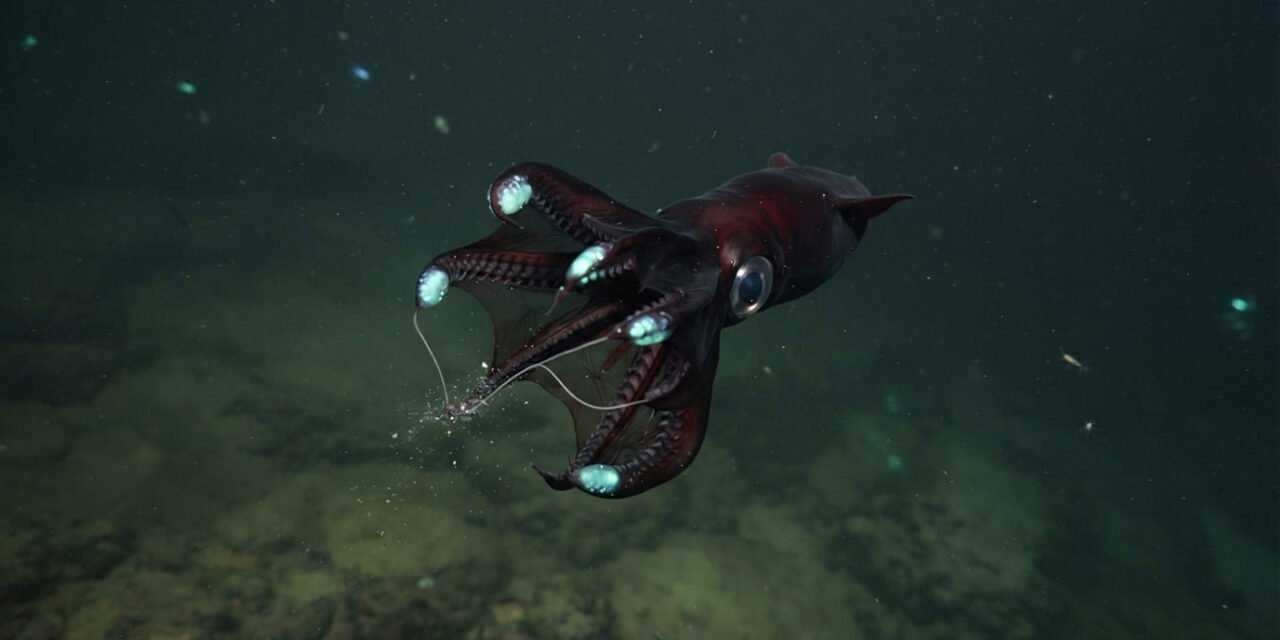
Yet, floating quietly in this suffocating darkness is a creature that seems pulled straight from a gothic horror novel. With its blood-red skin, glowing blue eyes, and webbing that looks like a high-collared cape, Vampyroteuthis infernalis, literally translated as the “vampire squid from hell,” looks like a deep-sea nightmare.
But if you look past its terrifying name and intimidating appearance, you find an incredibly peaceful, highly specialized animal that has completely hacked the physics of the deep ocean.
Neither Squid Nor Octopus
When marine biologists first hauled one of these creatures up in a deep-sea net over a century ago, they didn’t know exactly what to make of it. It looked somewhat like a squid, and somewhat like an octopus, but it didn’t quite fit the anatomical rules of either.
It turns out, the vampire squid is a living relic. It is the only surviving member of an entire order of cephalopods known as Vampyromorphida. It sits on a lonely branch of the evolutionary tree, suspended somewhere between octopuses and squids, possessing traits from both while maintaining features that are entirely its own.
Like an octopus, it lacks the two long, specialized feeding tentacles that squids use to snatch fast-moving prey. Instead, it relies on eight primary arms. But unlike any octopus, these arms are connected by a thin, fleshy webbing that forms a distinct, umbrella-like skirt.
The creature’s namesake comes from the dark color of its skin, which ranges from velvety black to deep, rusty red. At the tips of its arms, instead of suckers, it features rows of fleshy, sharp-looking spikes called cirri. When the animal is threatened, it flips its webbed arms backward over its head. This defensive posture, known as the “pineapple pose,” hides its vulnerable body and exposes an outward-facing sphere of these spiky projections. It looks exactly like Dracula pulling a spiked cape over his face.
However, despite this aggressive-looking display, the vampire squid is completely harmless. It has no ink sac, no venom, and almost no capacity for sudden, explosive movement.
Surviving on the Edge of Suffocation
To understand why the vampire squid is so slow and passive, you have to look back at the dead zone it calls home.
In an environment with almost zero oxygen, high-speed pursuits are impossible. If a predator tries to sprint, it will quickly burn through its limited oxygen reserves and essentially suffocate itself from exertion. The oxygen minimum zone is a slow-motion world.
Vampyroteuthis infernalis thrives here because it has the lowest metabolic rate of any known deep-sea cephalopod. Its entire physiology is built around radical energy conservation.
First, its body tissue is incredibly gelatinous. Unlike the dense, muscular mantles of shallow-water squids, the vampire squid’s flesh is watery and buoyant. It requires very little energy to maintain its position in the water column because it is essentially neutrally buoyant. It doesn’t have to swim to stay afloat; it just hovers.
Second, the vampire squid has evolved a highly specialized respiratory system. Its gills possess an incredibly large surface area, designed to extract every single available molecule of oxygen from the surrounding water. Furthermore, its blood contains hemocyanin, a copper-based protein that turns blue when oxygenated, which binds to oxygen far more efficiently in cold, low-pressure environments than the hemoglobin found in human blood.
This ultra-efficient biology allows the vampire squid to live exactly where the apex predators of the deep sea cannot. Fast-moving hunters like the Greenland shark (Somniosus microcephalus) or deep-diving marine mammals simply cannot tolerate the oxygen deprivation of the dead zone for long periods. The vampire squid traded physical speed for a biological safe room.
The Deep-Sea Scavenger
Because it cannot chase down fast-moving prey, the vampire squid had to rethink its entire diet. Shallow-water cephalopods are notoriously aggressive hunters, constantly snatching fish, crabs, and other squids. The vampire squid, however, has abandoned hunting altogether.
It is a detritivore. It eats garbage.
Specifically, it feeds on a substance marine biologists refer to as “marine snow.” As animals die near the surface, and as plankton and algae go through their natural life cycles, bits of organic matter slowly drift downward into the abyss. This endless, gentle rain of dead tissue, feces, and mucus is the primary food source for much of the deep ocean.
But marine snow is incredibly diffuse. Catching enough of it to sustain a meal is like trying to catch enough falling snowflakes on your tongue to quench a deep thirst.
To solve this, the vampire squid utilizes two highly specialized, thread-like filaments that are unique to its species. These filaments are incredibly long, sometimes extending well over a meter, which is much longer than the squid’s actual body. They are housed inside special pouches located between the animal’s arms.
When the squid is hungry, it simply hovers in the dark and deploys these long threads, letting them drift outward on the subtle deep-ocean currents. The filaments are covered in sensory hairs and sticky cells.
As the marine snow drifts down, bits of detritus stick to the deployed filaments. The squid waits patiently until a substantial amount of material has collected. Then, it slowly reels the thread back in. Using its arms, it scrapes the accumulated organic matter off the filament, packing the dead tissue and mucus into small, manageable spheres. It then uses its beak to consume the dense little pellets of marine snow.
It is the only cephalopod on Earth known to feed this way. It essentially fishes for dead matter using a sticky string.
The Bioluminescent Light Show
Living in complete darkness presents another unique challenge: communication and defense. When there is no sunlight, animals have to make their own.
Vampyroteuthis infernalis is a master of bioluminescence, possessing light-producing organs called photophores scattered across its entire body. Unlike many deep-sea creatures that use a single, glowing lure to attract prey, like the infamous anglerfish, the vampire squid uses light primarily to confuse and disorient.
At the very tips of its webbed arms, the squid has large, highly concentrated photophores. When a potential predator, such as a deep-diving fish, manages to spot the squid in the gloom, the vampire squid will flash these arm-tip lights intensely. Because the lights are located at the far edges of its body, this display makes the squid appear much larger than it actually is. It can also wave these glowing tips erratically, making it incredibly difficult for a predator to determine exactly where the squid’s main body is located.
Perhaps the most astonishing defensive trick involves its eyes. The vampire squid has the largest eyes relative to body size of any animal on the planet. They are usually a pale, milky blue. But right above these eyes are two massive, highly complex photophores that can be opened and closed like shutters.
When threatened, the squid will close the dark skin over its actual eyes and open these glowing “false eyes.” As a predator approaches, the squid slowly closes the shutters over the glowing organs, making the lights gradually shrink and fade into darkness. To a predator’s brain, this gradual dimming creates a powerful optical illusion. It looks exactly like the squid is rapidly swimming away into the distance, even though the animal hasn’t actually moved an inch.
If the illusion fails, and a predator gets too close, the vampire squid has one final, desperate defense mechanism.
Because it lacks an ink sac, ink is entirely useless in pitch-black water; it uses something far stranger. From the tips of its arms, it ejects a thick, glowing cloud of bioluminescent mucus. This sticky, radiant goo explodes in the water, creating a dazzling, blinding cloud of blue light. The glowing mucus often sticks to the predator’s face, overwhelming its sensitive eyes and marking it as a target for other, larger hunters in the area.
While the predator is flailing in a cloud of glowing slime, the vampire squid powers its way into the darkness using a pair of small, ear-like fins on the side of its mantle, disappearing back into the suffocating gloom of the dead zone.
The Ultimate Survivor
It is incredibly easy to look at deep-sea creatures and categorize them as monsters. Their adaptations are so alien to our surface-dwelling minds that they often seem terrifying.
But when you truly understand the vampire squid, the terrifying facade falls away completely. It is not a bloodthirsty hunter from hell. It is a slow, quiet scavenger. It is an animal that realized the best way to survive in a hostile world wasn’t to fight harder or swim faster, but to simply retreat to a place where nothing else could survive and learn to eat the things no one else wanted.
Vampyroteuthis infernalis didn’t conquer the deep ocean through brute force. It conquered it through extreme patience, biological efficiency, and a masterclass in optical illusions. In the quiet, suffocating darkness of the dead zone, the vampire squid is a brilliant reminder that sometimes the most successful strategy in nature is simply finding a quiet corner and refusing to die.