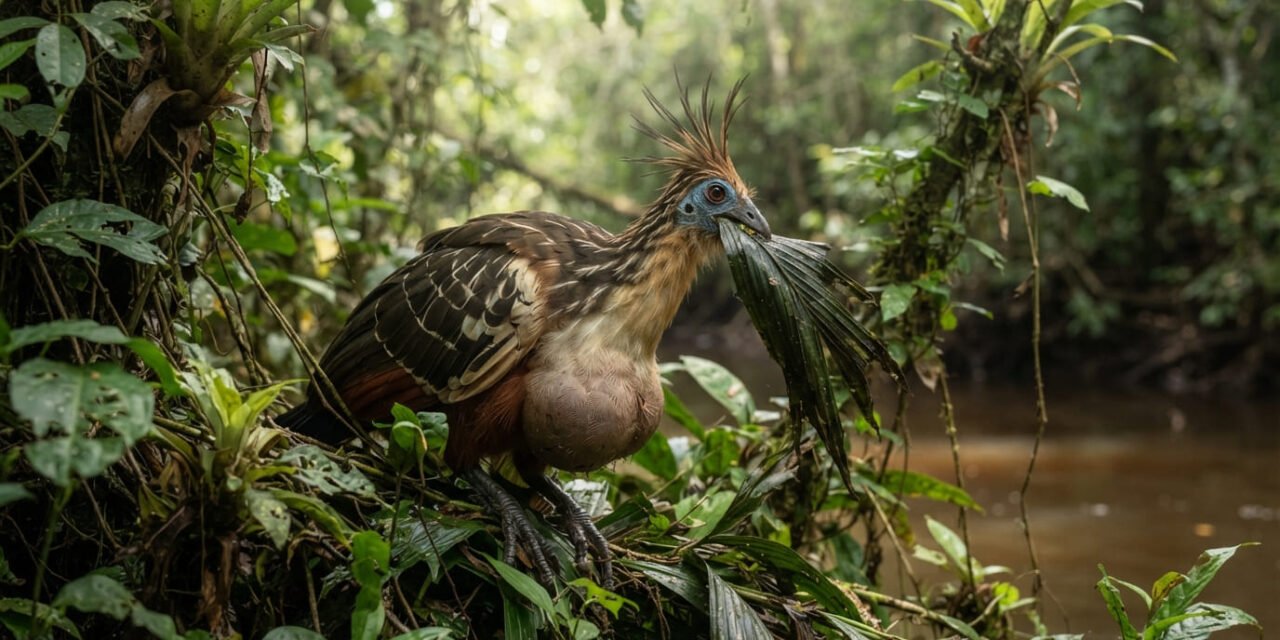
If you find yourself in the backwaters of the Amazon or the Orinoco basins, you might spot a bird that looks like it missed the memo on the last 60 million years of evolution. The Hoatzin (Opisthocomus hoazin) is a strange, prehistoric-looking creature with a bright blue face, blood-red eyes, and a wild, spiky crest. It is famous for being a clumsy flier and for a distinct, manure-like odor that follows it everywhere. But the most significant thing about this bird is not how it looks or smells. It is how it eats.
The Hoatzin is the only bird in the world that survives almost exclusively on a diet of green leaves. In the avian world, this is a biological “illegal move.” Leaves are incredibly difficult to turn into energy. They are packed with cellulose, which is a tough structural fiber, and often laced with toxic compounds meant to ward off herbivores. To get any nutrition out of a leaf, an animal needs a massive, slow-moving digestive system. This is why you see cows, deer, and sheep—the ruminants—standing around for hours chewing cud. They have the internal space for a heavy, liquid-filled fermentation vat.
Most birds cannot afford this weight. Flying requires an extreme power-to-weight ratio. A bird with a stomach full of heavy, fermenting mulch would be too heavy to take off. Yet, the Hoatzin has spent millions of years refining a system that allows it to live like a cow while nesting in the treetops.
The Physics of the “Flying Rumen”
To understand why the Hoatzin is so unique, you have to look at its chest. In a typical bird, like a pigeon or a hawk, the chest is dominated by massive pectoral muscles attached to a large keel-shaped breastbone. These muscles provide the power for flight. In the Hoatzin, these muscles are shrunken and displaced.
In their place sits an enormous, multi-chambered crop. In other birds, the crop is just a simple storage bag where seeds sit before moving to the stomach. In the Hoatzin, the crop and the lower esophagus have evolved into a complex fermentation laboratory. This organ accounts for nearly 10% of the bird’s total body weight. When it is full of freshly eaten leaves, it can be much heavier.
This large internal “vat” is what makes the Hoatzin such a poor flyer. The bird has sacrificed the structural real estate usually reserved for flight muscles to make room for its gut. When you see a Hoatzin “fly,” it looks more like a desperate, flapping hop from one branch to another. It cannot sustain flight for long distances because it simply doesn’t have the muscle mass to move its heavy, leaf-filled body through the air. It is a bird that has traded the sky for a steady, unlimited supply of food that no other bird can touch.
Bacterial Fermentation: The Microscopic Labor Force
The Hoatzin does not actually digest the leaves itself. It employs a massive colony of symbiotic bacteria to do the work. This process is known as foregut fermentation, and it is identical to the process used by cattle.
When the bird swallows a leaf, the material enters the crop, which is kept at a specific pH and temperature. The bacteria go to work breaking down the cellulose and hemicellulose. As these fibers break down, they release volatile fatty acids. These acids are the primary energy source for the bird. Without these microbes, the Hoatzin would starve to death with a full stomach, as its own digestive enzymes are incapable of cracking the tough cellular walls of the tropical plants it consumes.
This process is slow. It can take up to 45 hours for a single meal to pass through the Hoatzin’s system. For comparison, most fruit-eating birds process their food in less than an hour. The Hoatzin lives life in slow motion. It spends roughly 80% of its day perched motionless on a branch, letting the bacteria in its chest simmer and process its lunch.
There is a side effect to this constant internal composting: the smell. Because the fermentation happens in the foregut (the crop), the gases produced by the bacteria escape through the bird’s mouth. The Hoatzin breathes out the scent of a fermented marsh or a cow pasture. This is why locals in South America often call it the “Stinkbird.” Predators generally avoid them because the meat is said to taste just as bad as the bird smells, flavored by the high concentrations of secondary plant compounds and bacterial byproducts.
Chemical Warfare and Filtration
The leaves of the tropical rainforest are not just tough; they are dangerous. Trees like the Arum species, which the Hoatzin loves, are loaded with alkaloids and cardiac glycosides. These are chemicals designed to stop animals from eating the leaves by messing with their hearts or nervous systems.
The Hoatzin’s bacterial colony acts as a front-line defense. Many of these bacteria have evolved specifically to break down and neutralize these toxins before they ever reach the bird’s actual stomach or intestines. The crop is a chemical processing plant. By the time the food moves further down the digestive tract, the poisons have been dismantled into harmless components.
This gives the Hoatzin a massive competitive advantage. While other birds are constantly searching for rare fruits or high-protein insects, the Hoatzin is surrounded by a literal ocean of green food that is “poisoned” to everyone else but “dinner” to them. They never have to travel far to find a meal, which is fortunate, considering they can barely fly.
The Mystery of the Wing Claws
The Hoatzin’s strange biology is not limited to its gut. The most famous feature of the species appears when they are chicks. Hoatzin nests are almost always built on branches that hang directly over water. This is a deliberate security strategy.
If a predator—like a capuchin monkey or a large snake—approaches the nest, the chicks do not try to fly away. They are far too young for that. Instead, they bail out. They jump directly into the water below. They are surprisingly good swimmers and can even dive to hide from predators on the surface.
The problem is getting back to the nest. A wet, flightless chick at the base of a tropical tree is an easy snack for a caiman or a large fish. To solve this, Hoatzin chicks are born with two large, functional claws on the “thumb” and “index finger” of each wing. These are not just vestigial bumps; they are sharp, curved talons with strong muscles behind them.
The chick uses these claws like a mountain climber using ice axes. It hooks the claws into the bark and hitches itself back up the tree, limb by limb, until it reaches the safety of the nest. This is a visual echo of Archaeopteryx, the famous “missing link” between dinosaurs and birds. For a long time, people thought the Hoatzin might be a direct primitive survivor from that era. Modern DNA testing has shown they are actually a more modern lineage that simply re-evolved (or retained) these traits because their specific environment demanded it.
As the chick grows and its flight feathers come in, these claws fall off or are absorbed. The adult Hoatzin no longer needs them because it has developed its “flying cow” digestive system and can move (clumsily) through the canopy.
Why You Should Care
The Hoatzin is a living masterclass in trade-offs. In nature, you rarely get something for nothing. If you want to eat the most abundant food source in the forest (leaves), you have to give up the ability to be a high-performance flier. You have to accept a slow metabolism and a scent that keeps you socially isolated from other species.
The Hoatzin reminds us that “success” in the wild isn’t always about being the fastest, the strongest, or the most beautiful. Sometimes, success is just being the one who can eat the leaves that everyone else thinks are trash. It is a bird that has successfully integrated the lifestyle of a 1,000-pound mammal into a 2-pound frame, proving that as long as you have the right bacteria on your side, you can survive almost anything.
Quick Tips for Observing the Hoatzin
If you ever travel to see these birds, keep these three things in mind:
- Listen for the grunting. They aren’t songbirds. They make a sound like a heavy breather or a rhythmic croaking, which is often the first sign they are nearby.
- Look for “un-birdlike” movement. If you see something in the trees that looks like it’s struggling to climb rather than hopping, it’s likely a Hoatzin.
- Respect the smell. Don’t expect a pleasant tropical aroma. If the wind shifts and you suddenly smell a barnyard in the middle of a swamp, you’ve found their colony.
The Hoatzin is a weird, wonderful anomaly. It is a reminder that the world is much weirder than the standard nature documentaries usually portray. It is a dinosaur-clawed, leaf-eating, cow-smelling bird that has found its own perfect way to live in one of the most competitive environments on Earth.