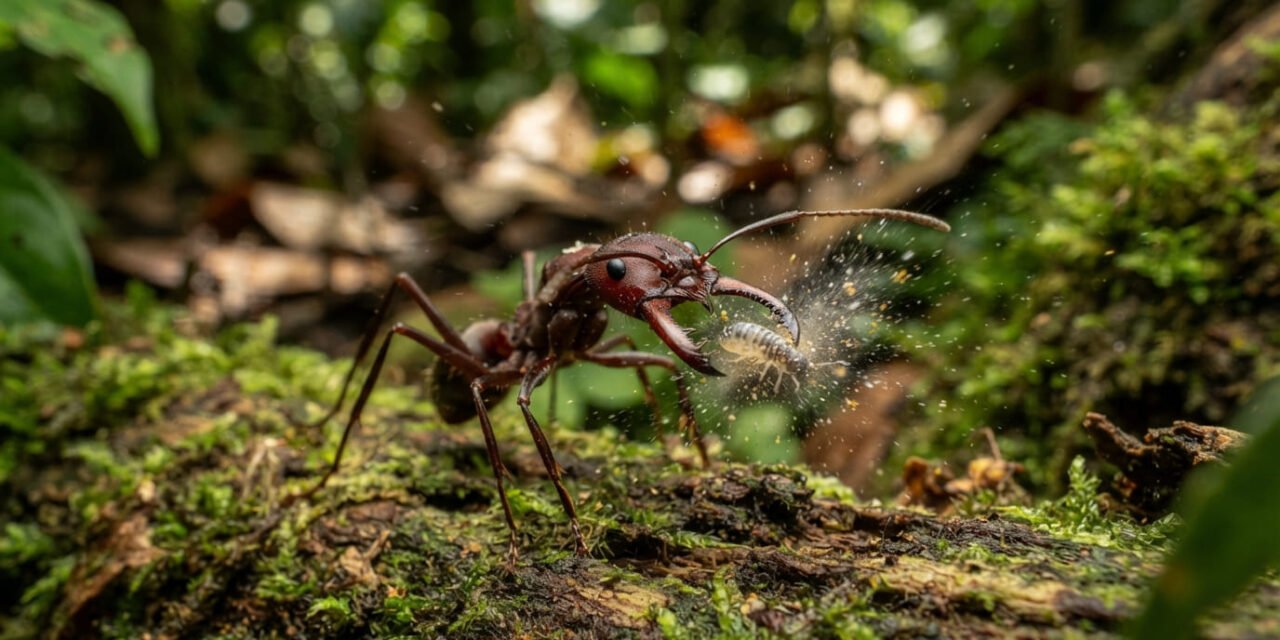
If you blink, you miss it. The Trap-Jaw Ant possesses one of the fastest moving body parts in the animal kingdom. Its mandibles snap shut at speeds reaching 145 miles per hour. This isn’t just a quick bite. It is a mechanical explosion. To put that speed in context, the strike happens in 0.13 milliseconds. That is 2,300 times faster than the blink of a human eye.
These ants live in tropical and subtropical regions across the globe. They are predators that hunt small insects, but their jaws serve two purposes. They are a lethal weapon for catching prey and a high-speed ejection seat for escaping danger. The biology behind this movement is a masterclass in kinetic energy storage.
The Mechanical Latch
Muscles alone cannot produce this kind of speed. If the ant relied only on muscle contraction, the jaws would move much more slowly. Instead, the Trap Jaw Ant uses a “latch-mediated spring actuation” system. Think of it like a crossbow. You spend a long time pulling the string back and locking it into a latch. When you pull the trigger, the latch releases all that stored energy instantly.
Inside the ant’s head, two large “closer” muscles pull back on the mandibles. As these muscles contract, they don’t move the jaws yet. An internal latch holds the jaws wide open at an angle of 180 degrees. This creates massive tension in the head’s exoskeleton. The ant’s head actually deforms slightly under the pressure, acting like a compressed spring.
The ant has two long, sensitive trigger hairs inside its mouth. When a spider or a cricket touches these hairs, the nervous system sends a signal to the latch. The latch releases. All the energy stored in the deformed exoskeleton and the contracted muscles dumps into the mandibles at once. The result is a strike that delivers a force 300 times the ant’s own body weight.
The Physics of Flight
The Trap-Jaw Ant uses its jaws for more than just eating. If a larger predator, like a lizard or a bird, threatens the ant, it uses its mouth to fly. The ant points its head toward the ground and triggers its jaws. When the mandibles hit the hard surface, the force of the strike kicks the ant into the air.
This is a defensive maneuver called the “propulsion jump.” A single strike can launch the ant eight inches into the air and nearly fifteen inches away. For a human, this would be the equivalent of jumping over a two-story building using only your teeth.
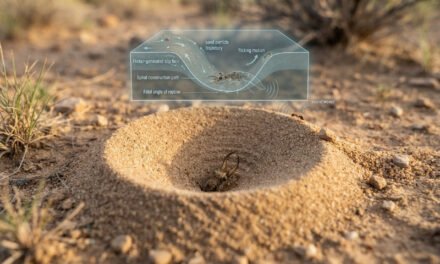
The ant often uses this move to escape “antlion” pits. These are funnel-shaped traps in the sand made by another insect. If a Trap-Jaw Ant falls in, it doesn’t try to climb out. It strikes the sand, and the recoil blasts it out of the pit. It is a chaotic escape—the ant often flips and spins in the air—but it is effective. The speed of the strike is so high that the predator doesn’t have time to react before the ant has vanished.
Handling the Recoil
With that much force, you might expect the ant’s head to shatter. The ant’s exoskeleton is reinforced with specific proteins and minerals that make it both hard and elastic. The joints of the mandibles are shaped like a ball-and-socket but with extra padding.
When the jaws snap shut, the impact creates a massive vibration. The ant’s brain is protected by a layer of connective tissue that dampens this vibration. Without this protection, the ant would give itself a concussion every time it caught a bug.
The “trigger” hairs are also highly specialized. They aren’t just hairs; they are sensors connected to the largest neurons in the ant’s body. This ensures the signal travels from the hair to the latch as fast as possible. Any delay would give the prey a chance to move. In the world of the Trap-Jaw Ant, a millisecond is the difference between a meal and an empty stomach.
The Cost of the Strike
Generating 145 mph movement requires a lot of energy. The muscles in the ant’s head are huge, taking up nearly half the space inside its skull. This leaves very little room for other organs. The ant has to eat frequently to maintain the chemical energy needed to “cock” the spring.
The ant also has to be careful about when it strikes. If it misses the target, it still experiences the massive recoil. A “dry fire” can be disorienting. The ant usually waits until it is certain of the hit. It uses its antennae to feel the exact position of the prey before the trigger hairs are touched.
Why You Should Care
Engineers study the Trap-Jaw Ant to build better micro-robots and small-scale machinery. Traditional motors are often too heavy or slow for tiny robots. By copying the ant’s latch and spring system, researchers can create robots that jump or move with incredible speed using very little battery power.
We also learn about material science. The ant’s ability to withstand 1,200g of force during its jump is better than most man-made materials. By looking at the microscopic structure of the ant’s head, we can develop tougher helmets and more resilient tools.
Hunting Tactics
When hunting, the Trap-Jaw Ant is a solitary worker. It walks slowly with its jaws locked open at 180 degrees. It looks like it’s carrying a pair of wire cutters on its face. It focuses on small, fast prey like springtails. These are tiny insects that jump when they feel a vibration.
The ant is so fast that it can catch a springtail before the springtail can jump. It is a battle of reflexes. The ant’s nervous system is hardwired for this single, explosive movement. Once the jaws close, they lock onto the prey. The ant then uses its stinger to finish the job. Most ants either bite or sting; the Trap-Jaw Ant does both with terrifying speed.
Colony Life
In a colony, these ants are highly organized. While one group hunts, others guard the nest. If an intruder enters the colony, the guards use their “jaw-jumping” to create a chaotic environment. Dozens of ants popping into the air at once can confuse a larger predator.
They also use their jaws to move heavy debris. If a rock is blocking a tunnel, several ants will strike it simultaneously. The combined force of their “hammers” can move objects many times their weight. They are the demolition experts of the insect world.
Observation in the Wild
If you see these ants in the leaf litter, you can identify them by their long, straight mandibles. They don’t look like typical ants. They look more like soldiers. If you get too close, you might hear the “click” of their jaws. That sound is the latch releasing.
Do not try to pick one up. While they are small, the strike can break human skin, and the follow-up sting is painful. They are a reminder that in the forest, size doesn’t determine who is the most dangerous. Sometimes, the smallest creature has the most advanced technology.
Final Thoughts
The Trap-Jaw Ant is a biological machine. It has traded the flexibility of a normal mouth for a high-speed weapon. It shows that evolution often favors specialization. By becoming the “fastest strike” in the forest, this ant has secured its place in the ecosystem.
It survives because it uses physics to its advantage. It stores energy, locks it with a latch, and releases it with a trigger. Whether it is catching a meal or launching itself into the safety of the air, the Trap-Jaw Ant proves that speed is the ultimate survival tool.