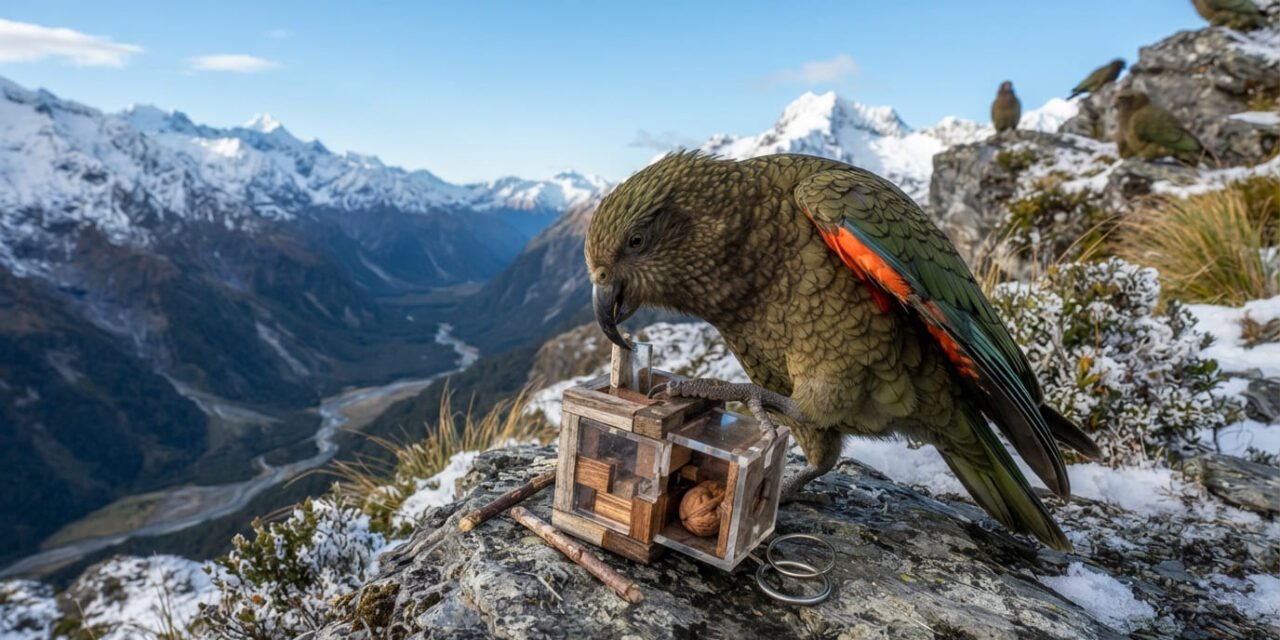
When most people think of parrots, they imagine bright green birds sitting on tropical palm trees in the hot sun. But in the snowy, rugged Southern Alps of New Zealand, there lives a very different kind of parrot. This bird doesn’t like the heat; it loves the cold, the wind, and the snow. This is the Kea.
The Kea is often called the “Mountain Parrot,” but it has another nickname: “The Monkey of the Mountains.” This is because the Kea is incredibly smart, curious, and a little bit naughty. Scientists who study animal intelligence believe the Kea might be the smartest bird in the world. In this blog, we are going to explore the life of this mountain genius and find out what makes them so special.
A Bird Built for the Cold
The Kea is a large parrot with olive-green feathers. At first glance, it might look a bit dull, but when it spreads its wings, you see a flash of brilliant orange underneath. This is their “hidden” beauty.
Because they live high in the mountains where it can be cold, Keas have thick, strong feathers to keep them warm. They have powerful, curved beaks that they use like a multi-tool. They can use their beak to dig for roots, crack nuts, or even slide open latches on human doors. They are the only parrots in the world that live in an alpine environment, which means they have to be very clever just to find food in the snow.
The Problem Solvers
The reason scientists are so impressed by Keas is their ability to solve complex puzzles. In many experiments, Keas have shown that they can think ahead and plan their actions.
1. Using Tools
In the wild, Keas have been seen using sticks as tools to reach bugs inside logs. In laboratories, researchers have given Keas boxes that require several different steps to open—like pulling a string, then turning a key, then pushing a button. The Keas don’t get frustrated; they study the box, figure out how it works, and open it in record time.
2. Working Together
Keas are also social learners. They watch each other to learn new tricks. If one Kea figures out how to open a “predator-proof” trash can, the rest of the group will watch and learn exactly how it was done. This “cultural learning” is a sign of very high intelligence, usually only seen in humans, monkeys, and dolphins.
The “Naughty” Parrot
If you ever visit the mountains of New Zealand, you will likely meet a Kea, and they will probably try to steal something from you! Keas are famous for their curiosity. They are not afraid of humans; in fact, they seem to find us very entertaining.
They have been known to:
- Unzip backpacks to steal snacks.
- Pull the rubber seals off the car windows (they love the texture of rubber).
- Steal shiny objects like keys or coins.
- Lock tourists inside outdoor toilets by sliding the latch from the outside!
While this can be annoying for travelers, it is actually a sign of their intelligence. This behavior is called “neophilia,” which means a love for new things. In a harsh mountain environment, being curious is a survival skill. If a Kea finds something new, it wants to know: “Can I eat this? Can I play with this? Can I use this?”
The Importance of Play
One of the most human-like traits of the Kea is that they love to play. They don’t just “play” to learn skills; they seem to play just for fun.
Scientists have even discovered that Keas have a specific “play call.” When one Kea makes this sound, it acts like a laugh. Other Keas who hear it will immediately start playing with each other—wrestling in the snow, tossing sticks, or doing somersaults. They are the only birds known to have “contagious laughter.”
Play is a very important part of brain development. It shows that the Kea has extra energy and a complex social life. They aren’t just surviving; they are enjoying their lives.
The “Doctor” of the Mountains
The Kea plays a very important role in the New Zealand ecosystem. They are omnivores, which means they eat almost anything. They eat berries, seeds, nectar, and insects.
When they eat berries, they fly long distances and spread the seeds in their droppings, helping the mountain forests grow. Because they live in places where other birds cannot survive, they are the main “gardeners” for many high-altitude plants. Without the Kea, the mountains of New Zealand would look very different.
A History of Trouble
Unfortunately, the Kea’s intelligence once got them into a lot of trouble. About 150 years ago, farmers in New Zealand began to notice that Keas were attacking their sheep. The birds would land on the sheep’s backs and use their sharp beaks to eat the fat near the kidneys.
Because of this, the government put a “bounty” on the Kea. For many years, people were paid to hunt them. Thousands of Keas were killed before they were finally protected by law in 1986. Today, there are only about 3,000 to 7,000 Keas left in the wild. They are now considered an endangered species.
Protecting the Genius
Today, the biggest threat to the Kea is not farmers, but “invasive species” like stoats and possums. These animals were brought to New Zealand by humans, and they eat the eggs and chicks of the Kea.
Because Keas nest in holes in the ground or under logs, they are very easy for predators to find. Conservationists are working hard to set traps for these predators and to create safe spaces where Keas can raise their families.
We are also learning how to live alongside them. Instead of getting angry when a Kea chews on a car, people are being taught to use “Kea-proof” materials and to never feed them. Feeding Keas “human food” like bread or crackers makes them sick and teaches them to hang around parking lots where they can get hit by cars.
Conclusion: Respecting the Mountain King
The Kea is a reminder that intelligence comes in many shapes and sizes. It doesn’t always look like a human in a suit; sometimes it looks like a green bird with orange wings somersaulting in the snow.
They are the “Mountain Geniuses” who have figured out how to survive in one of the toughest environments on Earth. They show us that curiosity and play are just as important as hunting and hiding.
When we look at a Kea, we should see more than just a “naughty” bird. We should see a master of problem-solving, a social leader, and a vital part of our planet’s biodiversity. By protecting the Kea, we are protecting a truly unique form of intelligence. We are ensuring that the snowy peaks of New Zealand will always have their “monkeys of the mountains” to keep us laughing and keep the forests growing.
The next time you solve a difficult puzzle, think of the Kea. They remind us that the world is a giant playground waiting to be explored, as long as you are brave enough to be curious.