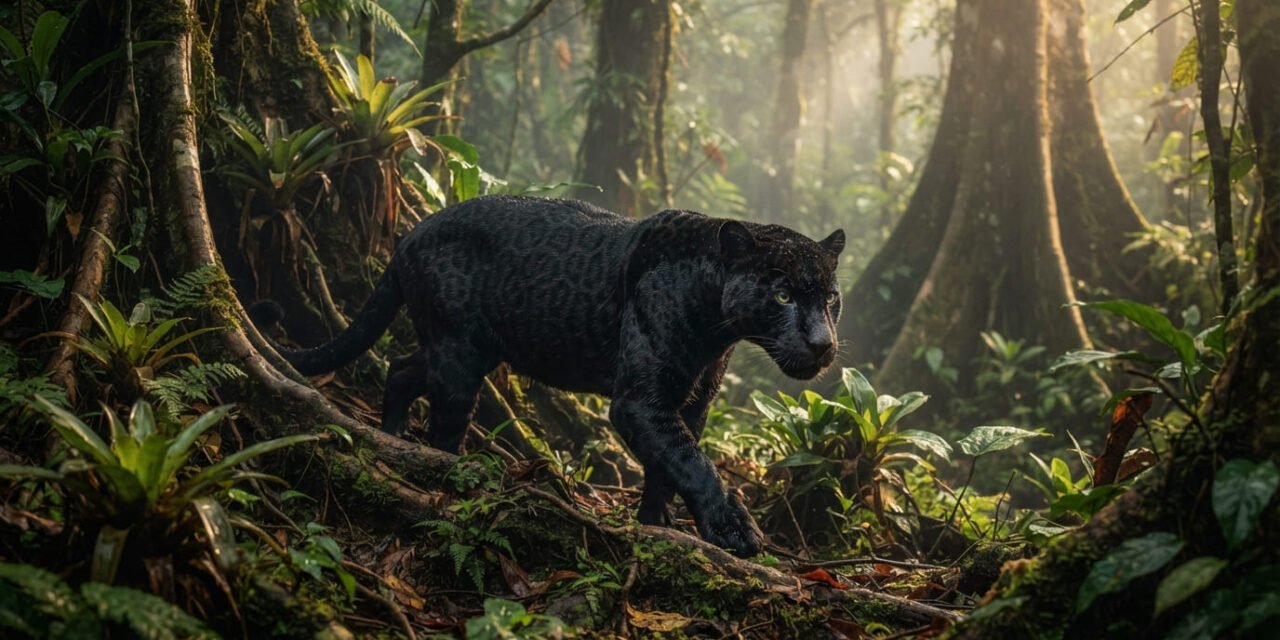
In the deepest, darkest parts of the rainforest, where the sunlight barely touches the ground, there lives a ghost. It moves without making a sound. It is a shadow among shadows. Many people call it the “Black Panther,” but very few people ever get to see one in the wild.
The Black Panther is one of the most mysterious animals on Earth. Because they are so hard to find, many legends and myths have been told about them. However, the truth is even more fascinating than the stories. In this blog, we are going to look at the real life of the “Forest Phantom” and learn the survival secrets of this beautiful big cat.
The First Secret: What is a Black Panther?
The biggest surprise for many people is that a “Black Panther” is not a separate species of animal. No animal is scientifically named a Black Panther. Instead, the name refers to any big cat that has a black coat.
In the wild, two main animals are called Black Panthers:
- Black Leopards: These live in the dense forests of Africa and Asia.
- Black Jaguars: These live in the jungles of Central and South America.
So, how do they become black? It is all because of something called “Melanism.” This is a genetic condition, like having black hair instead of blonde hair. Their bodies produce more dark pigment than usual.
If you look at a Black Panther in the bright sunlight, you will see an amazing secret: they still have spots! Underneath the dark fur, the typical “rosettes” (the circular spots of a leopard or jaguar) are still there. They are just hidden by the dark color of the fur. This is why scientists often call them “melanistic” leopards or jaguars.
The Master of Stealth
Being black in a bright world might seem like a disadvantage, but in the thick jungle, it is a superpower. The Black Panther is the ultimate master of stealth.
Most big cats, like lions or orange tigers, are easy to see in the dark. But the Black Panther disappears as soon as the sun goes down. Because they live in forests with very thick trees, the ground is always in shadow. Their dark fur allows them to blend in perfectly with the tree trunks and the dark leaves.
This makes them the perfect “ambush” hunters. They don’t chase their prey over long distances as a cheetah does. Instead, they wait. They sit perfectly still in the shadows until a deer or a wild pig walks by. By the time the prey sees the phantom, it is already too late.
A Life in the Trees
One of the reasons the Black Panther is so hard to find is that they spend much of their time above the ground. Leopards, in particular, are the best climbers of all the big cats.
A Black Panther has incredibly strong muscles in its shoulders and legs. They can climb straight up a tree trunk while carrying a heavy meal in their mouth! They do this to protect their food from other predators like hyenas or lions who might try to steal it on the ground.
The trees are also their “bedroom.” A Black Panther will often sleep on a thick branch high above the forest floor. From up there, they have a “bird’s-eye view” of everything happening in the jungle, but no one can see them looking down.
The Power of the Senses
To survive in the dark, you need more than just a black coat. You need super-senses. The Black Panther’s body is a high-tech survival machine.
1. Night Vision
A Black Panther’s eyes are specially designed for the dark. They have a layer in the back of their eyes called the “tapetum lucidum.” This layer acts like a mirror, reflecting light through the eye to help them see in almost total darkness. Their night vision is about six times better than a human’s.
2. Sensitive Whiskers
Their whiskers are not just hair; they are sensitive touch-sensors. In the dark, a panther uses its whiskers to feel the bushes and branches around its face. This helps them move through thick thorns without making a single “rustle” that might scare away their prey.
3. Incredible Hearing
A panther can hear the tiny “scritch-scratch” of a mouse or the footstep of a deer from a long distance. Their ears can move independently to catch sounds coming from different directions.
Solitary Survivors
Unlike lions, who live in groups called prides, Black Panthers are solitary animals. They live alone, and they hunt alone.
A panther has a large area of the forest that it calls its “territory.” They mark the trees with their claws and use scent to tell other panthers, “This is my home, stay away.” The only time you will see two adult panthers together is when they are mating.
Mother panthers are very protective. They hide their cubs in thick bushes or caves for the first few months. The mother teaches the cubs how to move silently, how to climb, and how to hunt. By the time a young panther is two years old, it is ready to go out into the dark forest and start its own life as a phantom.
Why Are They So Rare?
While melanism can happen in any leopard or jaguar population, Black Panthers are much rarer than spotted ones. This is because the “black gene” is recessive. This means both the mother and the father usually need to carry the gene for a cub to be born black.
Scientists have found that Black Panthers are more common in very humid, dark tropical forests (like those in Malaysia or the Amazon). In these places, the dark color is a huge help for survival. In open, sunny grasslands, a black cat would be too easy to see and might overheat in the sun, so they are seldom found there.
The Threat to the Shadow
Even though they are the kings of the jungle, Black Panthers are in trouble. Their biggest enemy is not another animal, but the loss of their home.
Every year, thousands of acres of rainforest are cut down for wood or to make space for farms. When the trees disappear, the “Forest Phantom” has nowhere to hide. Without the thick shadows of the jungle, their black coat becomes a problem instead of a help.
Also, because they are so beautiful, they have been hunted by poachers for their dark fur. Protecting the Black Panther means protecting the forests where they live. If we save the trees, we save the shadows, and if we save the shadows, we save the panther.
Conclusion: Respecting the Mystery
The Black Panther reminds us that nature is full of surprises. It shows us that a small change in a gene can create one of the most beautiful and mysterious creatures on the planet.
They are the guardians of the night. They are a reminder that the world still has secrets that we haven’t fully discovered. When we think of the Black Panther, we shouldn’t feel afraid. Instead, we should feel a sense of wonder. They are a sign of a healthy, wild forest.
The “Forest Phantom” doesn’t want to be found. It wants to live its life in the quiet, dark corners of the world, keeping the balance of the jungle in check. By respecting their space and protecting their forest homes, we can ensure that these magnificent black cats continue to walk the shadows for a long time to come.
The next time you look at a dark forest at night, imagine a pair of bright eyes looking back at you from the trees. That is the spirit of the panther—the silent, powerful, and beautiful king of the dark.