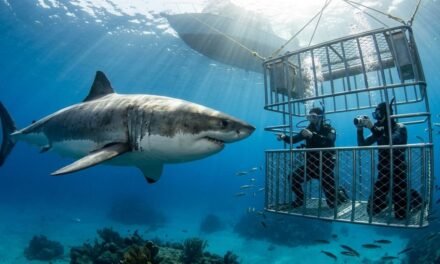
Imagine a large, beautiful forest. In this forest, there are wolves that keep the deer population healthy. If the wolves were gone, the deer would eat every green leaf until the forest became a desert. The ocean works the same way. In the deep blue world of our oceans, the “wolves” are the Great White Sharks.
We often call sharks “apex predators.” This is a fancy way of saying they are at the very top of the food chain. No one hunts the Great White Shark. Because they are at the top, they have a massive responsibility. They are the “Guardians of the Blue,” and their job is to keep the entire ocean in balance.
But what would actually happen if sharks disappeared tomorrow? The answer is a scary chain reaction that would eventually reach us on land.
The Ocean’s Doctor
One of the most important jobs a Great White Shark has is acting as the ocean’s doctor. In the wild, sharks don’t always go for the fastest or strongest fish. In fact, hunting a healthy, fast seal or a strong tuna takes a lot of energy. Instead, sharks often look for the slow, the sick, or the weak.
By removing the sick animals from the ocean, sharks ensure that diseases do not spread to the rest of the population. This keeps the schools of fish healthy and strong. Without sharks, these diseases would spread quickly, potentially wiping out entire species of fish that humans rely on for food.
When a shark “cleans up” the ocean, it isn’t being mean; it is performing a vital service that keeps the underwater world clean and thriving.
The Domino Effect: A World Without Balance
Scientists have a special name for what happens when a top predator is removed: a “Trophic Cascade.” Think of it like a row of falling dominoes. When you push the first one (the shark), all the others fall afterward.
1. The Middle-Manager Explosion
If Great White Sharks disappeared, the animals they usually eat—like seals, sea lions, and smaller sharks—would have no one to keep them in check. Their populations would explode. At first, you might think, “More seals sounds like a good thing!” But it isn’t.
2. The Great Hunger
With too many seals and mid-sized hunters in the water, they would need massive amounts of food. They would begin to eat every small fish, crab, and shrimp in sight. They would over-hunt the species that humans like to eat, such as salmon or cod. Eventually, these smaller animals would disappear because they are being eaten faster than they can reproduce.
3. The Collapse of the Coral Reefs
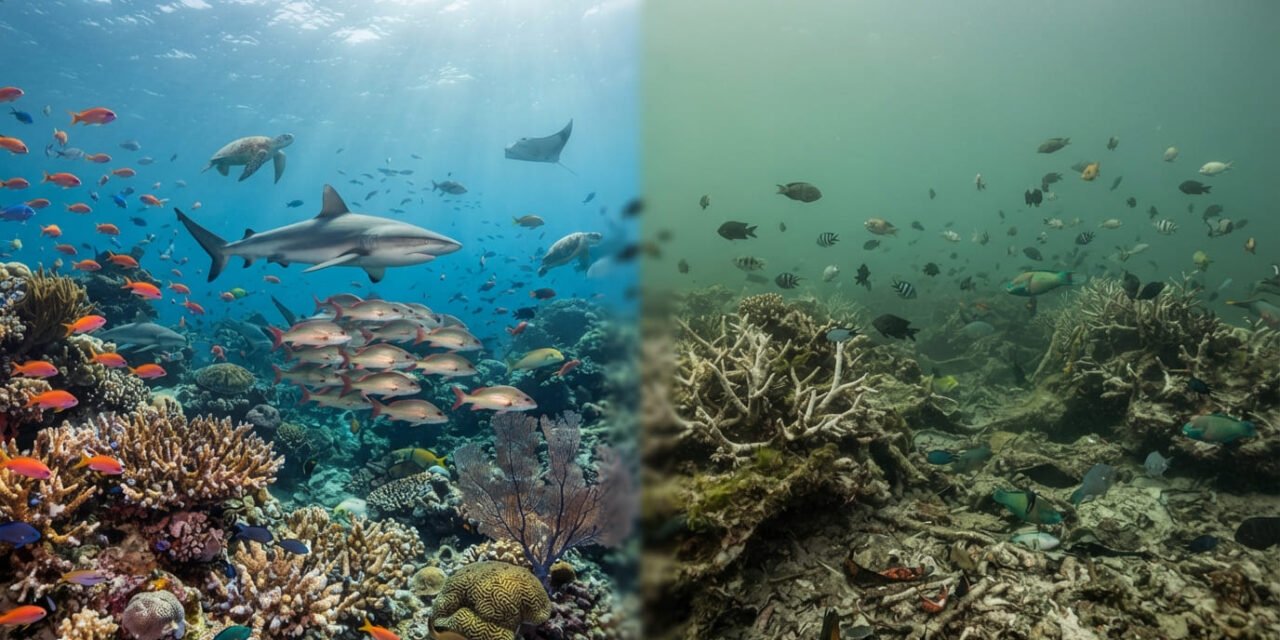
Many of these small fish have a job too: they eat algae (seaweed) off the coral reefs. If the seals eat all the small fish, the algae grow out of control. It covers the coral like a thick, green blanket, suffocating it. When the coral dies, the “cities of the ocean” crumble. Thousands of species of colorful fish lose their homes, and the once-vibrant reef becomes a gray, underwater graveyard.
Sharks and the Air We Breathe
This is perhaps the most surprising fact of all: sharks actually help us breathe.
Most people think that the world’s oxygen comes only from trees on land. But the truth is, more than 50% of the oxygen in our atmosphere is produced by “phytoplankton”—tiny, microscopic plants that live in the ocean.
How do sharks help tiny plants? It’s all about the balance we just discussed. By keeping the food web stable, sharks ensure that the creatures that eat phytoplankton (like small crustaceans) don’t become too numerous. If sharks disappear and the food web breaks, these tiny oxygen-producing plants could be wiped out.
If the ocean’s “lungs” stop working, life on land becomes much harder. Every second breath you take comes from the ocean, and sharks are the silent guardians of that process.
The Fight Against Climate Change
Great White Sharks even play a part in fighting climate change. The ocean is one of the world’s biggest “carbon sinks,” meaning it absorbs and stores carbon dioxide (CO2) from the atmosphere.
When a shark dies naturally, its large, heavy body sinks to the very bottom of the ocean. The carbon stored in its body stays trapped on the seafloor for hundreds or even thousands of years. This is called “Blue Carbon.”
More importantly, by protecting seagrass meadows (by keeping animals like sea turtles or dugongs from overgrazing in one spot), sharks help protect the plants that absorb CO2. Without sharks, these underwater meadows would be eaten away, releasing stored carbon back into the atmosphere and making the planet warmer.
The Reality: Why Are Sharks Disappearing?
Even though they are so important, sharks are in deep trouble. Humans kill about 100 million sharks every year. This is a staggering number.
The biggest threat is “Finning.” This is a practice where sharks are caught, their fins are cut off, and they are thrown back into the water. This is done to make “shark fin soup,” which is seen as a luxury in some cultures but has no nutritional value.
Other sharks are caught by accident in giant fishing nets intended for tuna or shrimp. This is called “bycatch.” Because sharks grow very slowly and only have a few “pups” (babies) at a time, they cannot recover quickly from these losses. They are being killed much faster than they can be born.
A Story of Hope: Bringing Back the Balance
The good news is that when we protect sharks, the ocean recovers incredibly fast. In places where “Marine Protected Areas” have been created—where fishing is banned—the results are like magic.
In these protected spots, the Great White Sharks return. Soon, the seal populations become healthy again, the small fish return to the reefs, the algae disappear, and the coral starts to grow back in bright, beautiful colors.
By saving the sharks, we aren’t just saving one species. We are saving the entire “Blue Machine” that keeps our planet running.
Conclusion: The Guardian’s Future
The Great White Shark has been the “Guardian of the Blue” for over 400 million years. They have seen the continents move and the mountains rise. They are the glue that holds the ocean together.
If sharks disappear, the ocean doesn’t just lose a famous animal; it loses its balance. The reefs will die, the fish will vanish, and even the air we breathe will be affected. We need sharks far more than they need us.
Being a friend to the shark means understanding that they aren’t “monsters” to be feared, but “doctors” to be respected. They are the architects of the underwater world, making sure that every living thing—from the tiny plankton to the giant whale—has a healthy home.
As we look toward the future, we must decide what kind of ocean we want to leave for our children. Do we want a silent, gray ocean without life? Or do we want a vibrant, blue ocean where the Great White Shark continues its ancient patrol?
When we protect the guardians, we protect ourselves. It is time to let the sharks do their job. It is time to keep the “silent pulse” of the ocean beating strong.