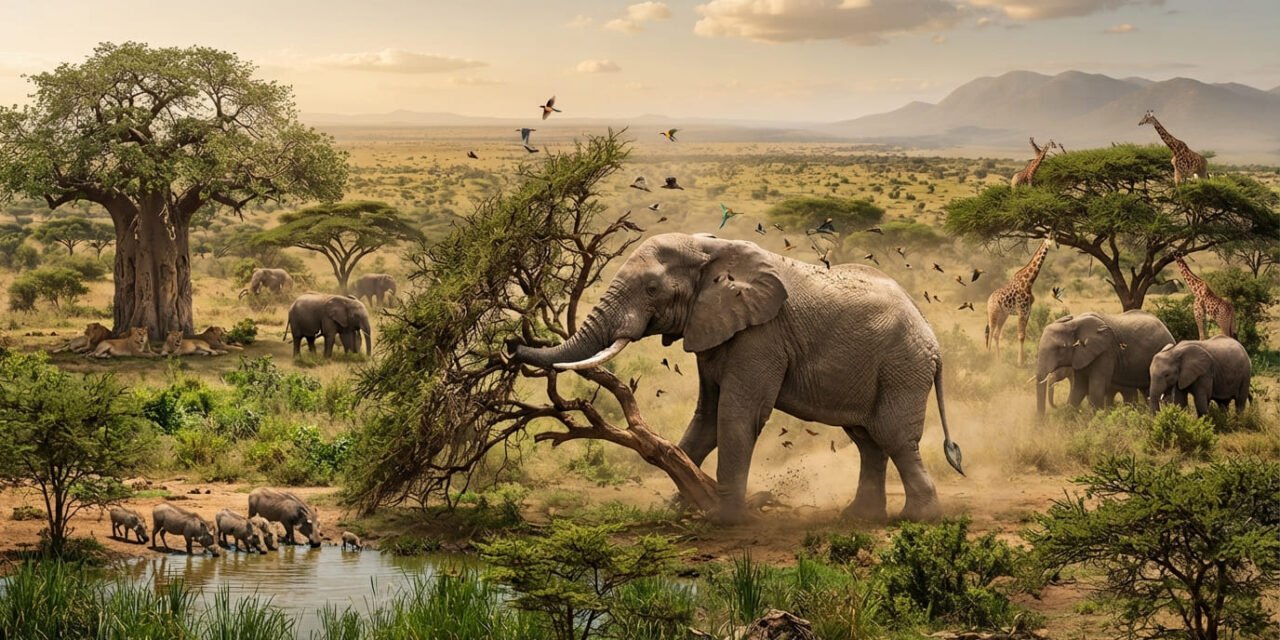
Imagine a vast, golden savanna in Africa or a thick, green jungle in Asia. To our eyes, these places appear to be wild, untouched nature. But if you look closer, you will see that these landscapes are actually “managed.” There is a giant at work, a creature that spends its entire day acting as a gardener, an engineer, and an architect.
This giant is the elephant.
Scientists often refer to elephants as a “keystone species.” Just like the top stone in an arch holds the whole structure together, elephants hold their ecosystems together. If they were to disappear, the entire environment would change, and many other animals would struggle to survive. In this blog, we are going to tell the story of how these “Eco-Architects” keep our planet alive through their daily work.
The Morning Shift: Clearing the Path
The story begins at sunrise. An elephant herd starts its day, and as they move, they don’t just walk—they transform the land.
Elephants are massive, weighing several tons. When they walk through thick, tangled bushes, they act like giant bulldozers. They push aside heavy branches and stomp down tall grass. While this might look messy, it is actually a vital service for the forest.
By clearing these paths, elephants create “highways” for smaller animals. Creatures like lions, leopards, and even smaller mammals like porcupines use these elephant paths to move quickly through the bush without getting stuck in the thorns. Without the elephants to clear the way, the forest would become too thick for many animals to navigate, making it harder for them to find food or mates.
The Afternoon Shift: The Master Gardeners
By midday, the elephants are hungry. An adult elephant needs to eat hundreds of pounds of food every single day. They eat grass, bark, leaves, and a lot of fruit. This is where their role as “Master Gardeners” truly begins.
1. Planting the Forests of the Future
When an elephant eats fruit, the seeds pass through its digestive system. Elephants travel very long distances—sometimes twenty or thirty miles in a single day. When they finally “deposit” their waste, they aren’t just leaving behind fertilizer; they are planting seeds far away from the original tree.
Because elephant dung is rich in nutrients, it provides the perfect “starter kit” for a new plant. In fact, some species of trees in the African and Asian forests rely almost entirely on elephants to spread their seeds. Without the elephants to carry these seeds across the landscape, these forests would stop growing new trees, and the jungle would slowly die out.
2. Pruning the Trees
Elephants also love to eat the tops of acacia trees and other shrubs. By knocking over some trees and eating the branches of others, they prevent the savanna from becoming one giant, dark forest.
This is important because many animals, like zebras and giraffes, need open grasslands to see predators coming. By “pruning” the trees and keeping the plains open, elephants maintain the balance between forest and grassland. They ensure there is enough light for the grass to grow, which feeds the gazelles, who in turn feed the cheetahs. It is a perfect circle managed by the elephants.
The Evening Shift: The Water Engineers
As the sun begins to set, the heat of the day can be intense, especially during the dry season. This is when the elephants show off their most impressive skill: engineering.
In many parts of Africa, rivers dry up for months at a time. The ground becomes hard and cracked. Most animals would die of thirst, but the elephant has a secret tool—its tusks and trunk.
Elephants can actually “smell” water deep underground. When they find a spot that smells promising, they use their powerful tusks to dig deep holes in the dry riverbeds. They scoop out the sand until cool, clean water bubbles up from below.
Once the elephants have finished drinking, they leave behind these “wells.” These man-made (or elephant-made) water holes become a lifeline for everyone else. Giraffes, baboons, birds, and insects all gather around the holes the elephants dug. In the middle of a drought, the elephant is the only reason these other animals stay alive.
The Night Shift: Providing a Home
Even when an elephant is resting, it is helping other creatures. One of the most fascinating parts of the elephant’s role is how it provides “housing” for smaller life forms.
1. The Dung Community
Remember the elephant dung we mentioned earlier? It isn’t just for seeds. It is a bustling city for insects! Dung beetles, for example, rely entirely on elephant waste. They lay their eggs in it and use it as food. These beetles then bury the dung, which helps aerate the soil and move nutrients underground.
Birds then come to eat the beetles, and small lizards hide near the dung to catch flies. A single pile of elephant waste can support a whole community of life for weeks.
2. Footprint Ponds
In the rainy season, an elephant’s footprint is more than just a mark in the mud. Because they are so heavy, their footprints create deep, compact holes in the ground. When it rains, these footprints fill with water and become tiny, miniature ponds.
Scientists have discovered that these “footprint ponds” are used by frogs and dragonflies to lay their eggs. They provide a safe place for tadpoles to grow, away from the big fish in the main rivers. It is amazing to think that just by taking a step, an elephant is creating a nursery for the next generation of frogs.
Firefighters of the Wild
One of the less obvious ways elephants protect the planet is by preventing massive wildfires. In the dry season, if the grass grows too tall and thick, it becomes like tinder for a fire. A single strike of lightning could burn thousands of acres.
By eating the dry grass and creating wide paths through the bush, elephants create “firebreaks.” These are gaps in the vegetation that can stop a fire from spreading across the entire savanna. By managing the growth of the plants, elephants keep the fire risk low, protecting the homes of countless birds and insects that live in the trees.
Why Their Survival Matters to Us
You might think, “This is all great for the savanna, but why does it matter to humans?”
The truth is, the health of our planet depends on these large ecosystems. The forests that elephants help plant and maintain are the “lungs” of the Earth. These trees breathe in carbon dioxide and breathe out the oxygen we need to survive. When elephants help a forest grow, they are helping to fight climate change.
Furthermore, elephants help keep the soil healthy. By moving nutrients around and digging for water, they ensure that the land stays fertile. This fertility supports the plants that keep the air clean and the water cycles moving. Without elephants, the land would become a desert, and a desert cannot support the life we need to thrive.
Conclusion: Respecting the Architects
The story of the elephant is not just a story of a big animal. It is the story of a hard-working professional who never takes a day off. From the moment they wake up until the moment they sleep, elephants are building a world that is better for everyone.
They are the engineers who dig the wells. They are the gardeners who plant the trees. They are the architects who design the landscape so that every other animal—from the tiniest frog to the tallest giraffe—has a place to call home.
When we talk about saving the elephants, we aren’t just talking about saving a beautiful creature. We are talking about saving the very systems that keep our planet healthy. Without the “Eco-Architects,” the wild places of the world would fall apart. By protecting them, we are protecting the future of our Earth and every living thing that calls it home.
The next time you think of an elephant, don’t just see a giant. See a builder. See a protector. See the silent gardener of the world.