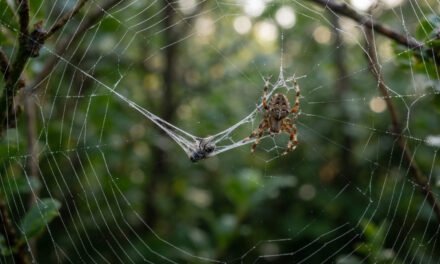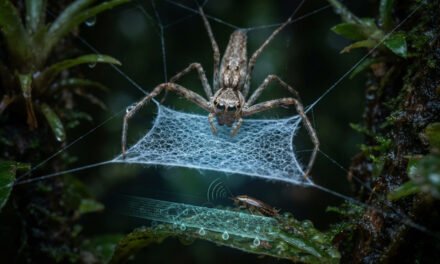
If you walk through an old apple orchard or a quiet woodland edge in North America just after the sun goes down, you’re entering a world ruled entirely by spiders. Most people understand how a typical spider operates. You picture an orb weaver spending hours meticulously spinning a massive geometric net between two tree branches. The spider sits in the middle of this beautiful silk trap and simply waits for a careless insect to fly into it. It is a passive game of chance.
But one specific arachnid completely abandoned this traditional strategy. It realized that building a giant static net requires a massive amount of energy and often yields highly unpredictable results. Instead of waiting for a meal to stumble into a trap, this creature decided to actively fish for its dinner using a custom-built weapon and a brilliant chemical disguise.
This is Mastophora hutchinsoni, commonly known as the bolas spider.
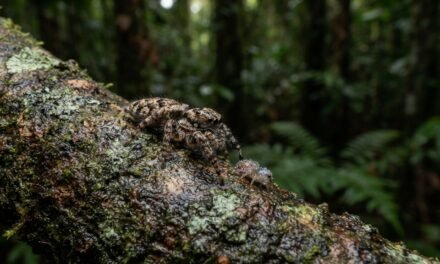
To understand how wild this spider’s hunting tactics really are, you first have to look at how it survives bright daylight hours. When the sun is up, the bolas spider is incredibly vulnerable. It does not hide in a burrow and it does not have the speed to run away from hungry birds. Instead, it relies on a visual bluff that is entirely disgusting but overwhelmingly effective.
During the day, the spider sits completely motionless on the upper surface of a broad leaf. Its body is bumpy, lumpy, and colored in mottled shades of brown, olive, and chalky white. The spider also possesses a glossy, wet-looking sheen across its abdomen. When a hungry robin or a foraging wasp scans the leaves for a meal, it does not see a spider. It sees exactly what looks like a fresh bird dropping splattered on the foliage.
Because nothing wants to eat a bird dropping, predators completely ignore the spider. It will sit in this exact position for the entire day, perfectly still, surviving purely by looking like a piece of biological waste.
But when the sun finally sets, and the diurnal predators go to sleep, the bird dropping suddenly wakes up. The spider crawls to the edge of the leaf and begins preparing for a highly specialized hunt.
The bolas spider does not eat regular flies or wandering beetles. It is an extreme dietary specialist. It hunts exclusively for male moths. Specifically, it heavily targets the bristly cutworm moth, scientifically known as Lacinipolia renigera, and the bronzed cutworm moth, known as Nephelodes minians.
Hunting flying moths in the dark without a large web seems completely impossible. A moth is fast, agile, and covered in powdery scales that allow it to easily slip out of regular spider silk. To catch one, the bolas spider utilizes biological warfare. It uses perfume.
Female moths attract males in the dark by releasing highly specific chemical sex pheromones into the wind. A male moth can detect a single molecule of this pheromone from miles away and will blindly follow the scent trail through the dark forest to find a mate. The bolas spider has evolved the astonishing ability to perfectly synthesize and emit the same chemical pheromones produced by the female moths.
This is a level of chemical engineering that completely baffles biologists. The spider is producing a complex cocktail of attractants designed for an entirely different species. When a male Lacinipolia renigera moth catches the scent on the night breeze, his brain tells him a willing female is waiting nearby. He aggressively follows the fake scent trail, flying directly toward the waiting spider.
The chemical brilliance of Mastophora hutchinsoni goes even deeper than a single fake scent. The bristly cutworm moth is typically active early in the evening, right after dusk. The bronzed cutworm moth, however, prefers to fly much later at night. The bolas spider actually changes the chemical recipe of its pheromone lure as the night progresses. It emits the bristly cutworm scent early in the evening and then smoothly transitions to emitting the bronzed cutworm scent around midnight, maximizing its chances of catching a meal no matter what time it is.
Luring the moth is only the first part of the trap. The spider still has to catch it.
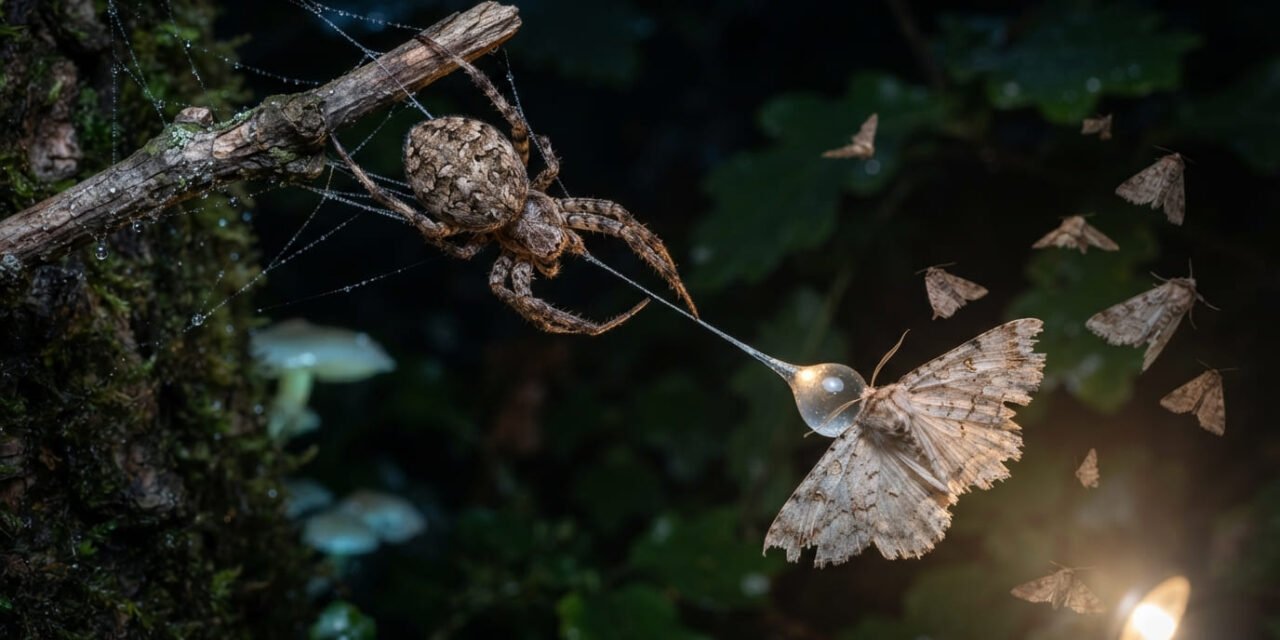
While the spider is releasing its fake pheromones, it begins to build its weapon. It secretes a single, thick line of flexible silk from its spinnerets. At the very end of this line, the spider deposits a massive, heavy glob of incredibly sticky liquid glue. This tool gives the spider its common name, because it closely resembles a bolas, a traditional throwing weapon consisting of weights at the end of interconnected cords used by gauchos in South America.
The spider hangs upside down from a horizontal branch, holding the end of the silk thread securely with one of its long front legs. The heavy sticky glob dangles in the empty air below. Now, the spider waits for the fake pheromones to do their job.
Because the spider has relatively poor eyesight, it does not rely on vision to track the incoming moth. Instead, the spider is covered in tiny, highly sensitive sensory hairs called trichobothria. These hairs are tuned to detect the microscopic vibrations and air pressure changes caused by the rapidly beating wings of a flying moth.
The male moth flies into the immediate area, frantically searching the dark leaves for the female he smells. As he buzzes closer, the spider feels the exact direction and distance of the moth through the air currents. The spider does not strike randomly. It waits until the moth is perfectly positioned just a few inches away.
In a fraction of a second, the spider swings its front leg, whipping the silk line and the heavy glob of glue in a rapid circular motion. The spider essentially casts a fishing line straight into the air.
The sticky glob smashes directly into the flying moth. The impact is sudden and violent. The glue at the end of the bolas is uniquely formulated. It is highly elastic and incredibly viscous, designed specifically to penetrate the powdery scales covering the moth and adhere tightly to the hard exoskeleton underneath.
The moth instantly panics and thrashes wildly, trying to fly away. But the silk line holding the glob is remarkably strong and stretchy. It absorbs the kinetic energy of the struggling insect, preventing the line from snapping. The moth is left dangling helplessly in the dark air, tethered securely to the branch above.
Once the prey is exhausted and trapped, the spider casually begins the harvest. It slowly reels the silk thread upward, hauling the heavy, struggling moth up toward the branch hand over hand. When the moth is finally within reach, the spider delivers a quick, paralyzing bite, injecting venom that immediately subdues the insect.
The spider then wraps the freshly caught meal in a neat sheet of white silk, securing it to the branch for later or consuming it right on the spot. This single catch provides a massive amount of protein and calories, easily sustaining the spider for days.
When you look at the entire hunting sequence of Mastophora hutchinsoni, you realize you are looking at one of the most inventive predators in the natural world. It completely rejected the passive web building lifestyle of its ancestors. It figured out how to look exactly like bird waste to avoid getting eaten during the day. It mastered complex chemical synthesis to perfectly mimic the mating perfumes of completely different species. And it invented a specialized sticky lasso to physically knock flying insects out of the night sky.
It is a quiet, unassuming little creature that proves absolute brute strength is rarely required for survival in the wild. Sometimes, all an animal really needs to conquer the dark is a perfect chemical disguise and a really good aim.