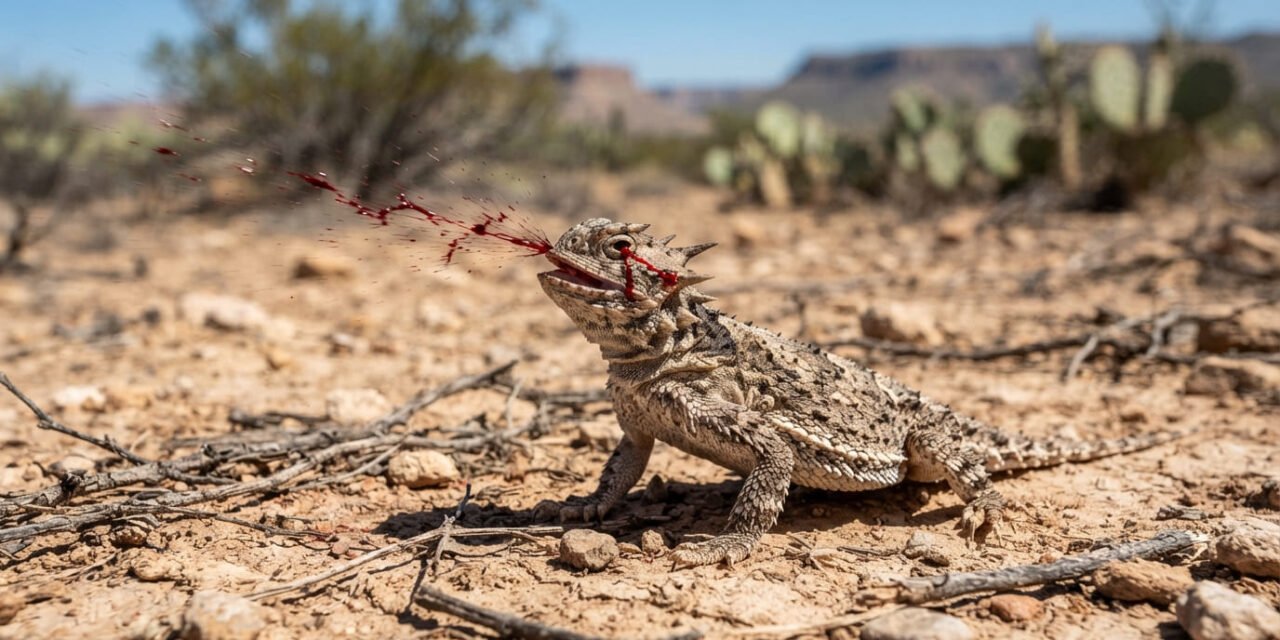
If you take a long walk through the arid scrublands of Texas or the dusty expanses of the Chihuahuan Desert, you will find an environment that absolutely punishes weakness. The ground is often baked hard by a relentless sun. The vegetation is sparse and covered in thorns. In this tough landscape, survival requires intense specialization. If you look closely at a patch of red dirt and gravel, you might see the ground suddenly shift, revealing what looks like a tiny prehistoric monster staring back at you.
This is Phrynosoma cornutum, widely known as the Texas horned lizard.
People who grew up in the American Southwest often affectionately call them horny toads. This nickname comes from their round, flattened bodies and blunt snouts, which give them the distinct appearance of an angry desert frog. But they are entirely reptilian. They are covered from snout to tail in sharp keratin spikes, with two incredibly prominent horns protruding directly from the back of their heads. They look perfectly designed for combat.
However, looks can be very deceiving. The Texas horned lizard is actually a slow-moving and relatively docile creature. It cannot outrun most predators. It does not have a venomous bite. But when it gets pushed into a corner by a hungry coyote, it unleashes a biological trick so shocking and strange that it sounds completely made up. It restricts the blood flow in its own head until the vessels in its eyes burst, shooting a stream of foul-tasting blood directly into the face of its attacker.
To understand why a lizard would resort to weaponizing its own blood, you have to understand the specific threats it faces and the highly specialized life it leads on the desert floor.
The Harvester Ant Diet
Before we discuss the blood, we have to look at the lizard’s diet. The Texas horned lizard is an extreme dietary specialist. It eats almost nothing but native harvester ants, specifically those from the genus Pogonomyrmex.
Harvester ants are large, aggressive insects with a remarkably painful sting. Most predators leave them entirely alone. But the Texas horned lizard treats a bustling ant mound like an all you can eat buffet. The lizard will find a busy ant trail, set up camp right next to it, and simply wait. When a worker ant walks by, the lizard snaps it up with a quick flick of its thick, sticky tongue.
A fully grown lizard can easily consume dozens to hundreds of these venomous ants in a single day. To survive this spicy diet, the lizard produces specialized enzymes in its stomach and mouth that completely neutralize the ant venom. Furthermore, the lizard wraps the ants in thick strands of mucus as it swallows them, preventing the insects from biting or stinging the delicate lining of its throat on the way down.
Because the lizard spends so much time just sitting next to ant mounds in the wide open desert, it is highly exposed to predators. Eating ants provides plenty of calories, but it does not provide the energy needed for high-speed sprints. Therefore, running away from danger is simply not an option.
The Art of Becoming Invisible
Since it cannot run, the first and most important defense mechanism of the Texas horned lizard is simply not being seen in the first place. Their camouflage is nothing short of an absolute masterpiece.
The scales of a Texas horned lizard perfectly mimic the colors of the desert floor. They are speckled with dusty reds, muted browns, and pale yellows. But their camouflage goes far beyond simple color matching. The lizard actually manages to eliminate its own shadow.
Predators like hawks and roadrunners are visual hunters. Their eyes are trained to look for the distinct shadow an object casts on the flat ground. To counter this, the scales along the sides of the horned lizard are specifically fringed. When the lizard spots a bird circling overhead, it flattens its body tightly against the dirt. The fringed scales along its ribs slope down perfectly to meet the sand, creating a seamless transition between the animal and the earth. With no shadow to give away its position, the lizard essentially becomes a rock.
If the camouflage fails and a predator gets too close, the lizard transitions to its second line of defense. It puffs its body up with air to make itself look as large and intimidating as possible. It lowers its head to point those two massive back horns directly at the threat. For a snake or a bird trying to swallow a meal whole, a puffed-up ball of sharp keratin spikes is a highly unappealing option. A snake that tries to swallow a horned lizard will often sustain fatal internal injuries from the spikes.
The Ultimate Weapon
While camouflage works well for birds, and sharp spikes work well for snakes, the desert is also home to mammalian predators. Coyotes, foxes, and bobcats have clever paws and strong jaws. They can easily bat a spiky lizard around, flip it over, and crush it.
When a Texas horned lizard is confronted by a canine or feline predator, it brings out its most extreme survival tactic. This process is scientifically known as autohemorrhaging.
When a coyote leans in to sniff or bite the lizard, the reptile actively restricts the blood flow leaving its head. It closes off the jugular veins, but allows the arteries to keep pumping fresh blood up into its skull. This creates a massive, rapid buildup of blood pressure inside the tiny head of the lizard.
The pressure specifically targets thin, highly specialized capillary beds located in the corners of the lizard’s eyes. As the internal pressure skyrockets, these tiny blood vessels eventually rupture. The result is a highly pressurized, targeted stream of blood that shoots straight out of the lizard’s eye sockets.
This is not a tiny drop or a subtle leak. The lizard can shoot this stream of blood up to four feet through the air with surprising accuracy. It almost always aims directly for the face and mouth of the attacking coyote or fox.
The Chemistry of Defense
You might wonder why a coyote would care if it gets squirted with a little bit of blood. Predators eat raw meat all the time, so blood should theoretically taste like a free appetizer.
But the blood of the Texas horned lizard contains a highly specific, noxious chemical compound. Biologists are still studying the exact makeup of this chemical, but they believe the lizard likely synthesizes it directly from the venom of the thousands of harvester ants it consumes.
When this chemical-laced blood hits the tongue or the nose of a coyote, the reaction is instantaneous and dramatic. The canine experiences an overwhelming, intensely bitter and foul taste. Coyotes that get shot in the mouth will immediately drop the lizard. They will shake their heads violently, whine, and aggressively rub their snouts in the dirt, trying to wipe the horrible taste off their tongues. The shock and disgust completely ruin their appetite, giving the unharmed lizard plenty of time to slowly waddle away and hide under a nearby rock.
Interestingly, this trick is highly target specific. The lizard never shoots blood at birds, and it never shoots blood at snakes. Its instincts know that the foul tasting blood only acts as a deterrent for mammals. It refuses to waste its valuable bodily fluids on a predator that will not care about the taste.
A Modern Struggle
Despite possessing one of the most incredible defense mechanisms in the animal kingdom, the Texas horned lizard is currently facing a massive fight for survival. Their populations have declined sharply across much of their historic range.
The biggest threat they face today is not natural predators, but human expansion and invasive species. As cities and suburbs pave over the desert scrublands, the lizards lose their native habitats. But an even more insidious problem lies with their food source.
Invasive fire ants have heavily colonized the southern United States. These aggressive invaders actively hunt down and displace the native harvester ants that the lizard relies on for food. The Texas horned lizard absolutely refuses to eat fire ants. As the harvester ants disappear from the landscape, the horned lizards simply starve to death. Conservationists are now working incredibly hard to protect native ant mounds and preserve large tracts of undisturbed land to give these amazing reptiles a fighting chance.
When you look at the Texas horned lizard, you see an animal that has completely mastered its environment. It learned how to vanish into the red dirt. It built a suit of armor to choke snakes. And it figured out how to turn its own circulatory system into a pressurized water gun loaded with chemical deterrents to fight off coyotes. It is a quiet, unassuming little creature that perfectly demonstrates just how wildly inventive nature can be when forced to survive in the harshest places on Earth.