If you rent a kayak and paddle quietly along a warm jungle river in Costa Rica, Panama, or Nicaragua, your eyes will naturally focus on the tall trees. You will look for colorful toucans in the canopy or monkeys swinging between hanging vines. The rainforest is dense, loud, and constantly moving. But if you shift your gaze down to the low branches overhanging the muddy riverbank, you might spot a creature that looks like a miniature dragon resting in the sun.
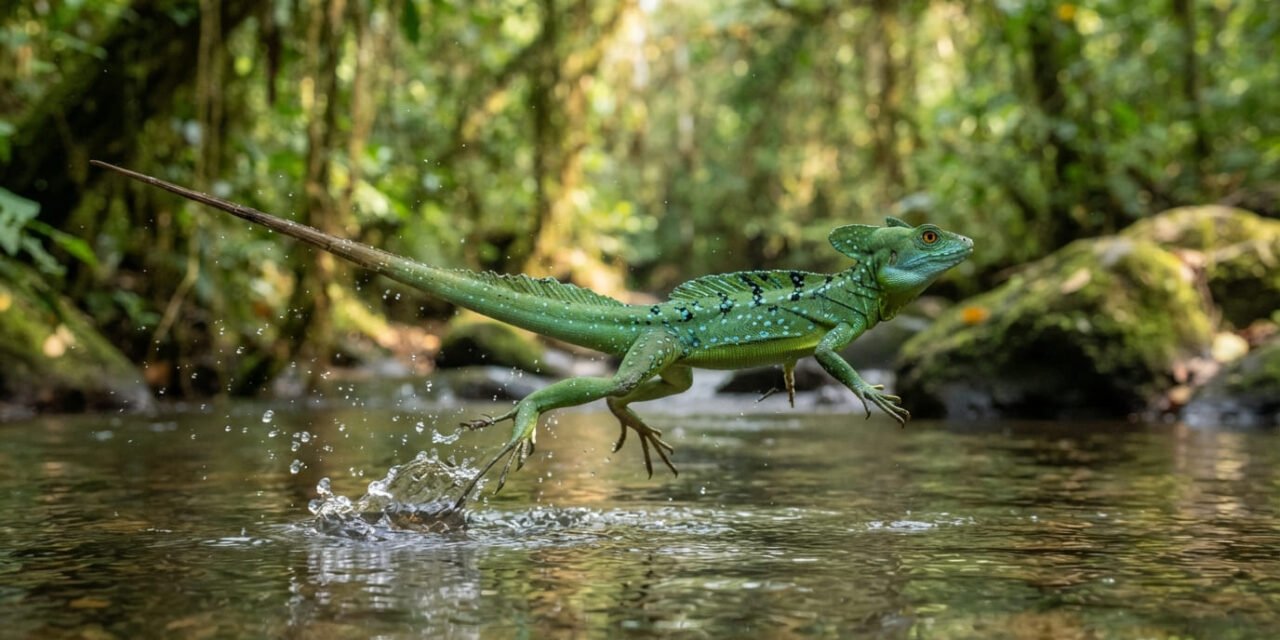
It is a brilliant emerald green color, speckled with small blue and white spots along its back. Males have large, sail-like crests on their heads, backs, and long tails.
This is Basiliscus plumifrons, commonly known as the green basilisk lizard.
For most of the day, it lives a quiet life. It sits motionless on leaves or branches hanging directly over the water, soaking up the tropical heat. But if a predator suddenly lunges from the bushes, or if you paddle your boat a little too close, the lizard does not simply dive into the river or scramble up a tree trunk.
It drops down to the surface of the river, stands up on its back legs, and literally runs across the top of the water.
This incredible feat has earned the species a famous nickname throughout Central America: the Jesus Christ lizard. To early explorers, watching a heavy reptile sprint gracefully across liquid seemed like a complete violation of the laws of physics. Humans sink instantly. Heavy animals sink instantly. Yet this lizard can sprint twenty or thirty feet across open water without sinking an inch.
To understand how Basiliscus plumifrons pulls off this miraculous escape, you have to look past the illusion and examine a masterpiece of fluid dynamics, specialized anatomy, and extreme biomechanics.
The Design of a Canopy Dragon
Before looking at the physics of running on water, it helps to understand how the lizard is built.
Basiliscus plumifrons is a relatively large reptile. Fully grown adult males can reach lengths of nearly three feet from the tip of their nose to the end of their tail, though much of that length is made up of their slender, whip like tail. Despite their impressive length, they are remarkably light. A healthy adult usually weighs less than nine ounces.
Their entire body is optimized for life in the trees and near the water. They have long, muscular hind legs equipped with thin, elongated toes. Their skin is smooth and somewhat water resistant, allowing them to shed moisture quickly.
The bright green coloration serves as near perfect camouflage among the sunlit leaves of the rainforest canopy. When resting on a branch, the light filtering through the leaves creates dappled patterns of light and shadow that match the blue and white markings on the lizard’s back.
However, camouflage is only the first line of defense. When a predator spots the lizard, the real show begins.
The Three Phases of Walking on Water
When a green basilisk lizard drops onto the river, it does not rely on surface tension. Smaller insects, like water striders, can walk on water because their weight is so tiny that they do not break the delicate molecular bonds on the water’s surface. A nine ounce lizard is far too heavy for surface tension to support it. The moment its foot touches the water, those molecular bonds break completely.
Instead, the lizard relies on pure speed, hydrodynamics, and kinetic force.
When the lizard sprints across the water, its feet move so fast that human eyes can barely track the motion. High speed video analysis reveals that every single footstep is divided into three distinct, highly calculated phases: the slap, the stroke, and the recovery.
The first phase is the slap. The lizard slams its back foot straight down onto the water’s surface with incredible velocity. This sudden downward force pushes the water out of the way, creating a powerful upward reactive force. This single initial slap provides roughly two thirds of the lift required to keep the lizard’s body above the surface.
The second phase is the stroke. As the foot continues moving downward into the water, it moves so quickly that the surrounding water cannot close in behind it fast enough. This creates a temporary, hollow pocket of air beneath the surface. The lizard quickly sweeps its foot backward through this air pocket before the water collapses. This backward stroke generates the powerful forward propulsion that drives the lizard across the river.
The final phase is the recovery. This is perhaps the most technically difficult part of the movement. Before the air pocket collapses and traps the foot underwater, the lizard has to pull its foot straight up and out of the cavity. If the foot gets caught in the closing water, the drag will instantly pull the lizard down, causing it to sink. The lizard pulls its foot up and forward through the empty air, preparing for the next slap.
The lizard repeats this slap, stroke, and recovery sequence up to twenty times per second with each leg. It is a violent, highly coordinated bicycle motion happening at unbelievable speed.
The Anatomy of the Foot
Slamming a foot down into the water is only part of the equation. To generate enough lift from the initial slap, the foot needs maximum surface area. But if the foot is too wide, it will create too much drag when the lizard tries to pull it out of the water during the recovery phase.
Evolution solved this dilemma by giving Basiliscus plumifrons a biological set of folding flippers.
Along the edges of the long toes on the lizard’s back feet are tiny, specialized flaps of skin and scales. When the lizard is walking on dry land or climbing a tree trunk, these tiny skin flaps remain folded up tightly against the sides of the toes. This keeps the foot narrow and nimble, allowing the lizard to grip rough bark and climb vines without anything snagging.
However, the moment the lizard hits the water and pushes its foot downward, the resistance of the liquid forces these skin flaps to unfold instantly. This drastically expands the total surface area of the foot, turning it into a wide paddle that catches the maximum amount of water during the slap phase.
As soon as the foot finishes the stroke and the lizard begins pulling it upward during the recovery phase, the water pressure reverses. The skin flaps instantly collapse back against the toes, reducing the surface area and allowing the foot to slide smoothly out of the water without creating drag. It is an automated, mechanical valve system built directly into the lizard’s toes.
Balance, Momentum, and the Long Tail
Generating lift and propulsion is useless if you cannot stay upright. Water is an unstable, churning surface. If the lizard tilts slightly to the left or right while sprinting, it will lose its footing, tumble sideways, and fall into the river.
This is where the lizard’s long, specialized tail comes into play.
The tail of Basiliscus plumifrons accounts for nearly two thirds of its total body length. As the lizard sprints bipedally across the surface, it holds its front legs tucked close to its chest or floating slightly out to the sides. Its upper body is angled slightly forward, and its tail is held high out of the water, extending straight back behind it.
The tail acts as an active counterweight and a dynamic rudder. As the legs churn wildly, the tail swings in precise, micro adjusted patterns to balance the shifting forces. If a sudden current or ripple tilts the lizard’s body to the left, the tail instantly whips to the right to correct the center of gravity.
Furthermore, the lizard relies heavily on forward momentum. It cannot stop and stand still on the water. It must maintain a high rate of speed from the moment it leaves the branch. If the lizard slows down even for a split second, the frequency of the foot slaps drops, the air pockets collapse, and gravity immediately pulls the animal underwater.
The Underwater Backup Plan
Even with specialized foot flaps and high speed foot slaps, running on water takes an enormous amount of physical energy. A green basilisk lizard can usually only maintain a water sprint for a distance of twenty to thirty feet before its muscles tire and its forward momentum fades.
So what happens when the run ends?
For Basiliscus plumifrons, falling into the water is not a failure. It is simply phase two of the escape plan.
The green basilisk lizard is an exceptional swimmer. When it loses its forward momentum and sinks beneath the surface, it does not panic. It tucks its legs tight against its body, splayed out backwards, and uses its long, laterally flattened tail to propel itself through the river. It swims with the smooth, serpentine motion of an alligator, quickly diving deep beneath the murky surface.
They can stay submerged underwater for remarkable lengths of time. A threatened basilisk lizard can dive to the bottom of a river, wedge itself under a submerged log or rock, and stay completely motionless for up to thirty minutes. Their nostrils feature specialized fleshy valves that keep water from entering their lungs while submerged.
If a predatory hawk drops from the sky to grab the lizard off a tree branch, the lizard drops to the water, sprints twenty feet across the river, dives below the surface, and hides under a rock at the bottom. By the time the hawk figures out what happened, the lizard has completely vanished.
Life in the Rainforest Ecosystem
Because Basiliscus plumifrons spends so much time near the water, its diet and lifestyle are tightly linked to the riverbank ecosystem.
They are omnivorous, though their diet consists mostly of live prey. They are highly active hunters, targeting a wide variety of invertebrates that live along the riverbank. A favorite meal is the house cricket, scientifically known as Acheta domesticus, as well as large grasshoppers like the giant timber grasshopper, Tropidacris cristata. They will also sit over quiet pools to catch freshwater prawns, such as Macrobrachium carcinus, snapping them out of the shallow water with lightning fast jaw strikes.
When the opportunity arises, they will also consume fallen fruits, berries, and small flowers that drop from the canopy onto the riverbank.
However, living near the water also means dealing with a massive list of deadly predators. The rainforest understory is full of animals that would love to eat a nine ounce lizard.
From the water, they are hunted by the spectacled caiman, Caiman crocodilus, which quietly patrols the river edges waiting for a lizard to drop from a branch. From the trees, large snakes like the Central American boa constrictor, Boa imperator, stalk the basilisk while it rests in the foliage. From the air, powerful birds of prey like the ornate hawk eagle, Spizaetus ornatus, swoop down through the canopy to snatch them off their perches.
Every single aspect of the green basilisk’s lifestyle is an ongoing battle to avoid these predators. Its green color hides it from the eagle. Its high perches keep it away from the caiman. And its ability to sprint across the surface of the river gives it an escape route that almost none of its predators can follow.
Masterclass in Evolutionary Physics
It is easy to look at an animal running across water and view it as a strange myth or a funny biological curiosity. We see videos of them skittering across ponds and we marvel at how funny it looks.
But when you break down the science, Basiliscus plumifrons is a masterclass in biomechanical adaptation.
It is an animal that took the simple problem of avoiding predators and solved it by mastering fluid dynamics. It evolved folding skin flaps on its toes to maximize surface area. It altered its skeletal muscle structure to allow for leg movements moving at twenty cycles per second. It turned its tail into a high speed gyroscope, and it learned how to exploit temporary air pockets created by atmospheric pressure and water displacement.
The green basilisk lizard did not break the laws of physics to walk on water. Instead, it learned how to use those laws more efficiently than almost any other land animal on Earth. It is a stunning, colorful, and powerful reminder that with the right anatomy and enough speed, even the impossible becomes just another way to survive.