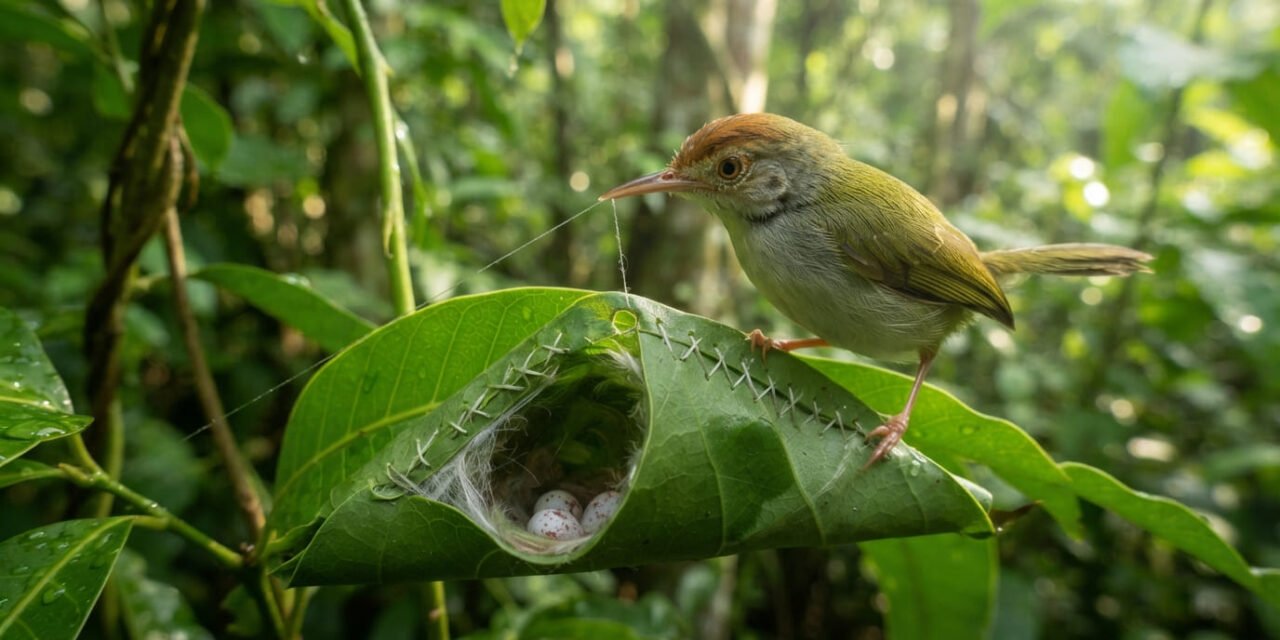
If you ever spend a quiet morning in a sunny garden or open woodland in tropical Asia, you will likely hear a remarkably loud, cheerful whistling sound. It is a sharp, repetitive call that sounds like it should belong to a bird the size of a crow. But if you follow the noise to the low shrubs and weeds, you will find a tiny, restless green songbird about the size of a teacup. It has a bright rust-colored crown on its head, creamy white underparts, and a long tail that it constantly cocks straight up into the air.
This is the common tailorbird (Orthotomus sutorius). It is a bold, energetic little neighbor that is highly comfortable living near human homes, gardens, and farmland. It was even immortalized by Rudyard Kipling in The Jungle Book as Darzee, the feather-brained but well-meaning tailorbird who sings of victories in the garden.
But there is nothing feather-brained about this bird’s home-building skills. While most birds construct their nests by simply piling up twigs, grass, and mud in the fork of a tree branch, the tailorbird executes a highly skilled craft project. Using its sharp beak as a needle and sticky spider silk as thread, this little bird folds and stitches living green leaves together to form a perfectly hidden, dangling pouch. It is one of the most sophisticated examples of textile work in the animal kingdom, and it is all done without fingers, scissors, or glue.
Wrap-Testing the Material
The tailorbird’s sewing project starts with a very careful search for the right raw materials. Unlike a human tailor who can cut fabric to fit any pattern, the bird must work with the shapes that nature provides.
The female tailorbird is the chief architect and builder. Before she begins construction, she flies from leaf to leaf, examining the foliage on low bushes. She is looking for a leaf that is healthy, flexible, and large enough to fold around her own body.
If she finds a single massive leaf, like that of a mango tree, a broad-leafed fig, or a garden ornamental, she will test it for size. She hops onto the surface and physically pulls the edges of the leaf around herself to see if they will meet. It looks exactly like a person trying on a winter coat in a department store to check the fit.
If a single leaf is too small, she does not give up. Instead, she looks for two or three smaller leaves that grow close together on the same twig. She will plan to stitch these separate leaves together along their edges to create a larger pocket.
Location is also critical. The chosen leaves must be at least three or four feet off the ground to keep them safe from hungry snakes, lizards, and cats. But they must also be nestled deep within the dense, shaded center of the bush, shielded from the hot sun and heavy monsoon rains.
The Needle and the Thread
Once she selects her leaves, the construction phase begins. The tailorbird’s only tool is her long, slender beak, which is exceptionally sharp and slightly curved at the tip. This beak acts as a high-precision awl, designed to punch clean holes through tough plant tissue.
For thread, the tailorbird searches the garden for materials that are both flexible and sticky. Her absolute favorite material is spider silk. Cobwebs are incredibly strong, thinner than a human hair, and naturally covered in a sticky residue that helps them cling to surfaces.
If spider webs are scarce, she will collect wild cotton fibers, the silky down of seedpods, plant fibers, or even fine strands of caterpillar cocoons. In urban gardens, tailorbirds have even been spotted stealing household items, like colorful sewing thread left on backyards or fibers pulled from outdoor mats and carpets.
While the female is busy prepping the leaves, her mate acts as the supply run manager. The male tailorbird flies back and forth through the garden, gathering fresh strands of plant fiber and spider silk and bringing them to the nesting site so the female never runs out of “thread.”
The Mystery of the No-Knot Stitch
For centuries, early naturalists who observed tailorbird nests in India and Sri Lanka wrote that the birds must be tying complex, deliberate knots to keep their leaf pockets from unraveling. They assumed that a bird would need to loop the thread and tie a secure double-knot at the end of each stitch, much like a human tailor does when finishing a seam.
But when modern researchers carefully examined these nests under magnifying glasses, they made a surprising discovery. The tailorbird does not tie any knots at all. In fact, if the bird tried to tie knots with its beak, the delicate fibers would likely snap, and the process would take far too much time.
So, how does the nest stay together? Why don’t the stitches slip out of the holes when the wind blows or when the heavy mother bird sits inside?
The secret lies in a clever engineering trick: the tailorbird uses rivets, not knots.
To start a stitch, the female uses her sharp beak to pierce a tiny hole through the overlapping edges of the leaves. While the beak is still in the hole, she pushes a strand of spider silk or plant fiber through the opening.
Because the plant fibers and spider silk are naturally rough and fuzzy, their loose ends instantly expand and fluff out once they pass through to the other side of the leaf. This fluffed-out end forms a tiny, bulbous stopper that is much wider than the hole itself. It acts exactly like the metal rivet on a pair of blue jeans. It is physically impossible for the expanded tip to slip back through the tiny puncture.
The living leaf also plays an active role in keeping the stitch secure. When the bird punches a hole, the living plant tissue does not split or tear. Because the leaf is alive and filled with moisture, the plant fibers are elastic. As soon as the bird removes her beak, the leaf tissue naturally springs back and constricts around the thread, gripping the fiber with a tight, natural seal. No glue or knots are needed; the combination of the fluffed-out fiber rivet and the self-sealing leaf keeps the pocket locked tight.
The Living Canvas
One of the most brilliant aspects of the tailorbird’s design is that she always sews with living leaves that are still attached to the plant. She never cuts a leaf off the branch to build her nest.
This is a vital survival strategy. If the bird used dead, dry leaves, they would quickly rot, turn brown, and fall to the ground. Even if they stayed attached, a brown pocket hanging in a sea of green bushes would stand out like a neon sign to predators.
By keeping the leaves attached to the branch, the leaves continue to receive water, sugar, and nutrients from the plant’s roots. They stay bright green, supple, and healthy throughout the entire nesting cycle.
Furthermore, when the tailorbird sews the leaves, she always positions them so that their shiny, dark green upper surfaces face outward. This ensures that the finished pocket blends in perfectly with the rest of the bush. A passing hawk or a climbing tree snake can look directly at the nest from a foot away and see nothing but a normal, healthy clump of green leaves. The camouflage is so seamless that human researchers often struggle to find the nests even when they know which bush to look in.
Because the punctures made by the bird’s needle-beak are so incredibly tiny, they cause very little damage to the leaf’s water transport system. The leaves do not brown or wither around the stitches. They continue to perform photosynthesis, keeping the nest’s outer armor alive and green for weeks.
Furnishing the Cradle
The stitched leaf pocket is not actually the nest itself. It is merely the protective, weather-proof envelope that houses the nest. Once the green cradle is securely stitched together, the female tailorbird must build a comfortable bed inside the pocket to protect her eggs.
She starts by lining the bottom of the leaf envelope with a layer of dry, soft grass and thin rootlets to form a supportive structure. On top of this framework, she packs an incredibly dense, soft layer of cushioning.
She collects thousands of tiny, fluffy seeds, downy feathers, animal hair, and cotton fibers. She stuffs these materials deep into the leaf pocket, packing them down with her feet until she has created a thick, warm, felt-like cup.
This interior padding is exceptionally soft, designed to insulate the delicate, reddish-speckled eggs from cold night winds and the dampness of the rainy season. It also acts as a shock absorber, keeping the eggs safe when strong garden winds shake the bush and cause the leaf cradle to swing back and forth on its twig.
A Perfect Partnership
Building a tailorbird nest is a demanding task that takes between two to four days of continuous, hard work. The female may add anywhere from 150 to 200 individual stitches to a single nest to ensure its structural integrity.
While she executes the complex stitching, her mate remains close by. He does more than just bring her threads; he also acts as her sentry. If a human walks into the garden or a cat prowls near the bush, the male will fly to a prominent branch and sing loudly to distract the intruder, drawing attention away from the secret construction site.
Once the nest is finished, the female lays a clutch of three to five tiny eggs. She sits inside the cozy felt cup, completely hidden within her green leafy envelope. When the chicks hatch, both parents work tirelessly to feed them a diet of tiny caterpillars, spiders, and flies, reaching into the leaf pocket to drop food into the waiting, yellow-gaped mouths.
By the time the chicks are ready to leave the nest, the leaves of the cradle may finally begin to show some wear. The constant movement of the growing chicks and the weight of the family can eventually strain the connections, but the living green shield holds together just long enough to ensure the next generation of songbirds takes flight safely.
Final Thoughts
The common tailorbird is a wonderful reminder that you do not need a massive brain, heavy muscles, or complex tools to achieve remarkable feats of engineering. Operating entirely on ancient instinct, this tiny garden bird uses the simple properties of plant fibers and the natural elasticity of living leaves to build a home that is both a physical fortress and a masterpiece of stealth.
The next time you hear a loud, energetic whistle coming from a shrub in your backyard, take a moment to look closely at the leaves. You might just spot a tiny green bird weaving a thread through a leaf, proving that with a little creativity and the right natural materials, you can sew your way to a safe and secure life.