If you look at a common vampire bat (Desmodus rotundus), you will probably feel a chill. It has a pushed-in nose, large pointed ears, and two razor-sharp incisor teeth that peek out from its upper lip. It is the only mammal on Earth that survives entirely on a diet of blood. At night, it leaves its dark cave or hollow tree to search for sleeping cattle, horses, or birds. It sneaks up on them by walking, galloping, and hopping across the ground like a tiny, winged spider. It is an animal designed for the shadows. But if you look past its terrifying reputation, you will find one of the most cooperative, compassionate, and generous social networks in the animal kingdom.
While most predators hunt for themselves, the vampire bat participates in an elaborate system of mutual survival. These bats do not just look out for their own family members. They actively share their food with starving neighbors, even if they are not related. If they did not cooperate in this way, their colonies would collapse within a matter of weeks. The vampire bat is proof that in the struggle for survival, a sharing network can be far more powerful than a sharp claw.
The Physics of the Infrared Nose
To understand why these bats have to share, you first have to look at how they hunt. Finding a vein on a thick-skinned cow in the pitch black of night is a massive challenge. If the bat takes too long or bites the wrong spot, the prey will wake up and stomp on it. To solve this problem, the vampire bat developed a form of thermal vision.
The bat has three small, hairless pits on its nose-leaf. These pits are lined with highly specialized heat-detecting proteins called TRPV1 receptors. Humans have these same proteins in their skin, tongue, and eyes. We use them to detect painful, burning heat, like when we touch a hot stove or eat a spicy chili pepper. In humans, these receptors only trigger when temperatures go above 43 degrees Celsius.
In the common vampire bat, a process called alternative splicing alters the shape of this protein. This creates a shorter version of the molecule, which lowers its activation threshold to about 30 degrees Celsius. This small change has a massive impact. It turns the bat’s nose into a highly sensitive infrared camera.
As the bat creeps up on a sleeping animal, it moves its head from side to side. The insulated pits on its nose-leaf detect the heat radiating from the warm blood flowing just beneath the prey’s skin. The bat can pinpoint a vein from 20 centimeters away in complete darkness. It knows exactly where to bite to get a steady stream of blood without needing to search or make multiple painful incisions.
The Painless Bite and the Capillary Drink
Once the infrared sensor locates a vein, the bat goes to work. It does not have typical canine teeth for ripping. It has two curved, razor-sharp upper incisors that lack enamel. Because they lack enamel, they are self-sharpening. When the bat bites, it does not crush. It shears away a tiny, circular piece of skin. This bite is so clean and painless that the sleeping host rarely feels it.
As the blood begins to pool, the bat does not suck it up. Instead, it uses its tongue. The underside of the tongue has two parallel grooves. The bat places its tongue against the wound, and the blood rises in the grooves through capillary action.
To keep the blood from clotting, the bat’s saliva contains a powerful anticoagulant protein. This protein blocks the chemicals that the host’s body uses to scab over a wound. It keeps the blood flowing freely for up to 30 minutes while the bat drinks. Within a single feeding session, a vampire bat can consume up to 100 percent of its own body weight in blood. It drinks so much that its stomach expands like a balloon, and it must begin urinating while it feeds just to shed enough water weight to fly back to its roost.
The Starvation Equation
This lifestyle of drinking blood is highly risky. Blood is mostly water, and it has very little fat or sugar. This means the bat cannot store energy for long periods. A vampire bat has a very high metabolism and must feed almost every single night to survive.
The starvation threshold for a vampire bat is incredibly short. If a bat fails to find a meal for just 60 to 70 hours, it will starve to death. It simply does not have the body fat to survive three consecutive nights without food.
In a stable colony, finding a meal is not guaranteed. On any given night, about 8 percent of the adult bats in a roost will return empty-handed. Young, inexperienced bats have an even harder time. Up to 30 percent of juveniles fail to find food on their nightly hunts. Because the margins of survival are so thin, a string of bad luck would mean certain death for a large portion of the colony. The bats needed a backup plan, and their solution was to share.
The Reciprocal Altruism Network
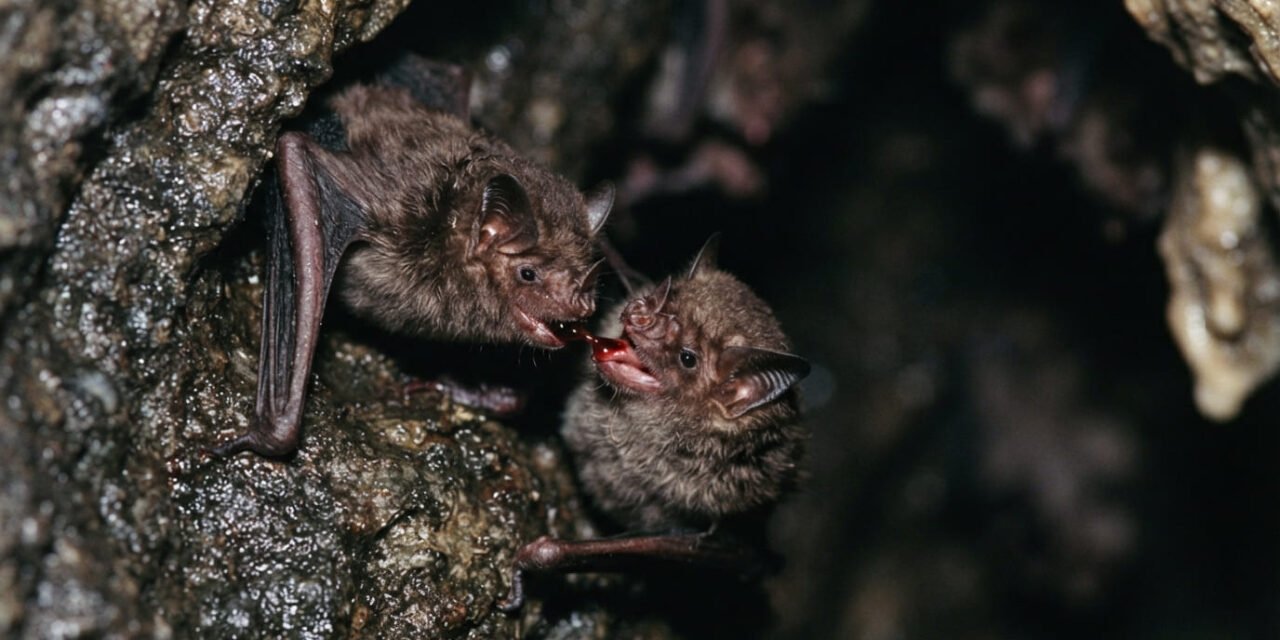
When a hungry bat returns to the roost after a failed hunt, it does not curl up and prepare to die. It searches for a roost-mate that had a successful night. The starving bat will approach a well-fed bat and begin a process of social solicitation.
It starts with grooming. The hungry bat will lick the successful bat under its wings and around its chest. This grooming is a physical signal. It is a polite way of saying, “I am starving, can you help me?” The hungry bat will eventually move its tongue to lick the lips of the donor.
If the successful bat decides to help, it will regurgitate a portion of the warm blood it drank earlier directly into the mouth of the hungry bat. This donation is a literal lifesaver. The donor loses some of its energy reserves, but it does not drop below its own danger zone. The recipient gains enough hours of survival to try the next night again.
This behavior is a textbook example of reciprocal altruism. It is a system based on mutual trust and memory. The bats do not just share with their own children or parents. They build complex networks of non-family friendships.
Remembering Friends and Punishing Cheaters
For a system of sharing to work, you must have a way to handle cheaters. If a bat always takes blood but never shares when it has a successful night, the system breaks down. This is why vampire bats have incredible memories and can live for up to 20 years in the wild.
Researchers like Dr. Gerald Wilkinson and Dr. Gerald Carter have spent years studying these bats in captivity and in the wild. They found that bats keep a mental record of who has helped them in the past. If Bat A saves Bat B from starvation, Bat B is much more likely to share with Bat A when the roles are reversed.
Conversely, if a bat refuses to share with a starving roost-mate, the colony remembers. The selfish bat is excluded from the sharing network. The next time that bat has a bad night, its pleas for food will be ignored. It is a social contract enforced by memory and exclusion.
Interestingly, the research showed that these relationships are not a simple, strict “tit-for-tat.” They are more like human friendships. A bat will not immediately cut off a friend if they fail to share once. They look at the overall quality of the relationship over time. By sharing with multiple unrelated bats, a single bat spreads its risk. It builds a safety net of multiple potential donors, ensuring that if its best friend is unable to help, someone else will step in.
Why You Should Care
The common vampire bat is a reminder that cooperation is a powerful evolutionary force. We often focus on the “selfish” side of nature, where animals fight and compete for every resource. The vampire bat shows us that sometimes, the best way to keep your genes alive is to keep your neighbor alive.
You should care about these bats because their social complexity challenges how we think about animal intelligence. To maintain a sharing network, a bat must be able to recognize dozens of individuals, remember past interactions, evaluate the needs of others, and make decisions based on trust. This requires a level of cognitive processing that we usually only associate with primates or dolphins.
Additionally, the chemicals in their saliva are helping human medicine. The anticoagulant protein they use to keep blood flowing has been synthesized by pharmaceutical companies to create drugs that break up blood clots in stroke patients. The vampire’s weapon has become a tool for saving human lives.
Final Thoughts
The vampire bat is a creature that lives on the edge of death every single day. It has turned its own vulnerability into a bond that holds its community together. It uses its nose to see heat, its teeth to steal blood, and its stomach to save its friends.
When you think of a vampire bat, do not just see a blood-drinking monster. See a master of social cooperation. See an animal that has proven that a small act of generosity can be the difference between extinction and survival. In the dark, cold hollows of the forest, these bats have spent thousands of generations proving that the most resilient wall against death is a circle of friends.