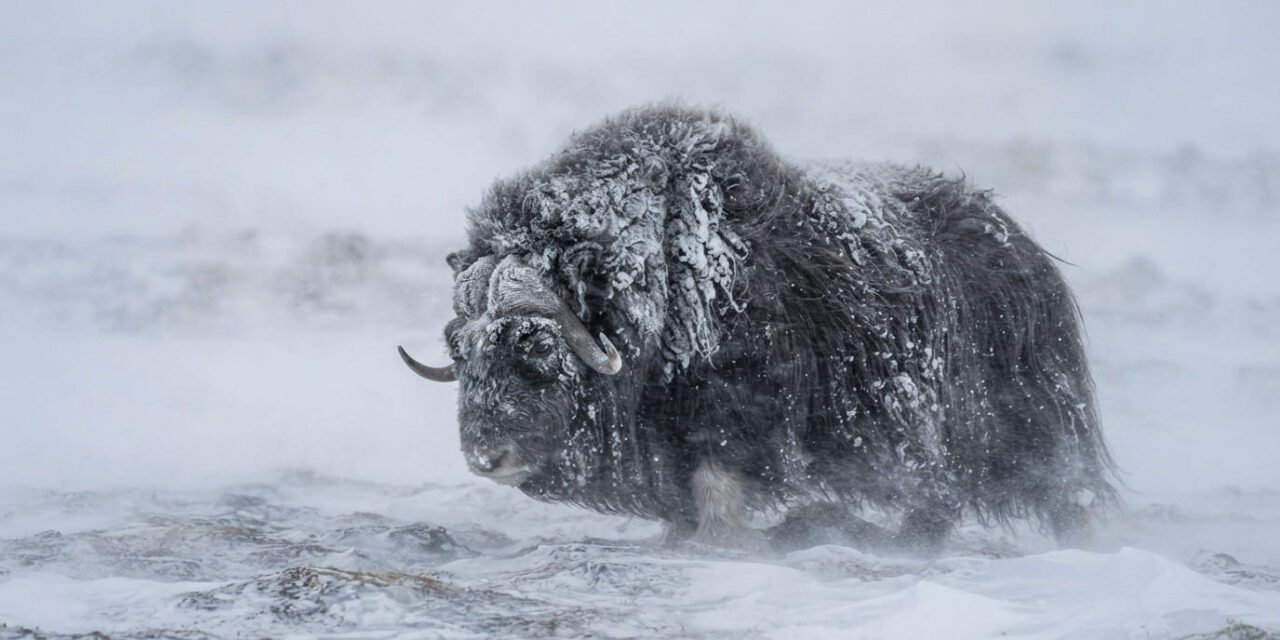
The Arctic tundra is an environment designed to kill anything that cannot generate or hold onto heat. In the middle of a winter blizzard in northern Canada or Greenland, the temperature often stays at -40 degrees Fahrenheit for weeks. The wind speeds can reach 60 miles per hour. Most animals either migrate south or go underground to hibernate. The musk ox does neither. It stands in the middle of the storm and waits it out. It is a biological furnace that uses a dual-layer armor of hair and wool to maintain a body temperature of 101 degrees while the air around it is cold enough to freeze gasoline.
The musk ox (Ovibos moschatus) is a relic of the Pleistocene. It lived alongside woolly mammoths and saber-toothed cats. It survived the ice age because it perfected the art of insulation. To understand how an 800-pound animal stays warm while standing still in a gale, you have to look at the two distinct layers of its coat.
The Outer Guard: The Windbreaker
The outer layer of a musk ox is made of long, coarse guard hairs. These hairs are dark brown and can grow up to 30 inches long. They hang down almost to the ground, giving the animal its shaggy, prehistoric appearance. These hairs are not there for warmth. They serve as a structural windbreaker and a waterproof shield.
These guard hairs are hollow and very stiff. Because they are so long, they create a physical barrier that breaks the force of the wind before it reaches the animal’s skin. They also shed snow and ice. When a musk ox stands in a storm, the snow accumulates on the outer tips of these hairs. Because the hair is so long, the snow stays far away from the body.
The heat from the animal doesn’t melt the snow, which prevents the coat from getting wet. If the coat got wet, the water would freeze into a sheet of ice, and the animal would die of hypothermia. These guard hairs ensure that the inner layer of the coat stays perfectly dry.
The Secret of Qiviut
Underneath the coarse guard hairs lies the most valuable fiber in the world: qiviut. This is the fine underwool of the musk ox. It is eight times warmer than sheep’s wool and finer than cashmere. While a single strand of human hair is about 75 microns wide, a strand of qiviut is only 18 microns.
Qiviut is not like standard wool. It does not shrink in hot water. It does not feel. Most importantly, it has a high “clo” value, which is the measurement of thermal insulation. The air pockets trapped between the tiny, crimped fibers of qiviut create a dead zone where air cannot move. This dead air is the best insulator on earth.
The musk ox grows this layer in the fall as the temperatures begin to drop. By mid-winter, the qiviut layer is several inches thick. It covers every part of the body except for the hooves, the horns, and a small patch between the eyes. This wool is so efficient that a musk ox can overheat if it runs too much, even in sub-zero temperatures. This is why they move slowly. They are designed for stationary survival.
Metabolic Heat Retention
Insulation only works if you have a heat source to trap. The musk ox is a ruminant, which means it has a four-chambered stomach. It eats dried grasses, sedges, and willow bark that it digs out from under the snow using its broad hooves.
The fermentation process inside the rumen generates a significant amount of internal heat. The musk ox is essentially carrying a compost pile inside its stomach that produces heat 24 hours a day. Because the qiviut layer is so effective, almost none of this metabolic heat escapes.
The musk ox also uses a system of counter-current heat exchange in its legs. The warm blood flowing from the heart to the legs travels right next to the cold blood returning from the hooves. The warmth from the outgoing blood is transferred to the incoming blood before it reaches the core. This keeps the internal organs warm while allowing the lower legs to stay at a much lower temperature, which prevents heat loss through the ground.
The Huddle: Collective Defense
When a storm becomes too intense or a pack of wolves approaches, the musk ox switches from individual survival to collective defense. They form a circle with their heads facing outward and their calves tucked into the center.
This formation is a wall of horns and guard hairs. It protects the smaller, more vulnerable calves from the wind and from predators. By standing shoulder-to-shoulder, the adults share their body heat. The temperature inside the center of a musk ox circle can be 20 degrees warmer than the outside air.
This strategy is highly effective against wolves, but it was almost the undoing of the species when humans arrived with rifles. The musk ox does not run away when threatened; it stands its ground in a circle. While this works against a wolf, it makes them easy targets for hunters. By the early 1900s, the musk ox was nearly extinct. Strict conservation laws and reintroduction programs in Alaska and Russia have helped the population recover to about 150,000 today.
Shedding the Engine
In the spring, the musk ox no longer needs its high-performance heater. As the sun stays up longer and the snow melts, the musk ox begins to shed its qiviut. The wool loosens from the skin and works its way through the long guard hairs. It often hangs off the animal in large, soft clumps.
In many Arctic communities, people go out into the tundra to collect this shed wool from bushes and rocks. This is a sustainable way to gather one of the rarest fibers on earth. A single adult musk ox can produce about five pounds of qiviut a year. Because the animals are not shorn like sheep, the wool is collected by hand. This makes it extremely expensive, often selling for $100 per ounce.
Why the Design Works
The musk ox is an example of “extreme niche” biology. It doesn’t try to be fast. It doesn’t try to be clever. It is a tank designed to endure. Every part of its body—from the hollow guard hairs to the fermentation in its stomach—is optimized for a single goal: keeping the core temperature at 101 degrees.
You should care about this animal because it provides a blueprint for extreme cold-weather gear. Manufacturers of high-end outdoor clothing study the structure of qiviut to create synthetic fibers that can mimic its heat-trapping abilities. The musk ox shows that survival in the most hostile places on earth doesn’t require movement or aggression. It requires the ability to stand still and hold onto the energy you already have.
Observations in the Modern Arctic
As the Arctic warms, the musk ox faces a new threat: rain-on-snow events. In the past, the Arctic only saw dry snow in the winter. Now, occasional rain falls and then freezes into a thick layer of ice over the grass. The musk ox cannot break through this ice with its hooves to reach its food. Thousands of animals have starved to death in single events in northern Russia and Canada.
The animal that survived the ice age is now struggling with the lack of ice. Their heavy coats, which are their greatest strength in a blizzard, become a liability in a wet, rainy winter. They can get soaked to the skin, and once that qiviut layer gets wet, it loses its insulating power. The “Arctic Engine” is a finely tuned machine, but it requires a very specific set of cold, dry conditions to function.
Final Thoughts
The musk ox is a living bridge to a world that ended 10,000 years ago. It is a creature of the deep cold. When you see a musk ox standing in a whiteout, you aren’t seeing a struggling animal. You are seeing an animal in its element. It is a 17-micron-thick layer of wool that stands between a prehistoric species and the end of the world. It is a reminder that the best way to handle a storm is often to grow a thick coat and wait for the sun to come back.