If you take a walk through a dry heathland or an open pine forest in the United Kingdom or central Europe during a warm summer evening, you might hear a sound that does not belong in the natural world. It starts at dusk, just as the last hints of sunlight fade from the sky. It sounds exactly like a small, well-oiled two-stroke engine idling in the distance, or perhaps a strange, mechanical clock winding up in the dark.
This continuous, mechanical purring, which can last for minutes at a time without a break, is known as a “churr.” If you try to follow the sound into the heath, you will quickly find that the source is incredibly difficult to locate. The sound seems to shift and bounce off the trees, completely disorienting you.
You are not listening to an engine. You are listening to a male European nightjar, scientifically known as Caprimulgus europaeus.
For centuries, this bizarre, elusive bird was surrounded by superstition and myth. Because people rarely saw the bird clearly, and because it has a large, wide mouth, farmers once believed that nightjars flew into their pastures under the cover of darkness to suck the milk directly from the udders of their goats. This ridiculous legend earned the bird the ancient moniker of the “goatsucker.”
The truth is entirely different, though no less fascinating. The European nightjar does not care about goats or milk. It is a highly specialized, nocturnal predator that spends its days perfectly hidden in plain sight, relying on a level of extreme camouflage that makes it practically invisible to the rest of the forest.
The Art of Becoming a Log
To understand the survival strategy of the European nightjar, you have to realize that this bird actively refuses to build a nest.
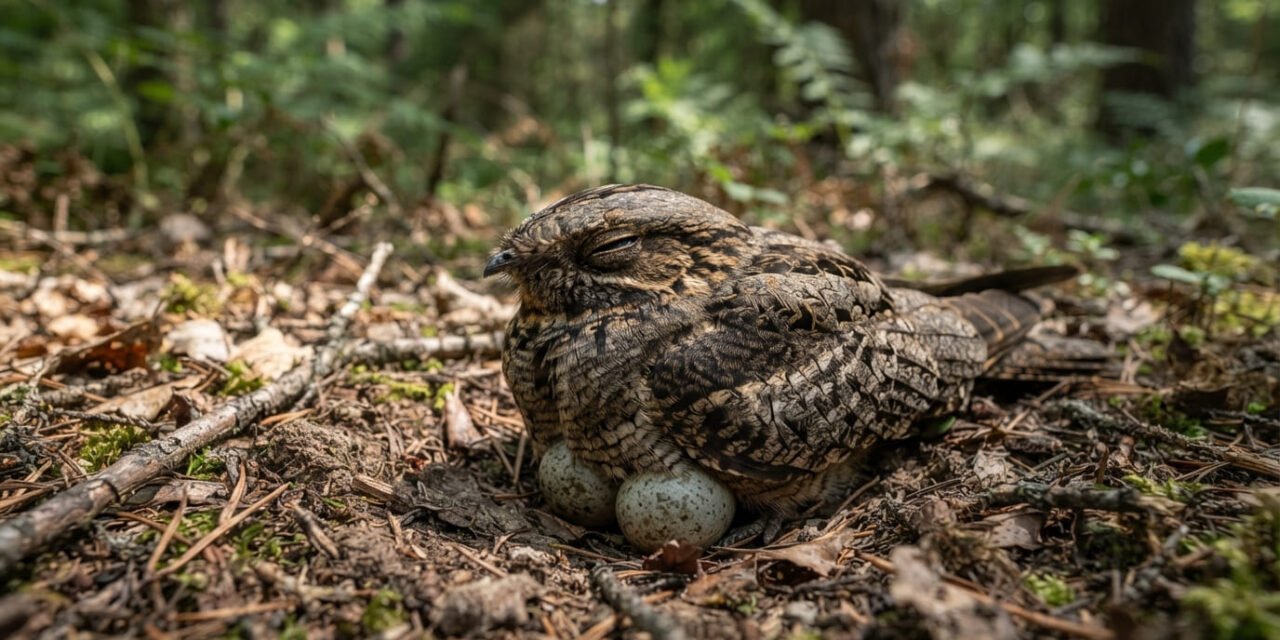
Most birds spend massive amounts of energy gathering twigs, weaving grass, or hollowing out tree cavities to create a safe, elevated fortress for their eggs. Caprimulgus europaeus simply skips that entire process. When a female nightjar is ready to lay her eggs, she searches the heathland or the forest floor for a patch of bare dirt, perhaps nestled among some dry pine needles or a patch of low-growing bracken. She lays one or two heavily mottled eggs directly onto the open ground.
This seems like an incredibly foolish evolutionary strategy. The ground is heavily patrolled by foxes, badgers, stoats, and stray cats. An egg sitting on the dirt is essentially a free meal for any passing predator.
The nightjar protects its vulnerable eggs by turning itself into an optical illusion. The plumage of a European nightjar is a masterpiece of cryptic camouflage. They are painted in incredibly intricate, densely patterned shades of gray, brown, and buff. The feathers feature tiny streaks and heavy mottling that completely shatter the outline of a bird.
During the day, the bird sits completely motionless over its eggs. It flattens its body against the earth and closes its large, dark eyes to tiny slits so they do not reflect the sunlight. If you walk within three feet of a nesting nightjar, you probably will not see it. Your brain will register a piece of rotting bark, a dry pinecone, or a patch of dead fern leaves.
If the bird is not nesting, it uses this same camouflage to rest in the trees. However, unlike a hawk or an owl that perches across a branch, the nightjar perches lengthwise. It presses its chest flat along the top of a thick branch, tucking its head down. The mottled gray feathers blend perfectly with the rough bark. It essentially turns itself into a natural extension of the wood, completely disappearing from the view of hungry hawks circling overhead.
The Aerial Acrobat of the Dark
The nightjar spends the entire day locked in this rigid, motionless state of extreme hiding. But when the sun finally sets, the disguise is abandoned, and the true nature of Caprimulgus europaeus is revealed.
The bird takes to the air. Its flight is completely silent. Because its feathers are remarkably soft, similar to those of an owl, they muffle the sound of the air rushing over the wings. It flies with deep, powerful wingbeats, occasionally gliding and sharply twisting through the canopy.
In flight, the nightjar suddenly looks surprisingly large, possessing a wingspan that can reach up to 60 centimeters. If it is a male bird, you might catch flashes of bright white patches located near the tips of its wings and on its tail feathers, which it uses to signal females and establish its territory in the dark.
The nightjar is an insectivore, and it hunts entirely on the wing. It does not use echolocation like a bat. Instead, it relies on exceptionally large eyes equipped with a highly reflective layer that acts as a biological light amplifier. The bird flies low over the heath, silhouetting its prey against the dim light of the night sky.
When it spots a target, it strikes. This is where the bird’s strange anatomy comes into play. The beak of a nightjar is incredibly tiny, barely a point on the front of its face. But the mouth itself is massive. When a nightjar opens its mouth, it gapes nearly from ear to ear, creating a massive, fleshy funnel.
It flies directly into a swarm of insects with its mouth wide open, scooping them out of the air. It heavily targets large, nocturnal insects. The nightjar frequently consumes large moths from the family Noctuidae, as well as various species of scarab beetles that take flight after dark. If a swarm of mayflies (from the order Ephemeroptera) happens to hatch over a nearby river, the nightjars will quickly gorge themselves on the soft-bodied insects.
Adding to their hunting efficiency, the nightjar possesses stiff, highly sensitive bristles surrounding its gaping mouth. These bristles act almost like a net or a sensory fence, helping to funnel the insects directly into the bird’s throat as it twists and dives through the dark air.
The Perils of Ground Dwelling
While their camouflage is practically flawless against visual predators like hawks and humans, nesting on the ground in modern Europe comes with a unique set of intense challenges.
A red fox or a badger relies heavily on scent, and if they happen to catch the scent of the nesting bird or the eggs, the camouflage becomes useless. When a predator approaches the nest site, the nightjar does not try to fight. It uses a different psychological trick.
The bird will suddenly flush from the ground when the predator is dangerously close, sometimes just a few feet away. But it does not fly up into the safety of the trees. Instead, it flutters erratically, dropping back down to the ground a short distance away. It will drag its wings through the dirt and call out in distress, perfectly mimicking the look of a severely injured bird.
This act is highly calculated. The predator sees what appears to be an easy, crippled meal and abandons the eggs to chase the adult. The nightjar continues this frantic, broken-wing display, leading the fox further and further away from the vulnerable nest. Once the predator is safely drawn away, the nightjar suddenly “heals,” taking off with powerful wingbeats and vanishing silently into the dark sky, eventually circling back to its eggs.
Despite these brilliant defensive tactics, the European nightjar is highly vulnerable to human activity. Because they favor open heathlands and clearings in pine plantations, their nesting sites are frequently disturbed. Off-leash dogs bounding through the heather can easily crush the unseen eggs. The expansion of agriculture and the loss of pristine heathland habitats have historically put severe pressure on the populations of Caprimulgus europaeus.
The Endurance of the Night
Perhaps the most astonishing aspect of the European nightjar is its sheer physical endurance.
The bird only spends the summer months in Europe and northern Asia to breed. When the weather turns cold in late August and September, and insect populations begin to die off, the nightjar knows it cannot survive the winter.
This small, perfectly camouflaged bird embarks on a massive migration. It flies across the English Channel, over the vast expanse of the Mediterranean Sea, and navigates across the brutal, unforgiving sands of the Sahara Desert. The European nightjars spend their winters in the scrublands and savannas of sub-Saharan Africa, often traveling thousands of miles entirely under the cover of darkness.
When spring returns, they retrace that massive journey, flying thousands of miles back to the same patch of English heathland or German pine forest to lay their eggs on the bare dirt once again.
When you understand the life of Caprimulgus europaeus, the old myths about goatsuckers seem entirely inadequate. The truth is far more impressive. It is a bird that abandoned the safety of the trees to hide in plain sight on the dangerous forest floor. It turned its own body into a perfect optical illusion of dead wood and dry leaves. It traded the daylight for massive eyes and a gaping, bristle-lined net of a mouth.
The European nightjar is a masterclass in highly specific adaptation, a creature perfectly designed to disappear entirely into the landscape during the day, only to become a silent, high-speed hunter the moment the forest goes dark.