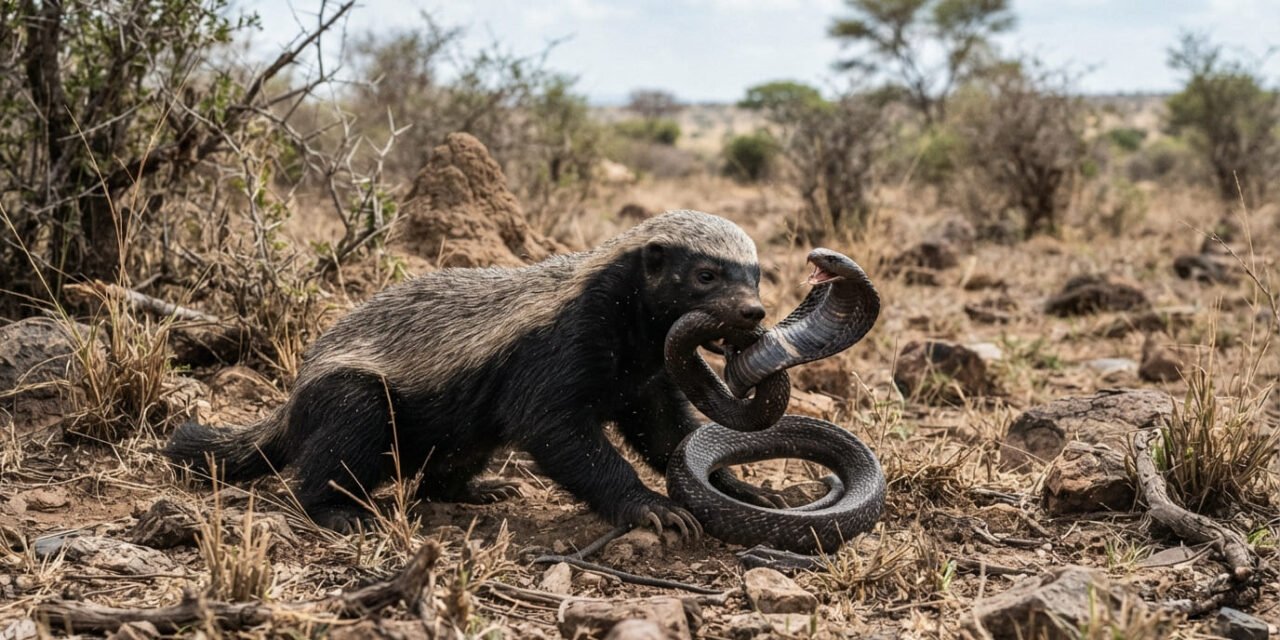
If you see a Honey Badger in the African savanna, you aren’t looking at a cute forest animal. You’re looking at a thirty-pound tank that doesn’t understand the concept of a losing battle. They have walked away from fights with lions and leopards. They have been attacked by swarms of bees that would kill a person. But their most famous party trick is their ability to hunt some of the deadliest snakes on the planet and survive the consequences.
The Honey Badger is a master of defense. Every part of its body is designed to absorb damage and keep moving forward. It isn’t just “brave” in a psychological sense; it is biologically equipped to be the most stubborn creature in the wild.
Armor Made of Skin
The first line of defense for a Honey Badger is its skin. It is incredibly thick—about a quarter of an inch at the neck. To put that in perspective, their skin is thicker than the hide of a buffalo relative to their size. It is so tough that traditional weapons like spears or machetes often fail to penetrate it. Even a dog’s teeth struggle to find a grip.
But the skin isn’t just thick; it is loose. If a predator grabs a Honey Badger by the back of the neck, the badger can actually turn around inside its own skin. It twists its body 180 degrees and bites the attacker right in the face. This makes it almost impossible to pin them down or deliver a finishing blow. They are like a person wearing a leather jacket that is three sizes too big; you can grab the jacket, but you can’t easily hurt the person inside.
Sleeping Off a Lethal Dose
Honey Badgers love to eat snakes. They will hunt anything from a puff adder to a King Cobra. During these hunts, the badger is almost always bitten. For any other mammal, a cobra bite is a death sentence. The neurotoxins in the venom shut down the respiratory system, causing the heart to stop within minutes.
The Honey Badger has a different ending to that story. Over millions of years, they have evolved a mutated nicotinic acetylcholine receptor. This is a scientific way of saying their nervous system has a “lock” that the snake’s venom “key” doesn’t fit into. The venom cannot latch onto their nerves and paralyze them.
When a Honey Badger is bitten by a highly venomous snake, it might collapse. It looks dead. It might lie on the ground for two or three hours while its body processes the toxin. But then, it simply wakes up. It stands up, shakes itself off, and usually finishes eating the snake that just bit it. They don’t have an “antidote” in their blood; they have a nervous system that simply ignores the poison.
Driven by High Metabolism
Honey Badgers are constantly on the move. They are restless hunters that cover miles of ground every day. This is because they have a massive metabolism. They burn through energy at a rate that requires them to eat almost constantly.
This high metabolism is the engine behind their aggression. They don’t have the luxury of being cautious. If they see a beehive or a lizard, they have to get it. This “all-or-nothing” approach to life is what makes them so dangerous. When they feel threatened, they don’t calculate the odds. They release a foul-smelling liquid from their anal glands—similar to a skunk but even more potent—and charge.
Lions often leave Honey Badgers alone. It isn’t because a lion couldn’t eventually kill one; it’s because the cost of the fight is too high. A lion doesn’t want to deal with a screaming, stinking, biting animal that won’t die easily. It’s easier for the lion to find a gazelle.
The Intelligence of a Raider
While they are famous for being “crazy,” Honey Badgers are actually very smart. They are one of the few non-primates known to use tools. In captivity, they have been filmed using sticks, stones, and even rakes to climb out of enclosures or reach food.
In the wild, they have a famous relationship with a bird called the Greater Honeyguide. The bird flies ahead and calls out to the badger when it finds a beehive. The badger uses its massive claws to rip the hive open. The badger eats the honey and the larvae, and the bird eats the leftover wax. It is a partnership built on a shared love for a high-calorie snack.
The Claws and Teeth
A Honey Badger’s claws are about two inches long. They are designed for digging, but they work perfectly as weapons. They can dig through sun-baked earth in minutes to reach a rodent’s burrow. When they fight, they go for the softest spots on their opponent. They are known to target the eyes and the groin of larger animals.
Their teeth and jaws are also surprisingly strong. They can crunch through the thick shells of tortoises or the heavy bones of a carcass. This allows them to eat parts of an animal that other predators leave behind. They are the ultimate survivalists because they can eat almost anything and live almost anywhere.
Why You Should Respect the Badger
The Honey Badger lives in Africa, the Middle East, and parts of India. They are solitary animals that don’t like company. They are a reminder that size is not the only measure of power.
We can learn something from their resilience. They have adapted to their environment by becoming too difficult to kill. They didn’t grow bigger; they grew tougher. They developed specific biological defenses against the specific threats in their neighborhood.
In a world where most animals spend their lives trying to hide or run away, the Honey Badger stays and fights. It is a creature that has decided that the best defense is a relentless offense.
A Threat to the Population
Even though they are tough, Honey Badgers face human threats. Farmers often trap or poison them because the badgers are notorious for breaking into chicken coops or destroying beehives. Because they are so stubborn, they will keep coming back to a food source until they are stopped.
They are also affected by habitat loss. They need large areas of land to hunt, and as farms expand, the badgers are forced into smaller pockets of territory. This leads to more conflict with humans. Despite their reputation for being invincible, they are still vulnerable to the changes we make to the planet.
Final Thoughts
The Honey Badger is a masterpiece of evolutionary engineering. It has the armor of a rhino, the poison resistance of a laboratory, and the attitude of a street fighter. It is an animal that lives life on its own terms.
When you hear people talk about “bravery,” they are usually talking about a person who overcomes fear. But the Honey Badger doesn’t seem to have fear to overcome. It is a biological machine built to survive. As long as there are cobras to hunt and beehives to raid, the Honey Badger will be there, ignoring the odds and walking away from fights that should have killed it. It is the most fearless animal in the world, not because it wants to be, but because its body won’t let it be anything else.