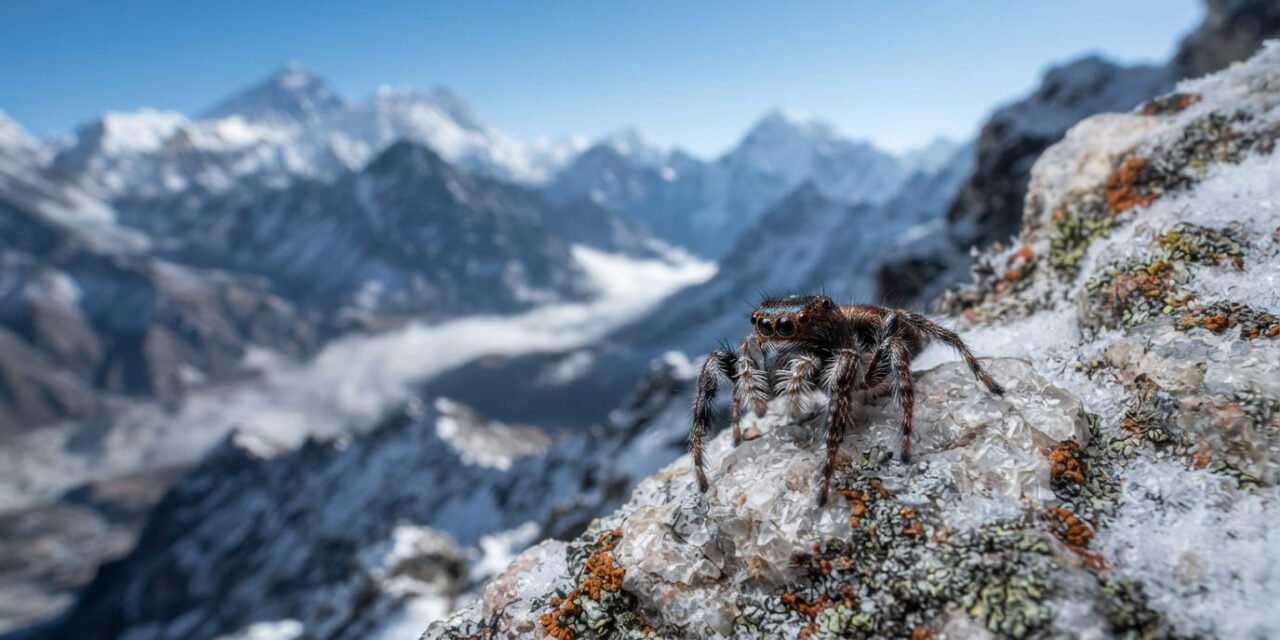
Most people think of Mount Everest as a graveyard. Above 20,000 feet, you enter the “Death Zone.” The air is too thin to support human life for long. The temperature drops far below zero. There are no trees, no grass, and no obvious food. But if you look closely at the rocky crevices near the world’s highest peaks, you might see a tiny pair of eyes looking back at you.
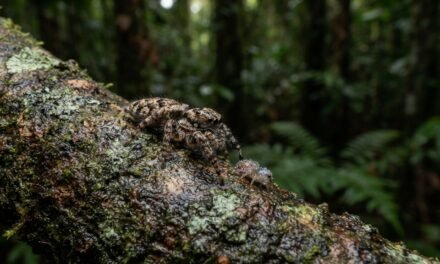
This is Euophrys omnisuperstes. Its name literally means “standing above all.” It is a species of jumping spider that lives at elevations up to 22,000 feet. It is the highest-dwelling permanent resident on Earth. While mountain climbers struggle to take a single step, this spider is busy hunting and jumping in the thin, freezing air.
Surviving the Thin Air
At 22,000 feet, there is only about forty percent of the oxygen available at sea level. For most animals, this causes immediate physical failure. Spiders don’t have lungs as we do. They use “book lungs,” which are thin, layered organs that allow oxygen to pass directly into their blood.
The Himalayan jumping spider has adapted to be extremely efficient at extracting what little oxygen is available. They don’t waste energy. They spend a lot of time tucked away in small pockets of air between rocks. These cracks act as a buffer against the wind and help trap a tiny bit of moisture.
The Anti-Freeze Secret
Cold is the biggest threat to an insect or arachnid. When water freezes, it expands. If the water inside a bug’s cells freezes, it shatters the cell walls and kills the creature instantly.
The Himalayan jumper uses a biological trick to survive. Their bodies produce “cryoprotectants.” These are special proteins and alcohols, like glycerol, that lower the freezing point of their body fluids. It is similar to the antifreeze you put in a car’s radiator. They can reach temperatures that would freeze a common house spider solid, yet their internal systems stay liquid.
Even with this antifreeze, they can’t stay active in the middle of a blizzard. They go into a state of “torpor.” This is a deep sleep where their metabolism slows down to almost nothing. They wait for the sun to hit the rocks. Because the rocks are dark, they absorb solar heat. The spider crawls out onto the warm stone, “recharges” its body heat, and goes looking for a meal.
What Do You Eat at the Top of the World?
The most obvious question is: what is there to eat? At 22,000 feet, there are no plants. No other bugs are living there permanently. The food chain seems to have a missing link.
The spider relies on the “aeolian” food chain. Aeolian means “driven by the wind.” High-altitude winds pick up debris from the valleys below. This includes bits of dead plants, pollen, and, most importantly, tiny insects like flies and springtails that get caught in updrafts. These insects are blown high up the mountain and die when they hit the cold ice and rocks.
The Himalayan jumping spider is a scavenger-predator. It patrols the edges of snowfields and rocky patches to find these “wind-fall” insects. It is a life lived on the leftovers of the lower world. They are the ultimate recyclers of the mountain.
Hunting by Sight
Jumping spiders are famous for their vision. They have eight eyes, but the two large ones in the front provide high-resolution, 3D vision. They can judge distances with incredible accuracy. This is vital when you are jumping across a gap between two freezing rocks. If you miss, you fall into a crevasse or get swept away by the wind.
Unlike many spiders, they don’t build webs to catch food. They are active hunters. Once they spot a wind-blown fly, they stalk it like a cat. They attach a silk “safety line” to the rock, then lunge. They can jump many times their own body length. The silk line ensures that even if they miss or the wind gusts, they don’t get tossed off the mountain.
The Physical Limits of Life
Scientists study these spiders to understand the absolute limits of biology. If a spider can live at 22,000 feet, could life exist on other planets with thin atmospheres? The Himalayan jumper proves that life doesn’t need a lush forest or a warm climate to thrive. It just needs a tiny bit of heat, a bit of moisture, and a way to handle the pressure.
They are also incredibly small. Most are only about five millimeters long. This small size is an advantage. They don’t need much food to survive, and they can find shelter in the tiniest cracks in the granite. Their dark color helps them absorb as much UV radiation as possible from the sun, which is much stronger at high altitudes.
Climate Change on the Peaks
The Himalayan jumper is currently safe from most human interference, but climate change is a threat. As the glaciers melt and the “permafrost” in the rocks thaws, the environment is changing.
If the mountains get too warm, other predators from lower altitudes might move up and compete with the spider. Or, the wind patterns that bring their food might shift. Because they live at the very top of the world, they have nowhere higher to go. They are at the end of the line.
Observing the Impossible
Most people will never see a Himalayan jumping spider in person. You have to be an elite mountaineer just to reach their neighborhood. But their existence changes how we look at the “barren” parts of our planet.
When you look at photos of Everest, you see white snow and grey rock. You see a place that looks dead. But tucked away in the shadows of those rocks is a complex, active creature with a specialized brain and a high-tech cooling system.
Final Thoughts
The Himalayan jumping spider is a master of the “Death Zone.” It doesn’t fight the mountain; it uses the mountain. It uses the wind to bring food, the rocks to provide heat, and its own chemistry to fight the cold.
It is a reminder that being “fearless” isn’t just for big animals like honey badgers. To be five millimeters long and face a 100-mile-per-hour wind at 22,000 feet takes a different kind of toughness. As long as the wind blows debris up the slopes of the Himalayas, this tiny navigator will be there, waiting for the sun to hit the rocks so it can take its next jump. It is the true king of the mountain, living in a place where humans can only visit with a tank of oxygen and a lot of luck.