Have you ever been to a backyard barbecue and watched a honeybee hovering over a bowl of fruit salad? It takes a little sip of juice, zips around for a second, and then disappears. A few minutes later, ten of its friends show up at the same bowl. It feels like they have a group chat going on, doesn’t it? Well, in a way, they do. But instead of texting, they use their bodies to dance a map into existence.
Scientists call this the “Waggle Dance.” It’s probably one of the most incredible things in the entire natural world. Imagine trying to give your friend directions to a coffee shop three miles away, but you can’t use words, you can’t use a phone, and you have to do it in a pitch-black room. That is exactly what a honeybee does every single day inside the hive.
The Dance Floor
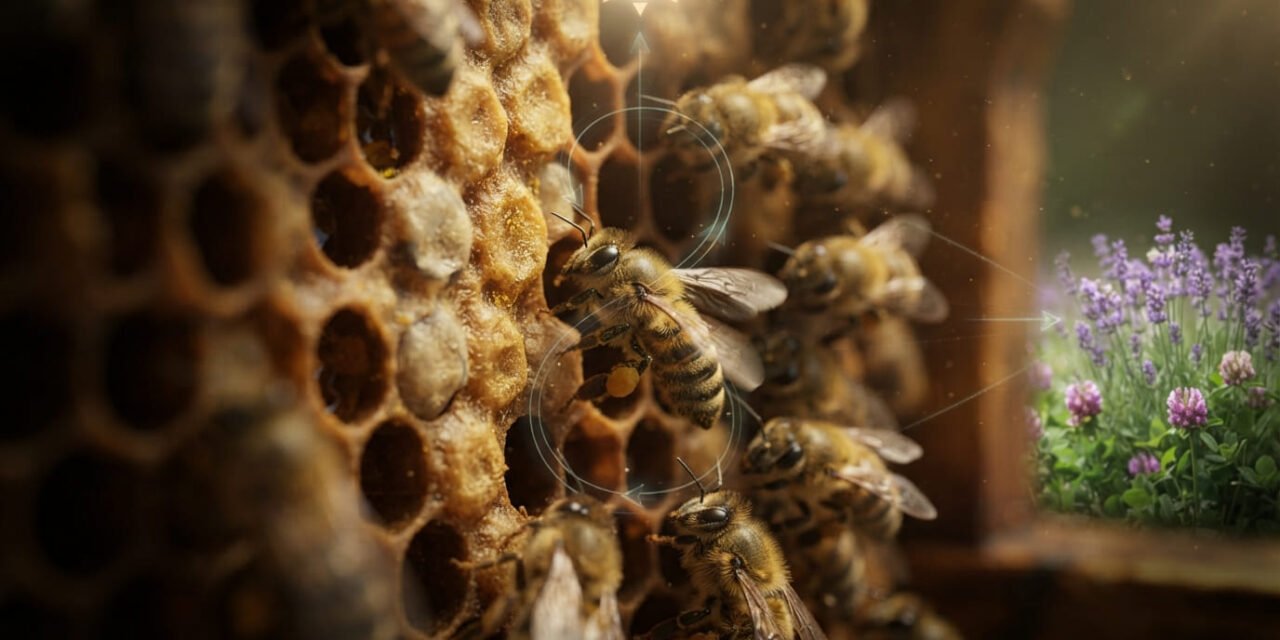
The beehive is a busy, dark, and crowded place. It’s made of wax combs hanging vertically. When a “scout” bee finds a great patch of wildflowers—maybe some clover or lavender a mile away—she flies back to the hive. She doesn’t just keep the secret to herself; she wants the whole family to eat.
She crawls onto a specific area of the honeycomb that acts like a dance floor. Even though it’s dark, the other bees can feel her movement through their antennae and the vibrations of the wax. She starts by running in a figure-eight pattern. The middle part of that figure-eight is the “waggle” part. She shakes her abdomen back and forth really fast while moving in a straight line.
The Math Behind the Shake
This isn’t just a happy dance because she found food. Every single movement she makes is a piece of data. It’s a code that tells the other bees two very specific things: which way to go and how far to fly.
1. The Angle of the Sun
Bees use the sun as their compass. But here’s the problem: the bee is dancing on a vertical honeycomb inside a dark box. She can’t see the sun. So, she uses gravity to represent the sun. If she waggles straight up the honeycomb, she’s telling her friends, “Fly directly toward the sun.” If she waggles at a 90-degree angle to the right, she’s saying, “Keep the sun on your left shoulder as you fly.”
It’s basically a geometry lesson. She’s translating a 3D world into a 2D dance, and the other bees are smart enough to translate it back into 3D when they leave the hive.
2. The Distance
The length of the “waggle” part tells the bees how far away the flowers are. Usually, one second of waggling equals about one kilometer (roughly 0.6 miles) of flight. If she waggles for a long time, the flowers are far away. If it’s a short burst, they’re just around the corner. She’s literally “measuring” the world with her body.
Why Speed Matters
It isn’t just about the direction and distance, though. The “excitement” of the dance tells the hive how good the food is. If the flowers are full of high-quality nectar, the bee will dance faster and with more energy. She’s essentially a tiny salesperson. If the nectar is low quality, she might only do a lazy, slow dance.
If the other bees aren’t impressed, they won’t bother following the directions. They’ll wait for a different scout to come back with a better “sales pitch.” It’s a democratic system where the best food source wins the most workers.
The Built-in GPS
One of the most mind-blowing parts of this is that the sun moves. If a scout bee finds food at 10:00 AM and comes back to dance, the sun is in one spot. But if she keeps dancing until 11:00 AM, the sun has moved across the sky.
Does the bee give the wrong directions? Nope. Bees have an internal clock that allows them to adjust their dance to account for the sun’s movement. Even though they can’t see the sky from inside the hive, they “know” where the sun should be and change the angle of their waggle to match. It’s a level of mental calculation that would make a math teacher proud.
The Taste Test
While the dance provides the map, the bee also brings back “samples.” As she dances, she pauses to share tiny drops of the nectar she found with the bees around her. She also carries the scent of the flowers on her body.
So, by the time a “recruit” bee leaves the hive, she has a map (the waggle), a compass (the sun), a distance (the duration), and a “wanted” poster (the smell). She knows exactly what she’s looking for and where it is. This is why you’ll see a sudden swarm of bees on a single bush; they’ve all been “debriefed” by the same scout.
The Hardest Workers in the Garden
We often take bees for granted, but their “Waggle Dance” is the reason we have so much variety in our diet. About one out of every three bites of food you eat is thanks to a bee. When they fly to those flowers they “mapped” out, they move pollen from one plant to another. This allows the plants to create fruits, nuts, and vegetables.
Think about your grocery store. The apples, the almonds, the blueberries, and the pumpkins—those are all there because a tiny bee did a figure-eight dance in a dark box a few miles away. Without their “GPS dancing,” plants wouldn’t get pollinated as efficiently, and our food systems would collapse.
Communication is Survival
The Waggle Dance isn’t just about food; it’s about the survival of the colony. In the spring, when a hive gets too crowded, the bees will “swarm.” The old queen leaves with half the workers to find a new home.
Scout bees fly out to look for hollow trees or gaps in walls. They come back and “dance” the locations of potential new homes. Other scouts will go and check out the “suggested” spots. If they like a spot, they come back and dance for it too. Eventually, a “consensus” is reached. When enough bees are dancing for the same location, the whole swarm takes off and moves to their new house. It’s like a neighborhood meeting where everyone gets a vote, but instead of talking, they just dance until everyone agrees.
The Threat to the Map
In our modern world, the Waggle Dance is getting harder for bees to perform. Pesticides can mess with a bee’s brain, making it hard for her to remember the map or fly in a straight line. Climate change is also causing flowers to bloom at different times, which can throw the bees’ schedule out of sync.
When we use too many chemicals in our gardens, we’re essentially “jamming” the bees’ GPS. If the scouts can’t communicate, the hive starves. This is why planting bee-friendly flowers and avoiding harsh sprays is so important. We need to keep their dance floors open and their maps clear.
Final Thoughts
The next time you see a bee in your garden, take a second to really look at her. She’s not just a bug looking for a snack. She’s a navigator, a mathematician, and a communicator. She’s carrying the coordinates of your backyard back to a hidden city, where she’ll perform a beautiful, rhythmic dance to tell her family about the wonderful flowers you’ve grown.
The Waggle Dance reminds us that intelligence doesn’t always look like a brain in a jar. Sometimes it looks like a vibration in the dark. It shows us that even the smallest creatures have a complex way of understanding the world.
We can learn a lot from the bees. They don’t argue, they don’t lie about where the food is, and they work together for the good of everyone. Their life is a dance of cooperation. And as long as they keep dancing, our world stays colorful, healthy, and full of life. It’s a small move, but it maps the whole world.