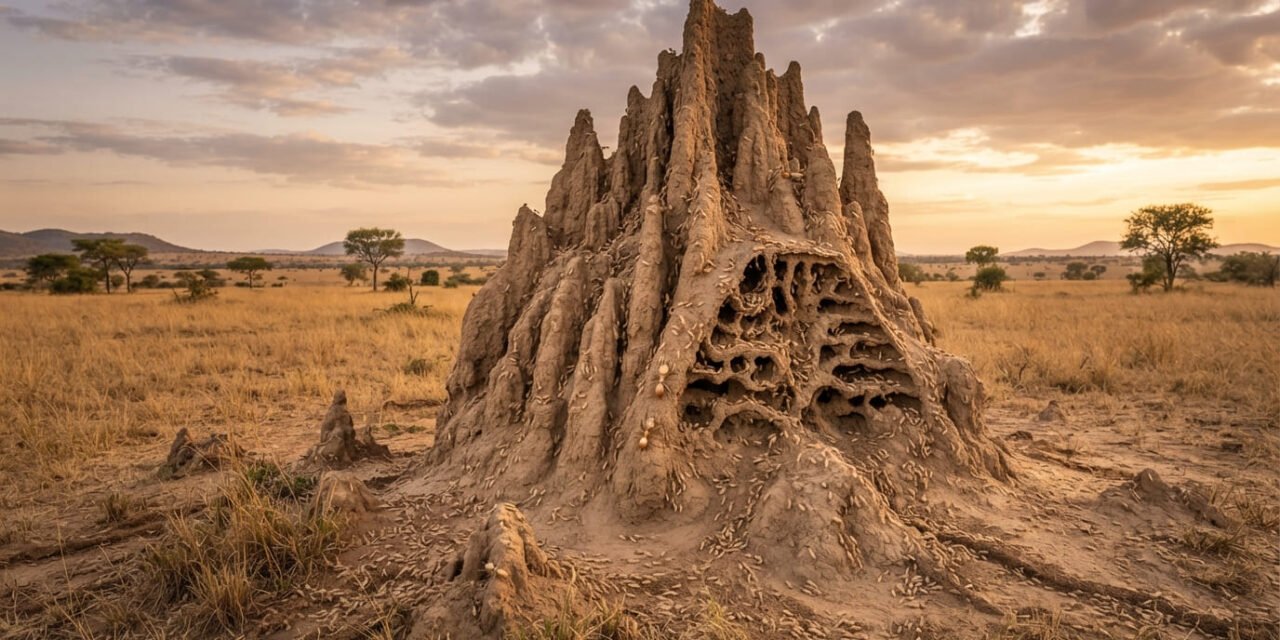
If I asked you to name the world’s greatest architects, you’d probably think of the people who built the Burj Khalifa in Dubai or the ancient pyramids in Egypt. But some of the most impressive structures on the planet aren’t built by humans with cranes and blueprints. They’re built by tiny, blind insects called termites.
In the grasslands of Africa and Australia, you can find termite mounds that tower seventeen feet high. To a termite, that’s like a human building a skyscraper that reaches two miles into the sky. And here’s the kicker: they do it without air conditioning, electricity, or a boss telling them where to put the next piece of dirt.
Most of us think of termites as “the bugs that eat my house.” But in the wild, they’re the master builders of the abyss, and they’ve figured out how to solve engineering problems that humans are still struggling with today.
A City Under the Hill
First, let’s clear one thing up. The big dirt mound you see above ground isn’t actually where the termites live. That’s just the ventilation system. The real city is located deep underground, where it’s safe from predators and the burning sun. Think of the mound as the “nose” and the underground tunnels as the “lungs.”
Down there, the colony is a buzzing metropolis. There are nurseries for the babies, a royal chamber for the King and Queen, and even “fungus gardens” where the termites grow their own food. Because termites can’t digest wood very well on their own, they grow a special type of mushroom on chewed-up wood, and then they eat the mushroom. They were farmers millions of years before humans even existed. They’ve mastered the art of sustainable agriculture on a scale that puts modern industrial farming to shame.
But living underground with millions of other bugs creates a massive problem: breathing. If you put a million people in a basement with no windows, they’d run out of oxygen pretty fast. Plus, all that activity creates a lot of heat. How does a bug that’s only a few millimeters long keep its city cool and fresh?
The Natural Air Conditioner
This is where the mound comes in. The termite mound is a masterpiece of passive cooling. Scientists used to think the mounds worked like a simple chimney, but they’re actually much smarter than that. It’s a complex, fluid-dynamic system that uses the energy of the wind and the sun.
The mound is porous, meaning it has tiny holes all over it. As the wind blows against the mound, it pushes fresh air in and sucks the “stale” air out. The termites have designed the internal tunnels to act like lungs. During the day, the mound absorbs heat from the sun. At night, that heat is released, which helps pull air through the system.
It’s a constant, breathing structure. Even when the temperature outside hits 100 degrees Fahrenheit, the temperature inside the fungus gardens stays within a few degrees of perfection. It’s better than the HVAC system in most modern office buildings, and it doesn’t cost a cent in utility bills. This level of climate control is essential because the fungus they farm is incredibly sensitive; if the temperature shifts too much, the food source dies, and the colony starves.
Building Without a Blueprint
How do they do it? If you’ve ever tried to build a LEGO set without the instructions, you know how hard it is. Now imagine doing it with a million other people while you’re all blindfolded. That’s the daily life of a termite. They don’t have eyes to see the structure they are building, yet they create something perfectly symmetrical and functional.
Termites use a concept called “stigmergy.” It’s a fancy word for a simple idea: the work itself tells you what to do next. When a termite drops a ball of mud mixed with its saliva, it leaves a chemical scent (a pheromone) on that mud. When another termite smells that scent, it thinks, “Hey, someone started a pillar here,” and it drops its ball of mud on top.
As the pillar gets taller, the scent gets stronger. If two pillars are close together, the scent from both starts to overlap in the middle. The termites follow that scent trail and start building a bridge between the pillars. They don’t need a project manager; they just follow the “smell” of the work. It’s a self-organizing system where the environment acts as the memory of the colony. It’s a bit like a group of jazz musicians improvising—they aren’t reading sheet music, but they’re listening to each other and building something harmonious.
The Queen’s Fortress
Deep in the heart of this dirt skyscraper is the royal chamber. The Queen is the most important part of the superorganism. She is massive compared to her workers—sometimes the size of a human finger. She is essentially an egg-laying machine, capable of producing up to 30,000 eggs a day.
Because she is so valuable, the workers build her a fortress of incredibly hard, sun-baked mud. This room is the most protected spot in the mound. If a predator, like an aardvark, starts digging into the mound, the soldier termites (who have huge, scissor-like jaws) will rush to the breach to fight it off, while the workers scramble to move the Queen even deeper into the earth. It’s a total commitment to the future of the colony. The walls of this chamber are so thick and strong that even humans often need heavy tools like pickaxes to break through them.
Why Architects are Copying Bugs
Humans are finally starting to pay attention to termite engineering. We’ve spent decades building glass boxes that require massive amounts of electricity to keep cool, but termites have shown us there’s a better way.
There’s a famous building in Zimbabwe called Eastgate Centre. It’s a huge shopping mall and office block that has no conventional air conditioning. Instead, the architect, Mick Pearce, studied termite mounds and designed the building to use the same “passive cooling” tunnels. By using the natural rise and fall of air temperature, the building stays cool all year round.
The building uses 90% less energy than a traditional building of the same size. By “listening” to the termites, we’re learning how to build cities that are more sustainable and better for the planet. It turns out that a “pest” might have the answer to our global energy crisis. We are seeing similar designs pop up in Australia and parts of the United States, where architects are using “biomimicry” to let buildings “breathe” just like a termite mound.
The Soil’s Best Friend
Outside of their building skills, termites are vital for the environment. Just like the ants we talked about, termites are “ecosystem engineers.” In dry areas, their tunnels allow rainwater to soak deep into the hard ground instead of just running off the surface. This creates “islands of green” in the middle of deserts.
When the rains finally come, the water follows the termite paths down into the aquifer, replenishing the underground water supply. Plants grow better near termite mounds because the soil is full of nutrients from the termites’ waste and the fungus they grow. In the savanna, you can actually see the landscape dotted with circles of lush grass—each one sits on top of a termite city. They are the hidden reason the African plains are so full of life. Without them, these vast grasslands would likely turn into dust bowls.
A Lesson in Humility
We often think of progress as a human invention. We think of high-speed internet and steel skyscrapers as the pinnacle of evolution. But termites have been doing high-end engineering for over 50 million years. They’ve solved the problems of waste management, climate control, and collective decision-making without a single computer or a single line of code.
There is a deep lesson in how they live. They don’t compete for the best view or the biggest office. Each termite, from the smallest worker to the largest soldier, is dedicated to the health of the whole. They show us that massive achievements aren’t always about individual genius; they’re about the strength of the community.
Final Thoughts
It’s easy to look at a bug and think it’s simple. We call them “creepy crawlies” and try to keep them out of our basements. But when you look at a termite mound, you’re looking at millions of years of intelligence. You’re looking at a structure that is perfectly adapted to its world, built by creatures who work in total darkness and total harmony.
These tiny architects show us that you don’t need a college degree or a big ego to build something that lasts. You just need to show up, do your small part, and trust your neighbors. They remind us that the most powerful force in nature isn’t the individual; it’s the group.
The next time you see a mound of dirt or a tiny bug in the grass, remember that there’s a whole world of math, physics, and cooperation happening right under your feet. We aren’t the only ones building skyscrapers. We’re just the ones who are finally learning how to do it as well as the termites. Maybe, if we keep watching them, we’ll learn how to build a world that breathes as easily as they do.