If you live in the Eastern or Midwestern United States, you might have experienced one of those summers where the air literally vibrates. It starts as a low hum in the morning, and by the afternoon, it’s a screaming, buzzing wall of sound that makes it hard to hear your own thoughts. It’s the sound of the Periodical Cicada, an insect that has become famous for one of the weirdest schedules in the animal kingdom.
Most insects live for a few weeks or maybe a year. But these cicadas? They play the long game. They spend 17 years hiding in the dark, silent and invisible, only to burst out of the ground by the billions for a single month of loud, frantic partying. It’s a survival strategy that sounds like something out of a science fiction movie, but it’s actually a brilliant piece of biological math.
The Life of a “Dirt-Dweller”
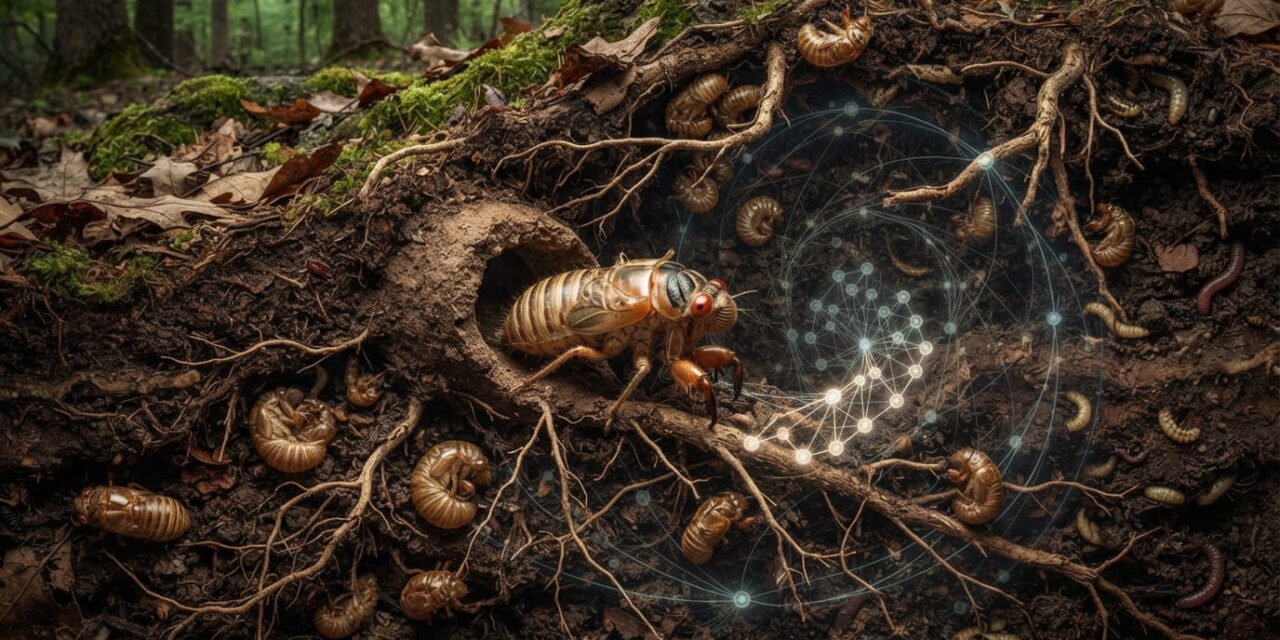
Let’s start at the beginning, because 17 years is a long time to keep a secret. When a cicada egg hatches, the tiny “nymph” (which looks a bit like a small white ant) falls from its tree branch and immediately starts digging. It goes about a foot underground and finds a nice, juicy tree root to latch onto.
And then… it stays there. For almost two decades.
It isn’t hibernating, though. It’s very much alive. It’s slowly drinking the sap from the tree roots, growing through different stages of its life. It lives in a little mud room, perfectly content in the darkness. While humans are going through elementary school, high school, and maybe even college, that same cicada is sitting in the dirt, waiting for its internal alarm clock to go off.
Counting the Years
One of the biggest mysteries for scientists was how an insect knows when 17 years have passed. They don’t have calendars, and they can’t see the seasons change from underground.
It turns out they “count” the years by monitoring the tree’s sap. Every spring, when the tree starts to grow new leaves, the sap changes in a very specific way. The cicada senses this chemical “pulse” and knows that one year has gone by. They are literally keeping track of time by tasting the heartbeat of the forest.
The Great Emergence
When the 17th year finally arrives, the cicadas wait for one more signal: the temperature of the soil. Once the ground hits a steady 64 degrees Fahrenheit, usually around May or June, the “Great Emergence” begins.
Imagine billions of insects all deciding to wake up at the exact same hour. They tunnel to the surface, leave their little exit holes in your lawn, and crawl up the nearest vertical surface—trees, fence posts, or even your garden gnome.
Once they’re hooked on, their old “skin” (the exoskeleton) splits down the back, and the adult cicada crawls out. At first, they are soft, white, and vulnerable. They have to wait for their new wings to dry and their bodies to harden into that familiar black-and-orange armor. If you walk through a forest during an emergence year, the ground is littered with these empty, golden-brown shells. It looks like a ghost town of tiny insects.
Strength in Numbers (The “Predator Satiation” Trick)
Why do they all come out at once? Why not just come out every year like other bugs?
It’s all about math. Specifically, it’s about a strategy called “Predator Satiation.”
Imagine you’re a bird, a squirrel, or a copperhead snake. Usually, you have to work hard for your dinner. But suddenly, there are billions of slow, clumsy, protein-packed cicadas everywhere. You eat until you can’t eat anymore. You’re stuffed. You’re “satiated.”
But because there are so many cicadas, the predators can’t possibly eat them all. Even if every bird in the state eats its weight in bugs, there are still millions of cicadas left over to mate and lay eggs. By coming out all at once, they “flood the market.” They sacrifice a few of their brothers and sisters so the rest of the family can survive.
The Prime Number Secret
There is another layer to this math that is even cooler. Have you noticed that they usually come out in 13-year or 17-year cycles? Both 13 and 17 are prime numbers.
This isn’t a coincidence. Most predators have population cycles that are shorter—like 2, 3, or 5 years. By choosing a prime number, the cicadas make it almost impossible for a predator’s “big population year” to line up with their emergence year.
If cicadas came out every 12 years, a predator with a 2, 3, 4, or 6-year cycle would be waiting for them every single time. But with 17 years? The math just doesn’t work out for the predators. The cicadas are literally outsmarting the rest of the forest with prime numbers.
The Loudest Love Song on Earth
Once their wings are dry, the males start singing. They have these special organs on their sides called “tymbals” that they vibrate like tiny drums.
A single male cicada is loud, but a chorus of millions is deafening. They can reach over 100 decibels—that’s as loud as a chainsaw or a low-flying jet. They do this for one reason: to find a mate. The females don’t sing; they just listen. When they hear a song they like, they flick their wings with a tiny “click” sound, and the male flies down to find her.
It’s a race against time. The adult cicadas only live for about four to six weeks. They don’t even have functional mouths to eat with! They spend their entire adult life focused on one thing: making the next generation. Once they mate and the females lay their eggs in the tips of tree branches, the adults die, and the forest goes quiet again.
A Gift for the Forest
Even though people sometimes complain about the noise or the “mess” of the dead cicadas, they are a massive blessing for the ecosystem.
When those billions of cicadas die and rot, they release a huge amount of nitrogen and nutrients into the soil. It’s like a giant shot of fertilizer for the trees. Studies have shown that in the years following a big cicada emergence, the trees grow faster and produce more seeds.
Also, all those exit holes in your yard? They act like a natural aerator, allowing air and water to reach the roots of your grass and plants. The “cicada summer” is basically a giant spa day for the forest.
Why We Should Appreciate Them
It’s easy to be annoyed by a bug that flies into your face or makes it impossible to hear the person sitting next to you on your porch. But the Periodical Cicada is a reminder of how vast and strange our world really is.
They are the ultimate “patience” experts. They show us that sometimes, waiting is the best strategy. They remind us that nature has rhythms that are much longer than our own human schedules. When you see a 17-year cicada, you’re looking at a creature that might have been born when you were just a toddler, or maybe even before you were born.
Final Thoughts
The next time a “Brood” (that’s what we call a specific group of cicadas) emerges in your area, try to stop and listen for a second. Don’t think of it as noise. Think of it as a 17-year-old celebration.
These bugs have survived for millions of years using nothing but math and timing. They aren’t dangerous—they don’t bite, they don’t sting, and they don’t carry diseases. They are just a bunch of clumsy, red-eyed time travelers coming up for a bit of sun before they head back into the long dark.
Enjoy the “scream” of the summer while it lasts. Because once it’s over, the silence will last for another 17 years. The next generation is already waiting in the branches, ready to fall to the dirt and start the long, slow count all over again. It’s a beautiful, weird, and perfectly timed dance, and we’re lucky to have a front-row seat.