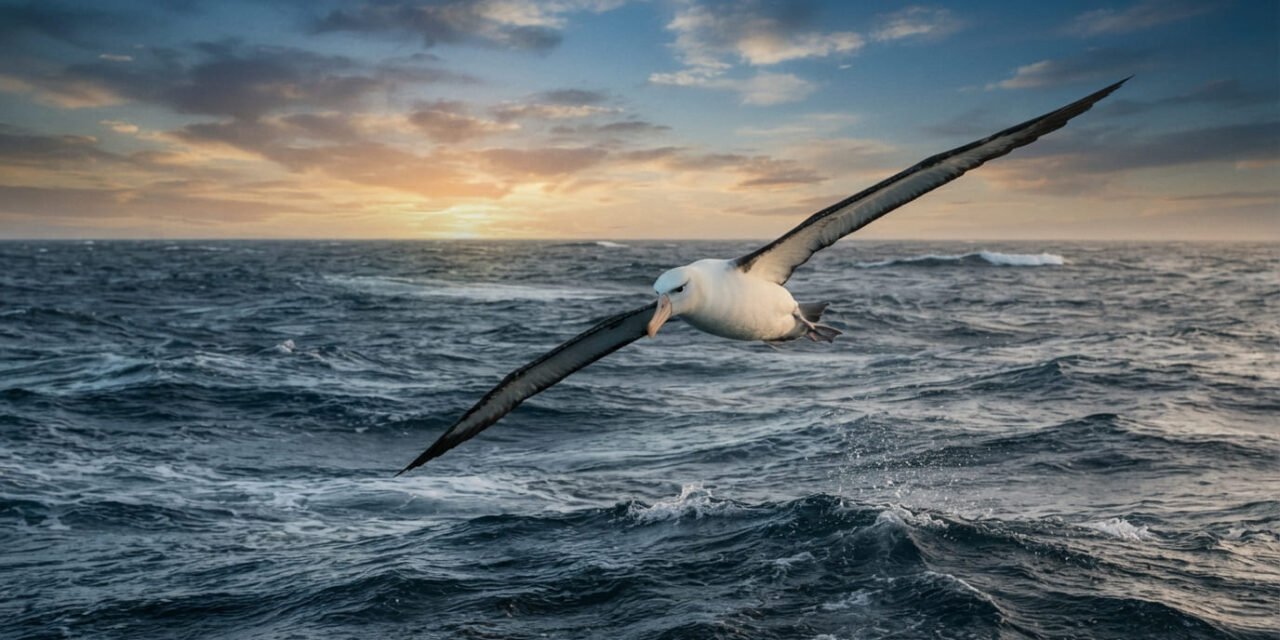
If you stand on the deck of a ship in the middle of the Southern Ocean, you might see a bird with a wingspan of eleven feet gliding inches above the waves. It doesn’t flap its wings. It doesn’t look like it’s working at all. This is the Wandering Albatross. It is built for a life that most of us can’t imagine. These birds spend eighty percent of their lives at sea. They are so specialized for flight that they can travel ten thousand miles in a single journey and barely use any energy.
The most incredible part of their life happens when they are young. Once a fledgling Albatross leaves its nest on a remote island, it heads for the open water. It will not touch dry land again for at least five years. It eats, sleeps, and grows entirely on the wing or floating on the surface of the ocean. They are the ultimate nomads of the planet.
The Physics of Dynamic Soaring
Most birds fly by flapping their wings to create lift. This takes a lot of muscle power and burns a lot of calories. If an Albatross tried to flap its way across the Pacific, it would starve to death in days. Instead, they use a technique called dynamic soaring.
The air just above the ocean surface is slower because of friction with the water. As you move higher up, the wind speed increases. The Albatross uses this difference in speed. It dives down toward the waves to gain momentum, then turns sharply into the wind and climbs back up. As it hits the faster air, it gets a boost of lift that shoots it upward without it having to flap once.
They repeat this cycle over and over. They weave a zig-zag pattern across the ocean, gaining energy from the wind itself. A Wandering Albatross has a special tendon in its shoulder that locks its wings in place like a pair of straight boards. This allows them to glide for hours with zero muscle effort. They are essentially biological gliders.
Sleeping While Gliding
If you are a bird that stays at sea for five years, you have to figure out how to sleep. An Albatross can’t just tuck its head under its wing on a branch. They use two different methods to rest.
When the weather is calm, they land on the water and float like a cork. But when they are on a long-distance mission, they use unihemispheric sleep. They shut down one half of their brain at a time. The side of the brain that is awake stays in control of the flight muscles and keeps an eye out for predators or obstacles. They take these half-brain naps in bursts of a few seconds or minutes while they are gliding.
Because their wings are locked in place by that shoulder tendon, they don’t fall out of the sky. They just keep moving with the wind. By the time they wake up fully, they might be fifty miles away from where they started their nap.
A Life Without Land
Young Albatrosses spend their first several years at sea because they have no reason to come back. They don’t breed until they are at least seven to ten years old. Until then, the land is a dangerous place full of predators like cats or rats on islands. The ocean provides everything they need.
They drink seawater. Most animals would die of dehydration if they did this, but the Albatross has a salt gland located right above its beak. This gland filters the salt out of their blood and drips it out through their nostrils. You will often see them with a “runny nose,” which is actually just pure salt being expelled from their system.
They eat squid and fish that rise to the surface at night. They have a sharp, hooked beak that is perfect for grabbing slippery prey. Because they spend so much time alone in a vast blue void, they have developed a sense of smell that is much stronger than most birds. They can smell a school of fish or a fishing boat from twelve miles away.
The Challenges of Marriage
When an Albatross finally decides to return to land to find a mate, it is a big deal. They are famous for having some of the longest “engagements” in the animal kingdom. They spend years practicing elaborate dances with potential partners. They bow, clack their beaks together, and spread their massive wings.
Once they pick a partner, they usually stay together for the rest of their lives, which can be sixty years or more. However, they only see their mate once every two years for a few months of nesting. The rest of the time, they are both out on the ocean, thousands of miles apart, flying solo. They trust that their partner will show up at the same spot on the same island two years later.
The Danger of Longlines
The Albatross is a master of the air, but it is struggling in the modern world. The biggest threat to their survival is longline fishing. These are fishing boats that trail lines up to eighty miles long with thousands of baited hooks.
When the Albatross sees the bait, it dives down to grab a free meal. It gets caught on the hook and is pulled underwater and drowned. Tens of thousands of Albatrosses die this way every year. Because they reproduce so slowly—laying only one egg every two years—the population cannot keep up with these losses.
Many fisheries are now using “bird-scaring lines” or weighted hooks that sink faster to help prevent this. These are simple changes that save thousands of birds without hurting the fish catch.
Why We Should Care
The Albatross is a record-breaker. They have the largest wingspan of any living bird. They cover more ground than almost any other animal on earth. They are the witnesses to the health of our global oceans.
When you look at an Albatross, you are looking at a creature that has solved the problem of distance. They don’t see the ocean as a barrier; they see it as a highway. They remind us that the earth is mostly water and that there are lives being lived thousands of miles from the nearest human being.
Their ability to navigate across a featureless ocean with no landmarks is still something scientists are trying to fully understand. They use the earth’s magnetic field, the position of the stars, and even the infrasound of waves hitting distant shores to find their way.
Observing the Nomad
If you are ever on a boat in the southern latitudes, look for a bird that doesn’t seem to move its wings. It will follow the wake of the ship, looking for scraps. It is a haunting sight to see a bird that large moving so silently.
They are often called “Gooney Birds” because they are very clumsy on land. Their legs are set far back on their bodies, and their wings are so long that they trip over them. But once they get a bit of wind under those wings and take off, they transform. They go from awkward hikers to the most graceful pilots in the world.
Final Thoughts
The Albatross is a reminder that specialized biology can lead to incredible feats. They have built a life in a place where humans cannot survive for more than a few days without massive amounts of technology. They do it with a salt gland, a shoulder lock, and a bit of physics.
The ocean is a rough, unforgiving place. But for the Albatross, it is home. As long as the wind keeps blowing across the waves, they will keep gliding. Our job is to make sure the ocean stays clean, and the fishing lines stay clear, so the “Super Generation” of birds can keep flying for another five years without ever having to touch the ground. They are the true kings of the wind, and the world would be a smaller, less magical place without them.