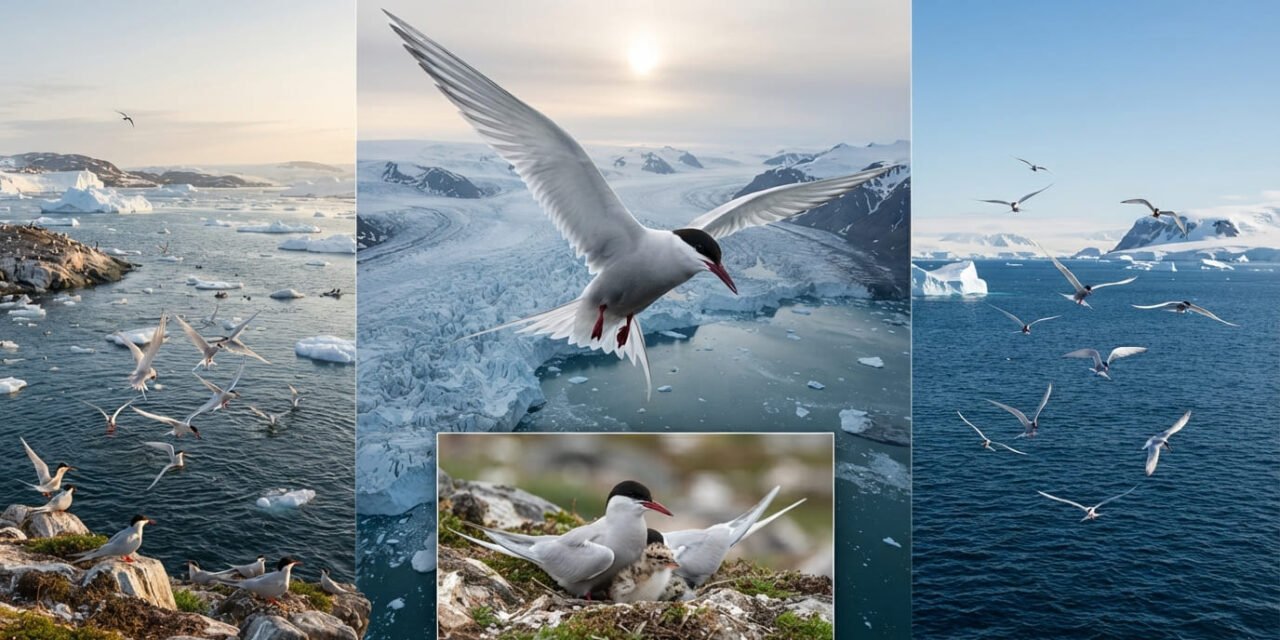
If you were to look at an Arctic Tern, you might see just a small, elegant bird with white feathers, a black cap, and a bright red beak. It weighs only about as much as a small computer mouse. But do not let its delicate appearance fool you. This tiny bird is the greatest traveler our planet has ever known.
While humans use airplanes and GPS to cross the globe, the Arctic Tern does it using nothing but its own wings and a mysterious internal compass. Every single year, this bird completes a journey so long that it seems impossible. It travels from the top of the world to the bottom, and then all the way back again.
In this blog, we are going to follow “The Longest Journey” and discover how this little bird lives a life of endless daylight.
A Life of Eternal Summer
Most animals have a home—a specific forest, a certain cliff, or a single meadow. But the Arctic Tern’s home is the entire planet.
The Arctic Tern has a very simple goal: it wants to live in summer all year round. To do this, it breeds in the Arctic (the North Pole) during the northern summer. When the air begins to turn cold and the sun starts to set for the winter, the tern doesn’t stay to face the snow. Instead, it takes to the skies and flies all the way to the Antarctic (the South Pole) just as the southern summer is beginning.
By moving between the two poles, the Arctic Tern sees more daylight than any other creature on Earth. It lives in a world where the sun seldom sets.
The Numbers of a Legend
To understand how incredible this journey is, we have to look at the numbers. Scientists recently used tiny tracking devices to measure the exact path these birds take.
They discovered that an Arctic Tern can fly over 44,000 miles (70,000 kilometers) in a single year. Because these birds can live for up to 30 years, a single Arctic Tern will fly enough miles in its lifetime to go to the moon and back three times!
Imagine a tiny bird, smaller than a pigeon, crossing the vast, empty Atlantic Ocean, flying through massive storms, and navigating across the equator twice a year, every year, for three decades. It is truly the marathon of the natural world.
How Do They Survive the Trip?
Flying 44,000 miles is physically exhausting. So, how does a bird that weighs only 4 ounces manage it? The secret lies in their “inheritance”—their specialized biology.
1. The Perfect Glider
The Arctic Tern is built for the wind. They have very long, narrow wings and a forked tail. This shape allows them to glide for long periods without flapping their wings very much. They “ride” the wind currents like a surfer rides a wave. This saves a huge amount of energy, allowing them to stay in the air for days at a time.
2. Sleeping and Eating on the Go
One of the most amazing facts about the Arctic Tern is that they can sleep while it flies. They can shut down half of their brain at a time, allowing one half to rest while the other half watches the sky and keeps the wings moving.
They also don’t need to land to eat. Because they are sea birds, they hunt “on the wing.” They hover over the ocean and then dive down to catch small fish or shrimp near the surface. They eat as they travel, using the ocean as a giant, moving buffet.
The Mystery of the Internal Compass
How does a bird find its way across thousands of miles of open ocean where there are no landmarks? There are no street signs or mountains in the middle of the Atlantic.
Scientists are still learning exactly how they do it, but they believe the Arctic Tern has three different “maps” in its head:
- The Sun and Stars: They use the position of the sun during the day and the stars at night to know which way is North and South.
- The Earth’s Magnetic Field: Arctic Terns have tiny particles of a mineral called “magnetite” in their beaks or brains. This allows them to “feel” the Earth’s magnetic field, acting like a built-in compass.
- Scent and Memory: They may also use the smell of the ocean and the memory of the wind patterns to stay on course.
When you combine these three things, you get a navigation system that is more reliable than the most expensive technology.
The Dangers of the Road
The journey is not without risk. The Arctic Tern faces many “roadblocks” along the way.
1. Predators
While they are in the air, they are mostly safe. But when they land to rest or to nest, they are hunted by gulls, foxes, and owls. To protect themselves, Arctic Terns are very aggressive. Even though they are small, they will dive-bomb much larger animals (and even humans!) if they get too close to their nests. They use their sharp red beaks like tiny spears to protect their families.
2. Extreme Weather
Crossing the equator means flying through the “Doldrums,” an area where the wind can suddenly stop or turn into a violent thunderstorm. A single bad storm can blow a bird hundreds of miles off course. Their survival depends on their ability to read the weather and adjust their flight path in real-time.
The Importance of the Journey
You might ask: “Why do they do it? Why not just stay in one place?”
The answer is about food and competition. During the summer at the poles, the oceans are full of life. The melting ice releases nutrients that create a massive explosion of fish and shrimp. By traveling to wherever it is summer, the Arctic Tern always has access to the richest food sources on the planet.
Additionally, by nesting in the remote Arctic, they avoid many of the predators found in warmer climates. The long journey is a high price to pay, but it gives them a life of plenty.
The Threat of a Changing World
Today, the Arctic Tern faces a new challenge that they cannot fly away from: climate change.
Because they rely on the timing of the seasons, any change in the weather can throw their journey out of sync. If the fish in the Antarctic hatch earlier because the water is warmer, the terns might arrive too late to eat. Also, the melting of the polar ice means they are losing the places where they rest and hunt.
Protecting the Arctic Tern means protecting the entire planet. Because they travel across the whole world, they are like “sentinels.” If the Arctic Terns are struggling, it means the health of the entire ocean is in trouble.
Conclusion: The King of the Skies
The story of the Arctic Tern is a story of incredible spirit. It is a reminder that you don’t have to be big to be strong. This tiny bird, weighing less than a lemon, carries the weight of the world on its wings every single year.
They live a life that we can only dream of—a life of “eternal summer,” seeing the world from pole to pole. They are the ultimate proof of nature’s resilience and intelligence.
The next time you look up at the sky and see a small bird flying overhead, think about where it might be going. It could be on a journey to the other side of the world. The Arctic Tern reminds us that the world is a big, beautiful, and connected place. And as long as the terns are flying, the pulse of the planet is still beating strong.
They are the guardians of the wind, the masters of the map, and the tiny kings of the longest journey.