
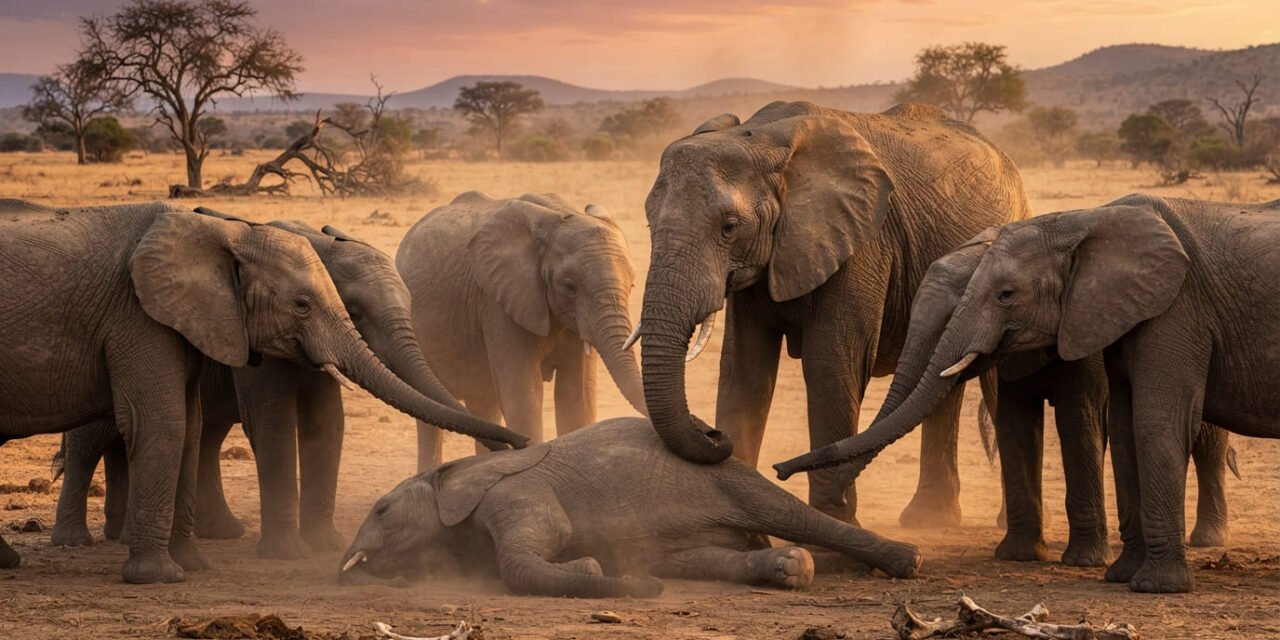
When we think of animals, we often think of survival. We think of hunting, eating, and sleeping. However, there is one animal on our planet that seems to share a very deep, almost human-like connection with its family: the elephant. For decades, scientists, researchers, and park rangers have watched elephants in the wild. What they have found is truly amazing. Elephants do not just live together; they love each other, they remember each other, and most importantly, they seem to mourn when they lose someone they love.
In this blog, we will explore the emotional lives of these “gentle giants” and look at the evidence that shows elephants truly do experience grief.
The Foundation: A Family Built on Love
To understand elephant grief, we first have to understand elephant society. Elephants live in what is called a “matriarchal” society. This means that the oldest and wisest female, the matriarch, leads the group. The herd is usually made up of her sisters, her daughters, and their young calves.
Unlike many other animals that leave their parents as soon as they are grown, female elephants stay with their mothers for their entire lives. They spend every day together for 60 or 70 years. They help raise each other’s babies, find water together, and protect each other from lions or other dangers. This constant closeness creates an incredibly strong bond. When you spend 50 years walking side-by-side with someone, they aren’t just a “herd member”—they are your life.
Do Elephants Experience Grief?
Grief is a complex emotion. It requires an animal to understand that someone is gone and to feel a sense of loss because of it. For a long time, scientists were careful about using the word “grief” for animals. They didn’t want to project human feelings onto them. However, after witnessing the same behaviors repeatedly, it became impossible to ignore.
1. The Death Rituals
One of the most famous sights in the African savanna is an elephant herd standing over a fallen family member. When an elephant dies, the others do not simply walk away. They often stay with the body for hours or even days.
Observers have seen elephants try to “wake up” the deceased. They use their trunks to gently shake the body or try to lift it back to its feet. They might bring food or water and place it near the mouth of the one who has passed. When they finally realize that their friend is not coming back, a quiet, heavy atmosphere settles over the herd. They often stand in total silence, with their trunks and ears hanging low. This “vigil” looks exactly like a human funeral.
2. Investigating the Bones
Perhaps the most unique thing about elephants is how they react to bones. If a group of elephants finds the sun-bleached bones of another elephant—even one that died years ago—they stop. They do not do this with the bones of zebras or buffalo.
They use their trunks and the sensitive soles of their feet to touch the skull and the tusks. They pass the bones around gently. Scientists believe that elephants might be able to recognize the individual by the smell or the shape of the tusks. It is as if they are visiting a graveyard to remember those who came before them.
3. Physical Signs of Sadness
Elephants show their emotions through their bodies. When an elephant is grieving, they often loses interest in eating. They may stop playing or interacting with others. There have even been reports of “weeping.” While scientists debate if the liquid coming from their eyes is exactly like human tears, it is clear that the animals are in deep distress.
In one famous case, a mother elephant carried her dead calf on her tusks for several days, refusing to let go. She walked slowly, falling behind the rest of the herd because she couldn’t bear to leave her baby behind. This shows a level of attachment that goes far beyond simple biological instinct.
Why Do They Feel So Much?
You might wonder why elephants have evolved to feel such deep sadness. The answer lies in their brains.
Elephants have the largest brain of any land animal. More importantly, they have a highly developed “hippocampus.” In humans, the hippocampus is the part of the brain responsible for emotions and memory. Because elephants have such a powerful memory, they remember the kindness, the protection, and the companionship of their family members.
When a matriarch dies, it is a disaster for the herd. She is the one who remembers where the water holes are during a drought. She knows the safe paths through the mountains. When she dies, the herd feels a loss of leadership, but they also feel the loss of a grandmother and a friend.
The Language of the Heart
Elephants also communicate their feelings in ways humans can’t always hear. They use “infrasound”—noises that are so low in frequency that the human ear cannot detect them. These rumbles can travel for miles through the ground.
When a herd is in mourning, researchers using special microphones have recorded deep, somber rumbles. These sounds are different from the high-pitched trumpeting they do when they are excited or scared. It is a low, mournful song that lets other elephants in the area know that a tragedy has happened.
What This Teaches Us
Learning about elephant grief changes the way we look at the world. It teaches us that humans are not the only beings with complex hearts.
Empathy and Compassion
Elephants don’t just grieve for their own family. They have been known to show “empathy” toward other species, too. There are stories of elephants trying to help injured humans or even protecting other animals from predators. They have a sense of “fairness” and “mercy” that is rare in the animal kingdom.
The Importance of Protection
Knowing that elephants feel such deep pain makes the threat of poaching even more heartbreaking. When a poacher kills an elephant for its tusks, they aren’t just taking one life. They are breaking a family. The remaining elephants often suffer from what we would call Post-Traumatic Stress Disorder (PTSD). Young “orphans” who see their mothers killed often wake up screaming in the middle of the night and remain fearful and depressed for years.
This is why conservation is about more than just numbers. It’s about protecting the emotional lives of these creatures. When we protect an elephant, we are protecting a mother, a sister, and a lifelong friend.
Conclusion
So, do elephants really grieve? The evidence from the wild says a loud and clear “yes.”
They mourn with their bodies, their voices, and their silence. They remember their dead and honor them by touching their bones. They show us that love is a powerful force that exists throughout nature, not just in humans.
The next time you see a picture of an elephant, look closely at their eyes. There is a world of wisdom and feeling behind them. They are the keepers of memories and the masters of many emotions. By understanding their grief, we can learn to have more respect for their lives and work harder to ensure they have a safe future in our world.
Elephants remind us that we are all connected by the same basic needs: the need to belong, the need to be loved, and the need to be remembered.