Imagine walking along a quiet coastal beach or a sheltered estuarine lagoon at dusk. The setting sun paints the sky in shades of violet and crimson, and the surface of the water is as smooth as dark glass. As you scan the shallow tide pools, you spot a striking black-and-white bird gliding silently through the calm air.
It does not dive from high above like a tern, nor does it wade slowly through the mud like an egret. Instead, it flies just inches above the water line, maintaining a perfectly level flight path. Its head is tilted downward, and its brilliant orange-and-black bill is held wide open.
As the bird glides forward at thirty miles per hour, the elongated tip of its lower jaw drops beneath the surface, slicing through the water like a hot knife through butter. It leaves a continuous, thin wake trailing behind it in the twilight.
Suddenly, without the bird ever stopping or looking down, its head snaps backward and its beak slams shut with a loud, wooden click. In a single fluid motion, the bird lifts a silver minnow out of the water, swallows it whole mid-flight, and lowers its lower jaw back into the mirror-like surface to continue its run.
This is the Black Skimmer (Rynchops niger). Found along the Atlantic, Pacific, and Gulf coasts of the Americas, this coastal bird possesses one of the most unusual hunting methods in the animal kingdom. Faced with the challenge of catching fast, slippery fish in murky, silt-filled waters and total darkness, the Black Skimmer gave up on visual hunting entirely. Instead, it built its entire survival strategy around high-speed aerodynamics, asymmetrical mechanics, and a lightning-fast tactile reflex.
The Anomaly of the Asymmetrical Bill
To understand how the Black Skimmer hunts, you first have to look at its most famous physical feature: its bill.
In almost all bird species on Earth, the upper and lower halves of the beak, known as the mandibles, are roughly equal in length. Whether it is a seed-cracking cardinal, an insect-eating warbler, or a fish-eating pelican, symmetry is the standard rule of avian design.
The Black Skimmer breaks this rule completely. It is the only group of birds in the world where the lower mandible is distinctly longer than the upper mandible, often extending up to three centimeters past the upper tip.
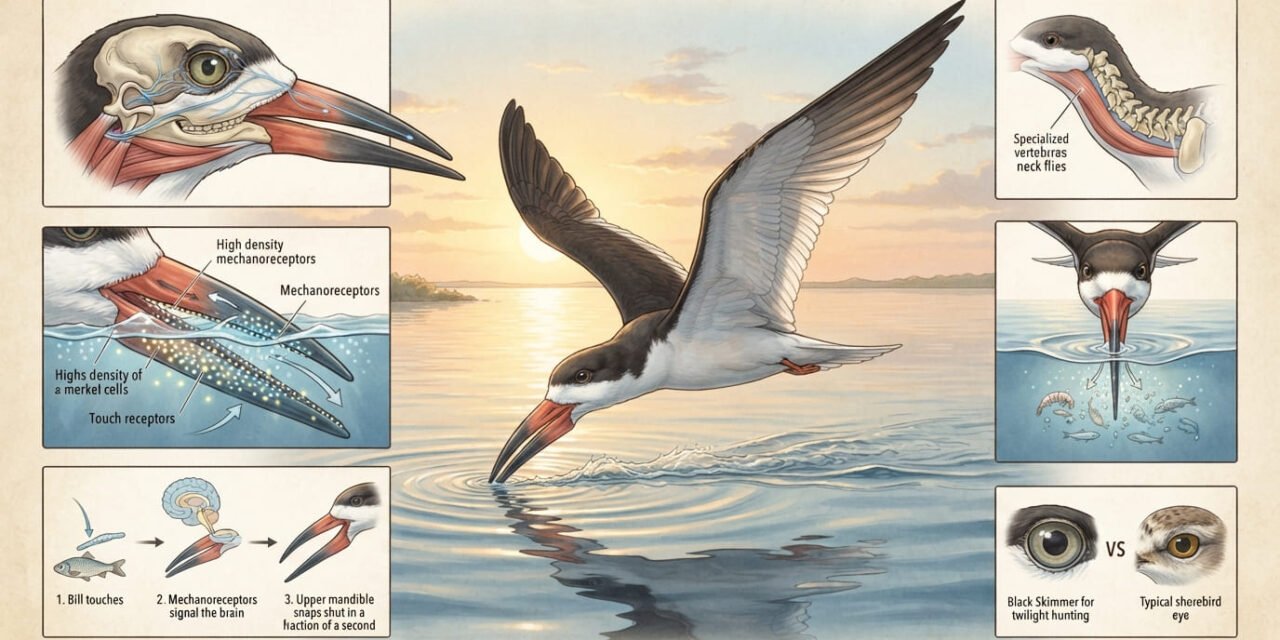
This lower jaw is an anatomical marvel. It is remarkably thin and compressed sideways, looking less like a typical beak and more like a double-edged razor or a flexible butter knife. The front edge is flattened to minimize water resistance, allowing it to slice through the surface film with minimal drag.
The upper mandible is shorter, thicker, and slightly curved. It fits neatly into a groove along the top edge of the lower jaw when closed. When the bird opens its mouth to hunt, the gap between the two tips is wide, leaving the knife-like lower jaw fully exposed to the water below.
Hunting Blind in Murky Waters
Most fish-eating birds rely heavily on keen vision. Ospreys spot fish from hundreds of feet in the air, diving headfirst into clear ocean water. Herons stand motionlessly in sunlit shallows, waiting for a shadow to move across the sand.
Visual hunting works wonderfully in clear water on a bright afternoon. But in estuaries, coastal marshes, and tidal rivers, the water is rarely clear. Tidal currents churn up fine mud, decaying marsh grass, and thick silt, creating an opaque, soup-like environment where visibility is zero.
Furthermore, many species of small fish, such as anchovies, killifish, and silversides, remain hidden in deep water during the day to avoid flying predators. They only swim up to the surface layer at dusk, at night, or during high tide under the cover of darkness.
If a Black Skimmer tried to rely on its eyes to catch these night-swimming fish, it would quickly starve.
The skimmer solved this environmental barrier by abandoning visual hunting altogether. It practices a strategy called tactile foraging. It does not look for fish underwater; it feels for them.
By using its lower jaw as a physical probe, the skimmer turns the surface of the water into a giant, interactive touch screen. It flies blind relative to the fish below, relying on its high-speed touch reflexes to register a meal the exact millisecond contact is made.
The Ultra-Fast Snap-Closure Reflex
Slicing a long, thin jaw through open water is only the first step. The true secret to the skimmer’s success lies in what happens the moment the lower bill touches a fish.
The skin covering the lower mandible is packed with thousands of microscopic sensory structures connected directly to the trigeminal nerve, the main sensory highway of the bird’s head. These touch receptors are exceptionally sensitive to physical pressure, friction, and sudden movements.
When a skimmer is flying along its path, its lower jaw is held open at a wide angle. As soon as a swimming fish, a shrimp, or a small squid hits the submerged lower bill, the sudden physical impact triggers an involuntary reflex loop.
The signal does not need to travel all the way through complex visual processing centers in the brain. Instead, the touch impulse travels directly through a rapid spinal-brainstem reflex arc, triggering the jaw muscles to contract instantly.
The skimmer’s mouth slams shut in less than forty milliseconds. To put that into perspective, a human eye takes over one hundred milliseconds to perform a single blink. By the time the fish registers that it has bumped into an obstacle, the upper jaw has already clamped down from above, trapping the prey in a firm grip.
Simultaneously, the bird executes a secondary mechanical adjustment. The sudden impact of striking a fish at thirty miles per hour generates intense backward force on the lower bill. If the bird kept its neck rigid, the force would yank its head backward under its body, causing a devastating crash.
To absorb this shock, the skimmer’s neck muscles instantly relax and yield, allowing the head to tuck downward and backward beneath the body. The bird then uses a powerful upward stroke of its wings to lift its head out of the water, flipping the fish around in its mouth so it can be swallowed headfirst before the skimmer lowers its jaw back into the water for the next strike.
Aerodynamics and Surface Drag
Flying inches above the water with a piece of your body dragged through the surface film presents a massive physical challenge.
Water is roughly eight hundred times denser than air. When the lower mandible enters the water, it creates a force known as hydrodynamic drag. This drag acts like an invisible anchor pulling backward on the bird’s face.
If a normal bird tried this, the asymmetric drag on its beak would cause its head to twist, pulling its body down into the waves or causing its wings to catch the water.
The Black Skimmer manages this drag through a combination of specialized wing design and muscular strength.
First, the skimmer has extraordinarily long, narrow wings relative to its body weight. This high aspect-ratio wing design provides immense lift while minimizing induced drag in the air. The long wings allow the bird to fly using slow, deep, and measured wingbeats that keep the body stable and horizontal above the water.
Second, the skimmer’s neck vertebrae and jaw muscles are unusually heavy and reinforced with strong tendons. The bird uses its powerful neck muscles to counteract the backward pull of the water, holding its head dead steady despite the continuous turbulence hitting its bill.
The bird also takes advantage of a physical phenomenon called ground effect. When a winged creature flies very close to a flat surface like water, the air trapped beneath the wings becomes compressed, creating a cushion of high pressure. This air cushion increases total lift while reducing drag, allowing the skimmer to float along the surface with remarkably little flapping effort.
From Equal Bills to Surgical Tools
One of the most fascinating aspects of the Black Skimmer’s biology is that this extraordinary bill design is not present when the bird hatches.
When a chick hatches on a sandy beach nest, both the upper and lower mandibles are exactly the same length. This early symmetry is essential for survival.
During their first few weeks of life, skimmer chicks do not hunt in the water. Instead, they walk around the sandy colony, picking up small fish and shrimp dropped on the dry sand by their parents. If a chick were born with a long, extended lower jaw, it would be unable to pick up food off flat ground, as the lower bill would constantly poke into the sand before the upper jaw could grasp the meal.
It is only when the young skimmer begins to grow its adult flight feathers and prepares to leave the nesting colony that a sudden surge of growth occurs in the lower jaw.
Over a period of a few weeks, the lower mandible accelerates its growth rate, quickly outpacing the upper jaw. The young bird begins practicing its skimming technique along shallow tide pools, learning how to gauge height, manage ground effect, and master the snap-closure reflex before migrating for the winter.
Lessons for Marine Robotics and Fluid Dynamics
You should care about the Black Skimmer because its unique hunting mechanics are helping human engineers solve complex problems in fluid dynamics and autonomous robotics.
Designing autonomous marine drones that can operate at high speeds right at the air-water interface is a major challenge. Instruments moving across the surface film frequently suffer from sensor disruption, spray resistance, and sudden changes in fluid drag.
By studying the cross-sectional shape of the skimmer’s lower jaw, marine engineers are designing low-drag hydrofoils and sensory probes for high-speed ocean drones.
Furthermore, roboticists building autonomous systems for low-visibility environments are looking closely at the skimmer’s tactile reflex loop. Instead of relying on heavy, power-hungry cameras and optical sensors that fail in muddy water or pitch darkness, bio-inspired micro-drones use high-speed mechanical touch sensors that trigger instant physical responses, allowing underwater vehicles to navigate obstacles and collect samples purely through tactile feedback.
Master of the Twilight Waters
The Black Skimmer is a wonderful reminder that nature often finds brilliant solutions by completely rethinking basic assumptions. When the environment made visual hunting impossible, this coastal bird did not try to build larger eyes or brighter senses.
Instead, it converted its body into a precision glider, turned its jaw into a knife, and relied on the speed of a touch.
The next time you stand on a quiet beach as the sun sets over the ocean, watch the calm shallows carefully. You might just see a long-winged shadow gliding inches above the tide, slicing the water with surgical accuracy, and proving that with the right physical reflex, you can hunt with absolute perfection even when flying blind.