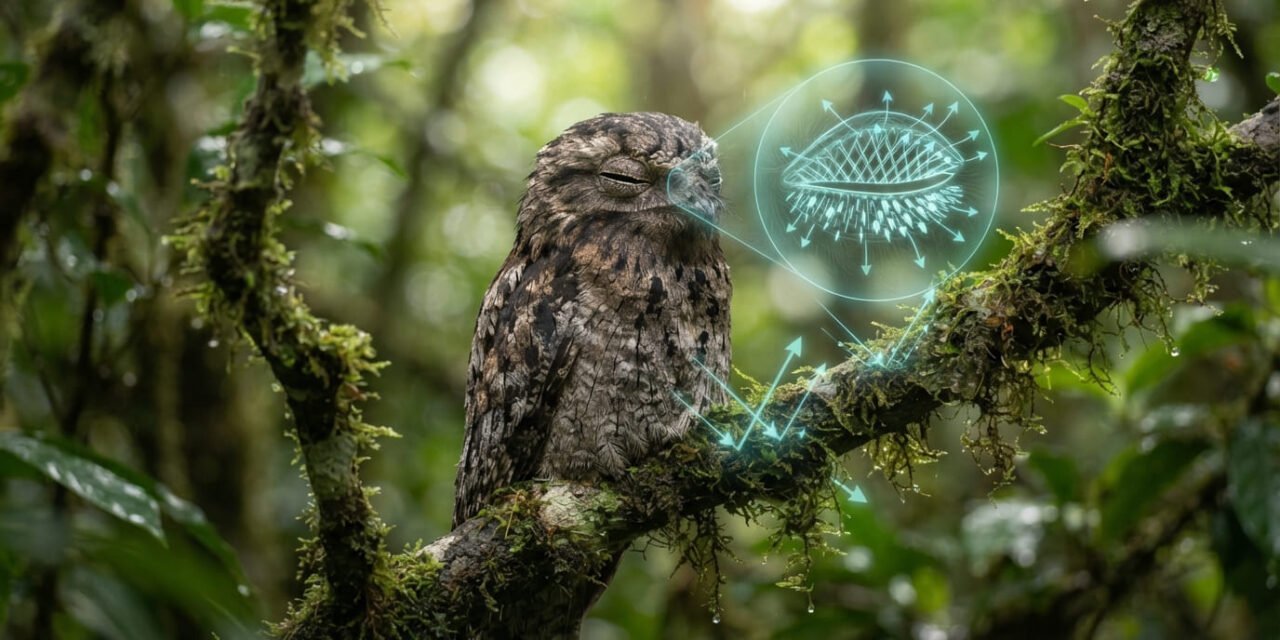
Imagine walking through the warm, dense rainforests of Central or South America on a bright afternoon. The air is thick with the sound of buzzing cicadas and dripping water. As you walk along a narrow dirt path, you stop to admire a tall, old tree with a broken branch sticking out from the side. The branch is dry, gray, and has a jagged, splintered tip. It looks completely ordinary. You might even lean against the trunk to take a rest, never realizing that you are standing just inches away from a wild bird.
The bird is sitting on the very end of that splintered wood, looking exactly like a continuation of the branch. It is not moving a muscle. It is not even blinking. In fact, its eyes appear to be tightly closed, as if it is fast asleep.
This is the potoo. It is a nocturnal bird that belongs to a unique family of forest-dwellers in the American tropics. During the night, the potoo is an active hunter with a massive mouth and giant eyes. But during the day, it has a completely different job: it must become a piece of wood.
To survive this daily transformation, the potoo relies on a set of features that seem almost magical. It does not build a nest; it has feathers that mimic mossy bark, and it has a posture that turns its body into a stick. But its greatest secret is its eyes. Even when the potoo looks like it is sleeping soundly, it is actually watching your every move through a pair of tiny, hidden windows in its eyelids.
The Muppet of the Night
To understand why the potoo needs to hide so desperately during the day, you have to look at what it looks like when it is awake. At night, the potoo is one of the most unusual-looking creatures in the canopy. It is often compared to a Muppet because of its exaggerated features.
The first thing you notice is its eyes. The potoo has massive, bulging yellow eyes with giant black pupils. When it opens them wide at night, they look like two bright ping-pong balls stuck to the sides of its head. These giant eyes are designed to capture every tiny bit of moonlight, helping the bird spot moths and beetles in the dark.
Then there is its mouth. From the outside, the potoo’s beak looks tiny and harmless. But when the bird opens its mouth, the jaw stretches back almost to its ears. It has a gaping, cavernous mouth that acts like a butterfly net, allowing the bird to fly through the dark air and swallow large insects whole without needing to grab them with its feet.
Local people in South America often call the potoo the “ghost bird” or the urutau. This name comes from the bird’s eerie, haunting call. When the sun goes down, the potoo makes a loud, melancholy sound that sounds like a person crying in the woods. It is a slow, descending whistle that can carry for miles through the quiet forest, adding to the bird’s mysterious reputation.
But having giant yellow eyes and a loud voice makes you a major target during the day. When the sun rises, the forest wakes up, and predators like hawks, monkeys, and tree snakes start searching the branches for an easy meal. If the potoo flew around or sat on a branch with its massive eyes wide open, it would stand out like a beacon. To stay safe, the potoo must disappear in plain sight.
The Art of Becoming Wood
The potoo’s camouflage is a masterclass in stillness and detail. When the morning light breaks, the bird finds a tree stump or a broken branch that matches its size. It crawls to the very tip of the wood and takes up its daytime position.
This posture is called the stick stance. The potoo stretches its neck upward, points its beak straight toward the sky, and flattens its feathers tightly against its body. By aligning its spine with the angle of the branch, the bird eliminates any shadows or outlines that might give away its presence.
Its feathers are a messy mix of gray, brown, black, and white. The pattern is not uniform; it matches the rough, irregular texture of decaying wood. The feathers even have small spots that look like patches of green moss, white lichen, or dry mold.
When the potoo enters this state, it stops moving entirely. It can sit in the hot sun or a heavy rainstorm for hours without twitching a single feather. It becomes so stiff and quiet that passing animals, and even experienced birdwatchers, can stare directly at the bird from a few feet away and see nothing but a dead stump.
This commitment to the disguise starts from the very beginning of the potoo’s life. Potoos do not build typical nests out of twigs and leaves. Instead, the female lays a single, spotted egg directly into a natural indentation on top of a branch.
When the chick hatches, it is covered in white, fluffy down that looks like fungus growing on a damp branch. Instinctively, the baby bird learns to adopt the stick stance alongside its parent. As the parent sits over the chick, the two birds blend into a single, seamless piece of wood.
The Problem with Peeking
While the potoo is excellent at playing dead, it faces a major problem. Sitting perfectly still on a branch is only a good defense if you know when danger is approaching. If a monkey climbs up the tree or a hawk circles overhead, the potoo needs to know so it can prepare to fly if the camouflage fails.
But a normal bird has to open its eyes to see.
If the potoo opened its giant yellow eyes to look around, the illusion would be ruined instantly. The sudden flash of bright yellow against the dark gray bark would catch the attention of any predator in the area. Even a tiny movement of the eyelid would be enough to give the bird away.
The potoo needed a way to watch the forest without showing any movement and without revealing its massive, colorful eyes. Its solution was to evolve a set of eyelids that act like a security camera system.
The Hidden Slits
If you look at a sleeping potoo with a magnifying glass, you will see a tiny, brilliant anatomical feature. The bird’s upper eyelids are not solid sheets of skin like ours. Instead, they have small, built-in notches or slits along their edges.
The common potoo usually has two of these tiny slits on each upper eyelid, while the great potoo can have three. These notches are always open, even when the rest of the eyelid is pressed tightly shut.
When the potoo closes its eyes to rest, these slits act like miniature peep-holes. The bird’s massive pupil dilates behind the closed eyelid, allowing it to gather light through the small openings.
This means that while the potoo looks fast asleep to the rest of the world, it actually has a clear, wide-angle view of the forest. It can monitor the movement of leaves, the shadows of passing birds, and the approach of predators without opening its eyes even a fraction of a millimeter.
The design of these slits is incredibly smart. Because they are located on the edges of the eyelids, the bird can see in multiple directions at once. When the potoo is holding its head in a vertical stick stance, the slits are positioned to let it look up and down simultaneously. It can watch for climbing snakes on the trunk below and flying hawks in the sky above at the same time.
If the bird is resting in a more relaxed, horizontal position, the slits give it a wide-angle view of the front and the back. It has nearly 360 degrees of visual awareness while remaining completely motionless.
Independent Shutters
To make the system even more effective, the potoo can control its eyelids independently. It can open one eye slightly while keeping the other completely closed, or it can rotate the eyelids over the eyeball to shift the position of the slits.
Because the bird does not have to turn its head to change its field of view, it avoids making the sudden movements that predators look for. If the potoo detects a human walking toward its tree, it does not panic. It simply watches through its eyelid slits, tracking your movement as you walk by.
If you stop to look at the branch, the potoo might compress its feathers even tighter and tilt its beak a few millimeters higher to enhance the camouflage. But to your eyes, the bird remains a lifeless, sleeping piece of wood. It is only when you get too close, within a few inches, that the bird will finally open its massive eyes in a sudden, startling flash, using the surprise to launch itself into the air and fly to a safer tree.
A Quiet Master of Efficiency
The potoo is a reminder that survival in the wild does not always require high speed, sharp claws, or aggressive strength. By focusing its resources on stillness, detail, and smart anatomy, this quiet bird carved out an exclusive niche where it can sleep in plain sight.
It took the simple challenge of staying safe while resting and solved it through a beautiful series of adjustments. It turned its feathers into bark, its posture into a branch, and its eyelids into a hidden security system. It is a master of natural stealth, proving that sometimes, the best way to see the world is to keep your eyes wide shut.
Final Thoughts
The next time you walk through a park or a forest and see a broken branch, take a second look. It is probably just a piece of wood. But if you are in the tropical forests of the Americas, there is a tiny chance that the branch is watching you.
The potoo is a wonderful example of how creative nature can be. It is a bird that lives on a branch during the day and hunts like a ghost at night. It survives because it does not try to fight the forest; it simply becomes a part of it, using its magic eyelids to keep a quiet, safe watch on a busy world.