If you were to walk through the dry, sun-baked woodlands of northern Mozambique, you would quickly realize how quiet the wild can be. The air is hot, the tall grasses are still, and the animals usually stay hidden in the shade. But if you are with a group of local honey hunters, this quiet wilderness suddenly comes alive with a very strange conversation.
A tiny, dusty-brown bird about the size of a starling flies down from a branch and lands nearby. It doesn’t run away. Instead, it ruffles its wings, spreads its tail feathers to show bright white spots, and starts chattering at you with an insistent, rattling call.
If you are a local hunter, you don’t ignore this bird. You talk right back to it. You make a loud, rolling trill followed by a short grunt: “brrrr-hm”.
As soon as the bird hears this, it chirps excitedly, flits to a tree a few dozen yards ahead, and waits for you to catch up. This is the greater honeyguide, known to science as an indicator indicator. It is one of the only wild, free-living creatures on Earth that actively seeks out humans, strikes up a conversation, and leads them on a treasure hunt through the wilderness.
A Wild Partnership
When we think of animal partnerships, we usually think of domestic animals. We think of dogs tracking prey, horses pulling carts, or falcons returning to a leather glove. All of these animals have been bred, trained, and kept by humans for thousands of years.
The honeyguide is entirely different. It is a completely wild, free-living bird. It does not sleep in a cage, it is not fed by hand, and it has never been domesticated. When the hunt is over, it flies back into the high canopy, completely independent of human care.
This cooperative relationship evolved naturally in the wild, likely over hundreds of thousands of years. It is a perfect trade of skills.
The honeyguide has an incredible talent for finding wild beehives. Bees often build their nests deep inside the hollows of ancient baobab trees, buried behind thick wood, or wedged into rocky crevices where they are completely invisible from the ground. The bird can find these hidden chambers easily, but it has a major problem: it cannot get inside.
Bees are aggressive, and their stings can easily kill a small bird. Even if the bees were calm, the bird does not have the strength or the tools to chop through solid wood to reach the honeycomb.
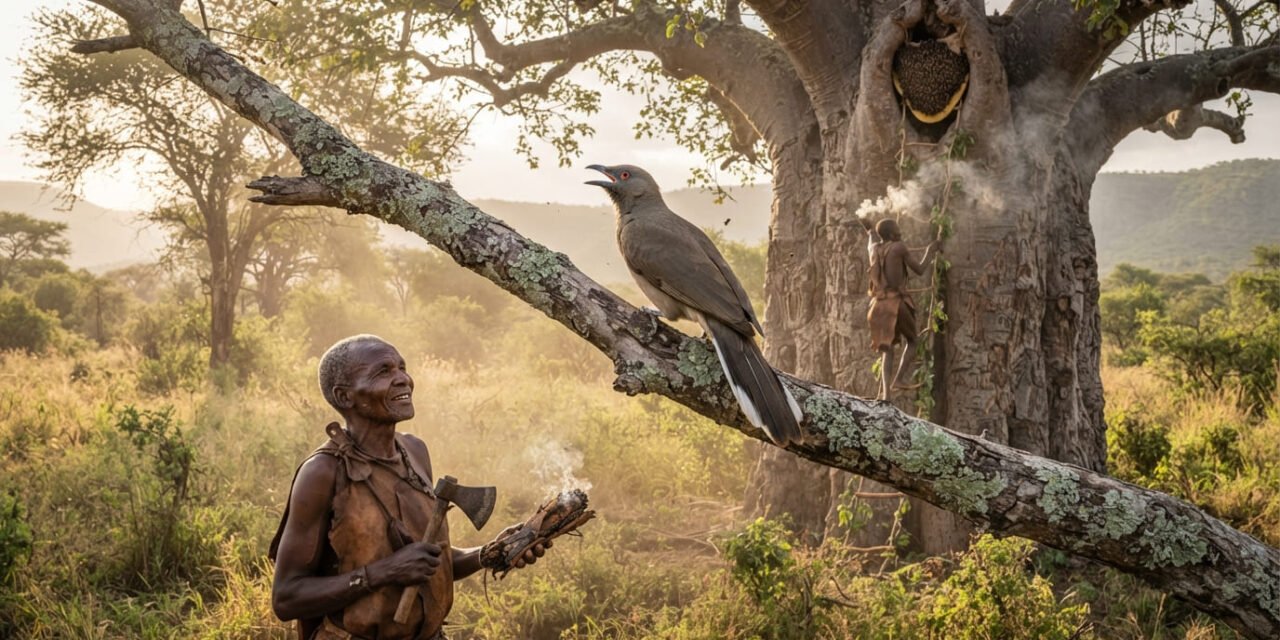
Humans, on the other hand, have axes to chop through the wood and fire to create smoke, which subdues the angry bees. But finding the hives in a vast, dry forest is incredibly difficult and takes hours of walking. By working together, the bird acts as the scout, the humans act as the muscle, and both walk away with a rich prize.
Learning the Local Dialects
For a long time, people believed that this guiding behavior was just a simple, automatic reflex. They thought the bird saw a human, got excited, and flew toward food. But recent studies have revealed a much more mind-blowing truth: the birds actually listen to, understand, and respond to the specific “language” of their local human neighbors.
In the Niassa National Reserve of Mozambique, the Yao people have been hunting wild honey for generations. When they want to find a hive, they call for the birds using the loud, distinct “brrrr-hm” sound. They never use this sound for any other purpose. It is a private, sacred signal meant only for the honeyguide.
When researchers played recordings of this trill and grunt in the forest, they found that local honeyguides were twice as likely to show up and lead the hunters compared to normal human speech or other bird calls. The trill acts as an invitation, telling the bird that the humans are ready to hunt and that a reward is waiting at the end.
But the story gets even more interesting. In the Kidero Hills of Tanzania, another group of people, the Hadza, also hunt honey with the help of these birds. The Hadza do not make the trill-and-grunt sound. Instead, they use a soft, melodic whistle that sounds almost like a bird call.
When scientists played the Hadza whistle to the honeyguides in Mozambique, the birds largely ignored it. And when they played the Yao “brrrr-hm” trick to the birds in Tanzania, those birds ignored it too.
The honeyguides have actually learned the specific “language” of the humans they live alongside. A bird in Mozambique understands the local Yao dialect, while a bird in Tanzania understands the Hadza whistle. It is a beautiful example of cultural learning, showing that these wild birds are paying close attention to the unique customs of their human neighbors.
The Hunt and the Smoke
Once the bird and the human agree to work together, the journey begins. The honeyguide flies in short hops from tree to tree, always keeping a few yards ahead of the hunters. It keeps up its loud, rattling chatter, as if encouraging the humans to keep walking. If the hunters slow down or lose the trail, the bird will fly back, perch on a lower branch, and chatter more urgently.
This walk can cover several hundred yards through the thick bush. When the party finally reaches the hive, the bird’s behavior changes completely. It stops chattering, flies to a branch very close to the nest, and sits perfectly still. It is the bird’s way of saying, “We have arrived.”
Now, it is the humans’ turn to do the heavy lifting. The hunters find a long, slender branch and tie bundles of dry leaves and bark to the end. They set the bundle on fire, creating a thick, billowing torch of smoke. They hoist this torch high into the tree, holding it right against the entrance of the bees’ nest.
The smoke confuses and subdues the bees, causing them to abandon the hive and gather in a quiet swarm on a nearby branch. With the danger minimized, the hunters use their axes to chop open the hollow tree trunk. They reach inside the dark chamber, pulling out heavy, dripping combs of golden, wild honey.
The “Beeswax Salad”
While the hunters are feasting on the honey and packing the sweet combs into buckets, the honeyguide sits quietly in the branches above, watching the process. It is waiting for its share of the treasure.
Surprisingly, the bird does not care about the honey. It cannot digest the sticky, sugary liquid. Instead, the honeyguide is after the beeswax itself.
The ability to digest wax is incredibly rare in the animal kingdom. Most creatures can swallow wax, but their stomachs cannot break it down, meaning it passes through their bodies without providing any nutrition. The honeyguide has a highly specialized digestive tract with unique enzymes that allow it to break down the tough, fatty lipids in beeswax, turning it into a rich source of daily energy.
Once the hunters are done extracting the honey, they make sure to leave a reward for their guide. The Yao people have a beautiful tradition of respect for this bird. They gather up the empty, wax-rich combs that don’t contain any honey, clean them off, and arrange them neatly on a bed of fresh green leaves on the forest floor. They call this a “beeswax salad.”
The hunters walk away, and the little brown bird flies down to the leaves to enjoy its well-earned feast, eating the wax and the calorie-rich bee larvae left behind.
A Brutal Beginning
While the honeyguide is a polite and cooperative partner to humans, it has a dark, ruthless side when it comes to its own family life. The honeyguide is a brood parasite, which means it never builds its own nest or raises its own chicks.
Instead, the female honeyguide sneaks into the nests of other cavity-nesting birds, like bee-eaters, kingfishers, or barbets. She will puncture the host’s eggs with her beak to destroy the embryos inside, and then lay her own egg in the nest before flying away.
If any of the host’s eggs survive and hatch alongside the baby honeyguide, they face a terrible fate. The honeyguide chick hatches early and is born with a sharp, hooked tip on its beak. While it is still blind and featherless, the tiny honeyguide uses this hook to attack and kill its foster siblings, ensuring that it receives all the food and care from the confused foster parents.
It is a brutal, cold-blooded way to start life, but it is the strategy that has kept this species successful for millions of years. It reminds us that nature is rarely simple; the same bird that can be a generous partner to a human can be a lethal enemy to its neighbor.
A Fading Conversation
The partnership between the honeyguide and humans is one of the most beautiful ecological relationships on earth. But sadly, it is starting to disappear.
As the modern world reaches into remote corners of Africa, local lifestyles are changing. Many people now buy sugar and processed honey from local shops rather than taking the time to hunt for wild hives in the hot sun. In some areas, traditional knowledge is fading, and the younger generation is not learning the ancient trills and whistles of their fathers.
In places where humans have stopped hunting wild honey, scientists have noticed that the honeyguides have also stopped trying to guide. Without the human response, the birds lose their motivation and eventually forget the habit.
Fortunately, in protected areas like Niassa in Mozambique and the savannahs of Tanzania, the ancient conversation is still going strong. It is a living reminder of a time when humans were deeply connected to the rhythms of the wild, proving that sometimes, the best way to thrive is to listen closely to the voices of the forest.